Atnaujinkite slapukų nuostatas

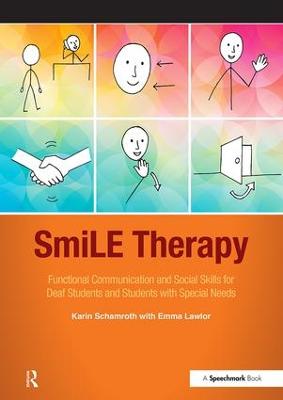
El. knyga: SmiLE Therapy: Functional Communication and Social Skills for Deaf Students and Students with Special Needs [Taylor & Francis e-book]

  • Formatas: 198 pages
  • Išleidimo metai: 29-Oct-2015
  • Leidėjas: Speechmark Publishing Ltd
  • ISBN-13: 9781315173467
  • Taylor & Francis e-book
  • Kaina: 166,18 €*
  • * this price gives unlimited concurrent access for unlimited time
  • Standartinė kaina: 237,40 €
  • Sutaupote 30%
Students with communication difficulties need skills to communicate functionally in everyday situations, without the usual support and protection from home and school. These skills need to be explicitly taught, to enable them to become confident young adults. SmiLE Therapy is an innovative therapy designed to equip students with the skills necessary to become responsible individuals who operate at the highest level of independence that their circumstances and condition allow.

Teachers and speech and language therapists have always included functional life skills practice in their work with students. Now, for the first time, they can do so using a therapy with a proven method that has demonstrable outcomes.

This book is a practical step-by-step resource, designed to guide teachers and SLTs in the delivery of SmiLE Therapy with students who have communication difficulties due to deafness, specific language impairment, learning difficulties, autism or physical disability. It includes a clear step-by-step approach to preparing, running and evaluating SmiLE Therapy, with photocopiable resources and clear outcome measures from each module to share with parents, staff, education and health managers.
Acknowledgements v
Introduction 1(10)
Part 1 Theory and key elements of smiLE Therapy
11(12)
Introduction
12(3)
Delivering smiLE Therapy
15(8)
Part 2 Preparing and running smiLE Therapy modules
23(52)
Introduction
24(2)
Step 1 Preparing for a module
26(12)
Step 2 Initial filming of the communication task
38(5)
Step 3 Running each group session
43(8)
Step 4 Creating the Communication Skills Checklist (CSC)
51(5)
Step 5 Teaching, practising and learning skills through role play
56(2)
Step 6 Watching initial filmed task and self-evaluating
58(4)
Step 7 Role playing, problem solving and the start of generalisation
62(2)
Step 8 Final filming of the communication task and self-evaluating
64(2)
Step 9 Generalisation
66(4)
Step 10 Demonstrating smiLE Therapy outcomes
70(5)
AQA Unit Award Scheme accreditation
73(2)
Part 3 The modules
75(46)
Introduction
76(1)
Module 1 Clarification skills
77(7)
Module 2 Entering and leaving an office
84(5)
Module 3 Entering and leaving a shop
89(4)
Module 4 Requesting in an office and using the Hierarchy of Communication Strategies (HoCS)
93(7)
Module 5 Requesting and refusing in an office
100(5)
Module 6 Requesting in a shop and using the Hierarchy of Communication Strategies (HoCS)
105(5)
Module 7 Independent travel -- communicating at a train or an underground station
110(4)
Module 8 Work experience -- meeting your supervisor
114(7)
Part 4 SmiLE Therapy with other client groups
121(11)
Introduction
122(1)
Case Study 1 smiLE Therapy in a mainstream primary school
123(3)
Case Study 2 smiLE Therapy in a mainstream secondary school
126(3)
Case Study 3 smiLE Therapy in a Special Needs Department of a post-16 college
129(3)
Outlook for smiLE Therapy
132(5)
Appendices
137(49)
Appendix 1 Explaining Tm deaf
138(2)
Appendix 2 Taking responsibility
140(2)
Appendix 3 Hierarchy of Communication Strategies (HoCS)
142(5)
Appendix 4 Additional materials to support smiLE Therapy modules
147(28)
Appendix 5 Letters and consent forms
175(3)
Appendix 6 Feedback forms
178(3)
Appendix 7 Templates for writing up smiLE Therapy outcome measures and audits
181(4)
Appendix 8 Abbreviations
185(1)
References 186
Karin Schamroth, Specialist Speech and Language Therapist in Deafness ,Whittington Health, Haringey, North London, UK Emma Lawlor, Specialist Speech and Language Therapist, London Community Healthcare NHS trust (CLCH) in West London