Nanocarbon polymer biocomposites have gained increased attention from both researchers and manufacturers due to the significant improvement in their physico-mechanical, thermal and barrier properties when compared to conventional materials. Their dimensions, biodegradable character, cost-effectiveness, and sustainability are among the main drivers for increasing demand.
However, it is difficult to achieve uniform dispersion between the carbon filler and matrix as it easily forms agglomerations. Production of nanocarbon polymer biocomposites with high mechanical and thermal properties is also limited, but there has been rapid progress in processing possibilities to produce nanocomposites based on various biodegradable fillers.
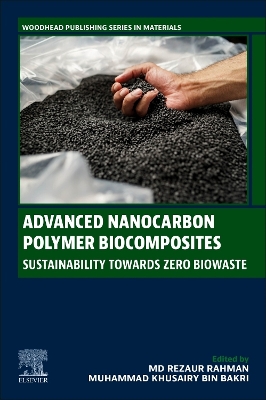
Advanced Nanocarbon Polymer Biocomposites: Sustainability Towards Zero Biowaste collects all these novel scientific findings in one place. It discusses in detail their physical, chemical, and electrical properties and presents the latest research findings on nanocarbon polymer biocomposites with filler loadings and their improvement on compatibility. The book will be of great interest for those researchers who are concerned with the production and use of nanocarbon polymer biocomposites as a new innovative advanced material.
1. Nanocarbon from Pine Wood Sawdust and Its Biocomposites Applications
2. Current and Future Development of Nanocarbon and its Biocomposites Production
3. Biosynthetic and Natural Nanocarbon Production
4. Aspen Wood Sawdust and Its Biocomposites Applications
5. Impact on Biocomposites Using Various Types of Nanocarbon and Polymer
6. Roles of Simulation Model on Production of High Performance Nanocarbon Polymer Biocomposites
7. MMT-Activated Nanocarbon from Pine Wood Sawdust and Its Biocomposites
8. Titanium (IV) Oxide Activated Nanocarbon from Pine Wood Sawdust and its Biocomposites
9. Iron (III) Chloride Activated Nanocarbon from Pine Wood Sawdust and its Biocomposites
10. Zinc Oxide Activated Nanocarbon from Aspen Wood Sawdust and its Biocomposites
11. Activated MMT Nanocarbon from Aspen Wood Sawdust and its Biocomposites
12. Titanium (IV) Dioxide Activated Nanocarbon from Aspen Wood Sawdust and its Bio-composites
Ts. Dr. Md Rezaur Rahman is an Associate Professor in the Department of Chemical Engineering and Energy Sustainability, Faculty of Engineering, Universiti Malaysia Sarawak (UNIMAS), Malaysia. Since 2012, he has also served as a Visiting Research Fellow at the Faculty of Engineering, Tokushima University, Japan. His academic journey includes experience as a teaching assistant at Bangladesh University of Engineering and Technology (BUET) and as a Research Project Leader under the Malaysian Ministry of Higher Education. In 2015, he was appointed as an External Supervisor at the Faculty of Engineering, Swinburne University of Technology, Melbourne, Australia. Dr. Rahman holds a Ph.D. from Universiti Malaysia Sarawak and brings over 12 years of experience in teaching, research, and industry collaboration. His research expertise spans conducting polymers, nanocomposites, and advanced materials, including graphene, nanoclay, fire retardants, and nanocellulose-reinforced polymer composites. He has made significant contributions to the development of hybrid-filled polymer blends and the chemical modification of lignocellulosic fibers such as jute, coir, and kenaf. To date, Dr. Rahman has authored seven books, 20 book chapters, and over 200 articles in international journals, establishing himself as a prominent researcher in polymer science and nanotechnology. He is also listed in Stanford University's Top 2% Scientists list of the world's most cited scientists. Dr. Hj. Muhammad Khusairy Bin Capt. Hj. Bakri is a Postdoctoral Research Associate at Washington State University (WSU). He specializes in materials and mechanical engineering. He holds a BEng (2014), MEng (2016), and PhD (2018) from Swinburne University of Technology. His research focuses on developing composites making them durable by improving their interfacial interaction and stability of composites through advanced thermal and chemical treatments. His research also emphasizes bio-composites for sustainable and economically viable applications. He also has published over 279 scholarly works, including journal articles, book chapters, newspaper/bulletin, and conference proceedings, focusing on his expertise in wood composites, bio-composites, biomaterials, and wastewater treatment. Previously, Dr. Khusairy worked as a Research Fellow at Universiti Malaysia Sarawak (UNIMAS) from 2019-2021. During that time, he has collaborated with many researchers through international research projects across Malaysia and abroad. He is also certified as a Graduate Engineer and Professional Technologist under the Malaysian Board of Technologists (MBOT). He is a lifelong member of the Association of Professional Technicians and Technologists (APTT) located in Sarawak, Malaysia. Dr. Khusairy has received worldwide recognition, having been nominated and selected as a finalist for the Swinburne Alumni Impact Awards in 2022, and was included in Successful People in Malaysia 2023.

 Lisainfo e-raamatute kohta