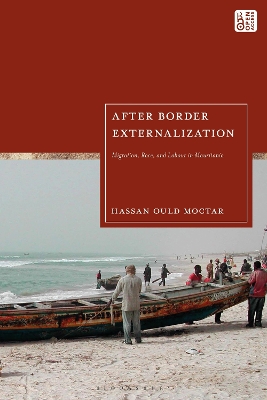
After Externalization is an incisive study of migration in Mauritanias borderlands. The book is much more than a study of the effects of European border policies in Africa. Hassan Ould Moctar has a more ambitious goal, to painstakingly investigate the links between migrant illegality, colonial legacies, global capitalism, and security technologies. Along the way, he shows us the twilight of a Eurocentric world order. This book is a rich contribution to our understanding of border politics in the Sahel and beyond. -- Philippe M. Frowd, author of Security at the Borders (2018) Drawing upon extended ethnographic fieldwork, this is a deeply perceptive and rich account of the impact of EU border externalisation on Mauritania's society, politics, and economy. A powerful corrective to the Eurocentric ways in which borders and migration are so often spoken about today. -- Adam Hanieh, University of Exeter, UK In this important new addition to the literature on border externalisation, Hassan Ould Moctar offers us a tour de force of how these intricate and intimate multi-scalar practices play out in the context of Mauritania, firmly contextualising externalisation efforts within wider processes of colonialism, racial capitalism, and importantly, opportunities for resistance. -- Polly Pallister-Wilkins, Associate Professor, University of Amsterdam and author of Humanitarian Borders: Unequal Mobility and Saving Lives Coloniality, racialised exploitation, illegality have become crucial concepts in our understanding of the so-called migration crisis. After Border Externalization takes us onto a journey where these concepts are brought to life, incarnated and situated. Its rich ethnography provides nuance and celebrates ambiguity, elevating Hassan Ould Moctar's sophisticated analytical critique. After Border Externalization charts new and exciting investigative trajectories in the field of Critical Borders and Migration Studies. * Dr Paolo Novak, Co-Director, Centre for Migration and Diaspora Studies, SOAS, UK * This pertinent work provides a broad yet solid foundation on border externalization and offers readers the opportunity to reconsider the role of African states in border politics, and all the components of the text fluidly link to craft a clear narrative. It is especially useful for those interested in domains such as postcolonial studies, political science, and African border and migration studies. * African Studies Review *