Muutke küpsiste eelistusi

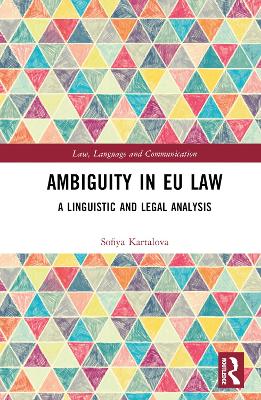
Ambiguity in EU Law: A Linguistic and Legal Analysis [Kõva köide]

(Max Planck Institute for the Study of Crime, Security and Law, Germany.)
  • Formaat: Hardback, 234 pages, kõrgus x laius: 234x156 mm, kaal: 480 g, 1 Line drawings, black and white; 1 Illustrations, black and white
  • Sari: Law, Language and Communication
  • Ilmumisaeg: 07-Oct-2022
  • Kirjastus: Routledge
  • ISBN-10: 1032279907
  • ISBN-13: 9781032279909
  • Kõva köide
  • Hind: 144,00 €*
  • * hind on lõplik, st. muud allahindlused enam ei rakendu
  • Tavahind: 192,00 €
  • Säästad 25%
  • Raamatu kohalejõudmiseks kirjastusest kulub orienteeruvalt 3-4 nädalat
  • Kogus:
  • Lisa ostukorvi
  • Tasuta tarne
  • Tellimisaeg 2-4 nädalat
  • Lisa soovinimekirja
  • Raamatukogudele
  • Formaat: Hardback, 234 pages, kõrgus x laius: 234x156 mm, kaal: 480 g, 1 Line drawings, black and white; 1 Illustrations, black and white
  • Sari: Law, Language and Communication
  • Ilmumisaeg: 07-Oct-2022
  • Kirjastus: Routledge
  • ISBN-10: 1032279907
  • ISBN-13: 9781032279909
"Ambiguity - an expression or utterance giving rise to at least two mutually exclusive interpretations - has been traditionally regarded as an ever-present, and therefore trivial, feature of EU law, alongside other forms of linguistic indeterminacy. At the same time, ambiguity has been condemned as a perilous defect in the legal text, since it is commonly assumed that the Court of Justice of the EU (CJEU) would necessarily exploit it to engage in judicial activism. In contrast, more recent theories present ambiguity as a means of promoting greater acceptability and coherence, while trusting the CJEU's willingness to exert judicial restraint for the benefit of judicial cooperation. This ground-breaking work challenges some of the theoretical assumptions about ambiguity in EU law and puts forward a more accurate and complete theory about the CJEU's strategic use of ambiguity. Ambiguity is here transformed from an underestimated or misunderstood detail of undetermined significance to a desirable systemic feature of the EU legal order with concrete properties and impact. Ambiguity as the implicit basis of the CJEU's decision-making is shown to be strategically valuable for the implementation of the authority of EU law at some of the most pivotal moments in the evolution of the EU legal order. This interdisciplinary investigation presents in-depth linguistic and legal analysis of ambiguity found in the text of key provisions of EU Treaties and in the language of some of the CJEU's leading preliminary rulings in the area of fundamental rights, freedom of movement and EU citizenship. The book suggests a categorisation of examples, basic guidance about the type of case and situation where the phenomenon is likely to emerge as well as an assessment of the advantages and disadvantages of this unusual judicial technique. The book will be a valuable resource for researchers and academics working in the areas of Law and Language, Public International Law, EU Law and Multilingualism"--

This interdisciplinary investigation presents in-depth linguistic and legal analysis of ambiguity found in the text of key provisions of EU Treaties and in the language of some of the CJEU’s leading preliminary rulings in the area of fundamental rights, freedom of movement and EU citizenship.

Acknowledgements ix
PART 1 In Search of the Strategic Value of Ambiguity for the Authority of EU Law
1(52)
1 Introduction
3(5)
2 Ambiguity in Legal Texts
8(9)
3 Ambiguity in EU Law
17(25)
4 A Framework for Analysis
42(11)
PART 2 The Case Studies
53(132)
1 Judicial Activism Reconsidered?: The CJEU's Strategic Resolution of Ambiguity in Melloni (Case C-399/11)
55(26)
2 Judicial Activism Reinvented?: The CJEU's Strategic Production of Ambiguity in Akerberg Fransson (Case C-617/10)
81(34)
3 Judicial Restraint Reconfirmed?: The CJEU's Strategic Resolution of Ambiguity in Keck (Joint cases C-267/91 and C-268/91)
115(31)
4 Judicial Activism in Retrospect?: The CJEU's Strategic Resolution of Ambiguity in Ruiz Zambrano (Case C-34/09) and Dereci (C-256/11)
146(39)
PART 3 Ambiguity as a Desirable Systemic Feature
185(2)
Ambiguity as a Desirable Systemic Feature of the EU Legal Order 187(14)
Appendix A Multilingual Analysis - Akerberg Fransson (C-617/10) 201(5)
Appendix B Multilingual Analysis - Keck (Joined cases C-267/91 and C-268/91) 206(5)
Bibliography 211(19)
Index 230
Dr. iur. Sofiya Kartalova is a Postdoctoral Researcher at the Department of Public Law at the Max Planck Institute for the Study of Crime, Security and Law, Freiburg im Breisgau, Germany.