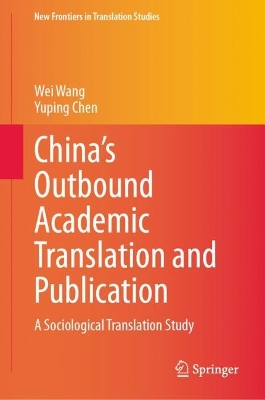
This monograph provides a rare sociological analysis of Chinas efforts to globalise its academic knowledge through translation and international publication. Centring on the Chinese Outbound Academic Translation Initiative (COATI), a major State-funded programme administered by the National Office for Philosophy and Social Sciences, it examines how academic knowledge is translated, negotiated, and institutionally positioned within global knowledge economies. A distinctive contribution of the book lies in its use of first-hand auto-ethnographic data drawn from the authors direct involvement in COATI-funded projects, offering unique insider perspectives on institutional processes, professional negotiations, and translation decision-making. These insights are complemented by interviews with authors, translators, editors, and publishers, alongside analysis of policy documents, translation drafts, and detailed case studies of selected volumes. Theoretically, the book reconceptualises translation as a socially embedded practice shaped by networks of human and nonhuman actors, policy agendas, institutional structure, and agency. This volume will appeal to scholars and postgraduate students in Translation Studies, Chinese Studies, sociolinguistics, and global knowledge studies concerned with contemporary knowledge circulation.
Chapter 1 Chinas Outbound Translation Initiatives and Sociology of
Translation.
Chapter 2 Shifts In Paragraph Segmentation: A Theme-Rheme
Analysis and a Translators Habitus Interpretation.
Chapter 3 Human Actors
Agency and Networking in the Coati Projects.
Chapter 4 Nonhuman Actors Role
and Agency in Coati Translation.
Chapter 5 Translationsant at Work in Coati
Translation.
Chapter 6 Structure versus Agency: Rethinking Power in Chinas
Outbound Academic Translation and Publication.
Wei Wang is Chair of Chinese Studies and an Associate Professor of Translation Studies at the University of Sydney. His research fields involve sociolinguistics, translation studies, applied linguistics and language education. His scholarship is distinguished by an interdisciplinary approach that foregrounds the interconnections between language, identity, agency, and power. He is the author of Ethnic Identities of Kam People in Contemporary China: Government versus Local Perspectives (Routledge, 2021) and the editor of Analysing Chinese Language and Discourse across Layers and Genres (Benjamins, 2020). His work has been published widely in leading international journals, including Discourse Studies, Applied Linguistics Review, Journal of Multicultural Discourses, Linguistic Landscape, Perspectives, and Australian Review of Applied Linguistics.
Yuping Chen is a Professor of Translation Studies at China Agricultural University, and her PhD is from the University of Sydney. Her research interests include Translation Studies and Discourse Analysis. She is the author of Translating Film Subtitles into Chinese: A Multimodal Study (Springer, 2019). Her publications have appeared in Perspectives: Studies in Translation Theory and Practice, The Journal of Specialised Translation, Chinese Translators Journal.

 Lisainfo e-raamatute kohta