Muutke küpsiste eelistusi

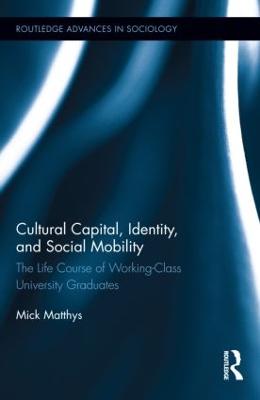
Cultural Capital, Identity, and Social Mobility: The Life Course of Working-Class University Graduates [Kõva köide]

(Universiteit Utrecht, The Netherlands)
  • Formaat: Hardback, 286 pages, kõrgus x laius: 229x152 mm, kaal: 690 g, 4 Tables, black and white
  • Sari: Routledge Advances in Sociology
  • Ilmumisaeg: 17-Aug-2012
  • Kirjastus: Routledge
  • ISBN-10: 0415510279
  • ISBN-13: 9780415510271
  • Kõva köide
  • Hind: 164,25 €*
  • * hind on lõplik, st. muud allahindlused enam ei rakendu
  • Tavahind: 219,00 €
  • Säästad 25%
  • Raamatu kohalejõudmiseks kirjastusest kulub orienteeruvalt 3-4 nädalat
  • Kogus:
  • Lisa ostukorvi
  • Tasuta tarne
  • Tellimisaeg 2-4 nädalat
  • Lisa soovinimekirja
  • Raamatukogudele
  • Formaat: Hardback, 286 pages, kõrgus x laius: 229x152 mm, kaal: 690 g, 4 Tables, black and white
  • Sari: Routledge Advances in Sociology
  • Ilmumisaeg: 17-Aug-2012
  • Kirjastus: Routledge
  • ISBN-10: 0415510279
  • ISBN-13: 9780415510271
"This qualitative study explores the meaning of working-class origin in the life and career of university graduates. Social transition from a working-class background to a middle-class milieu results in loyalty conflicts and communication barriers. The lack of social and cultural capital and the absent sense of an assertive self-presentation are pivotal barriers to gaining management functions. Positions in certain key sectors are not necessarily allocated according to professional capacity, but to obscure social connections, regulated by cultural codes and tests. Matthys approaches social mobility as a trajectory of identity construction in which different classes are integrated, and uses the notion of identity capital to interpret and discuss the meaning of the individual drive in social mobility. "--

This qualitative study explores the meaning of working-class origin in the life and career of university graduates. Social transition from a working-class background to a middle-class milieu results in loyalty conflicts and communication barriers. The lack of social and cultural capital and the absent sense of an assertive self-presentation are pivotal barriers to gaining management functions. Positions in certain key sectors are not necessarily allocated according to professional capacity, but to obscure social connections, regulated by cultural codes and tests. Matthys approaches social mobility as a trajectory of identity construction in which different classes are integrated, and uses the notion of identity capital to interpret and discuss the meaning of the individual drive in social mobility.

Arvustused

"With social mobility stalled, social inequalities growing and graduate underemployment emerging despite widened higher education, this is a timely book. It is a study that deserves to be replicated beyond the Low Countries with their tight coupling of higher education and jobs."

Chris Warhurst, University of Warwick, UK (Work, Employment and Society, Volume 28, Issue 4, pp. 669-670)

List of Tables
ix
Preface xi
1 (When) Working Class-Children Enter Academic Learning: Problem Formulation, the Field and Method
1(29)
2 A Tough Life?
30(14)
3 Identity, Context and Agency
44(21)
4 A Firm Foundation
65(31)
5 A Successful Transformation
96(30)
6 Career and Life
126(38)
7 Hicks and Proletarians
164(31)
8 Reflections: The Part I Have Played
195(28)
9 Abstract and Conclusions
223(26)
Appendix: List of Respondents 249(2)
Notes 251(4)
References 255(12)
Index 267
Mick Matthys is a Professor at University Utrecht.