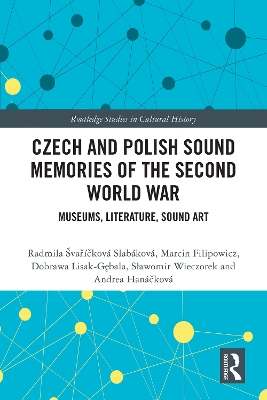
This book investigates the crucial yet often overlooked role of sound in shaping the memory of the Second World War.
Through an interdisciplinary and transnational approach, this volume addresses a notable gap in memory studies and argues that auditory experiences are central to how war is remembered, commemorated, and narrated. By placing sound at the heart of collective remembrance, this book reveals how sonic elements influence public discourse, shape collective identities, and contribute to the evolving transformation of war memory. Bringing together scholars from the Czech Republic and Poland, it examines how the Second World War has been remembered through sound since the 1990s across three distinct media: museum exhibitions, prose fiction, and sound art – including soundwalks and field recordings. This innovative framework underscores the importance of exploring how different media evoke and reproduce sound to grasp the complexity and diversity of wartime memory in Central Europe. Focusing on Czech and Polish memory cultures, the book demonstrates that sound may function in multiple and sometimes contradictory ways: as a means of reinforcing national narratives, as a tool for critical engagement, or as a medium for experimental and marginal perspectives.
This volume is essential reading for scholars in memory studies, sound studies, cultural and public history, museology, literary theory, and musicology, as well as for museum professionals and anyone interested in how the past resonates – literally and metaphorically – through sound.
This book investigates the crucial yet often overlooked role of sound in shaping the memory of the Second World War.
Arvustused
Sound remains one of the least explored areas within the flourishing field of memory studies. As a Czech-Polish memory venture, this book addresses a significant gap by mapping the polyphonic mnemoscape of World War II across diverse memory media. A landmark in memory studies.
Jie-Hyun Lim, Sogang University
This pioneering collection of essays brings together the historical intersection between sound, memory and war in new and innovative ways. The interdisciplinary approach adopted opens exciting avenues of inquiry and in so doing is an indispensable and invaluable volume in the field of sound studies and war.
Joy Damousi, University of Melbourne
This imaginative study challenges the visual bias that has long dominated memory studies, drawing attention to sonic icons that resonate across generations. Through its comparative, transnational and multisensory approach, it offers a vital contribution to memory studies, sound studies and post-socialist heritage research. It transforms the way we listen to the past."
Ewa Domaska, Adam Mickiewicz University in Pozna; Visiting Professor, Stanford University
PART 1: Museums
1 Museums as the Medium of War Sounds
Radmila vaķkovį Slabįkovį
2 Weapon Sounds and Sirens in Czech and Polish Museums and Memorials
Radmila vaķkovį Slabįkovį
3 Voices in Czech and Polish Museums and Memorials
Radmila vaķkovį Slabįkovį
PART 2: Literature
4 Literature as the Medium of War Sounds
Marcin Filipowicz and Dobrawa Lisak-Gbala
5 Thanatosonic Scarcity, Silence and Sounds of German in Contemporary Czech
Prose Fiction
Marcin Filipowicz
6 Voices, Weapon Sounds and Machine Noises in Polish Post-memorial Prose
Fiction
Dobrawa Lisak-Gbala
PART 3: Sound Art
7 Czech Soundwalk Production on the Second World War
Andrea Hanįkovį
8 Toward and Beyond Sound Memories: Field Recordings at Holocaust Memorial
Sites in Poland
Sawomir Wieczorek
Conclusion
Radmila vaķkovį Slabįkovį, Marcin Filipowicz, Dobrawa Lisak-Gbala and
Sawomir Wieczorek
Radmila vaķkovį Slabįkovį is Professor of History at Palackż University Olomouc. She is editor of Family Memory: Practices, Transmission and Uses in a Global Perspective (Routledge, 2021).
Marcin Filipowicz is Professor of Gender and Literary Studies at Charles University in Prague and at the University of Warsaw. He is the author of numerous articles and several monographs, including Configuring Memory in Czech Family Sagas: The Art of Forgetting in Generic Tradition (2022).
Dobrawa Lisak-Gbala is an assistant professor at the Institute of Polish Studies, University of Wrocaw. She is the author of the monograph Poetycka tanatosonika. Dwiki przemocy zbrojnej w wierszach z lat 19391945 (2025).
Sawomir Wieczorek is an assistant professor at the Institute of Musicology, University of Wrocaw. He is the author of On the Musical Front: Socialist Realist Discourse on Music in Poland, 19481955 (2020) and co-editor of Sounds of War and Peace: Soundscapes of European Cities in 1945 (2018) and Sensitive Sound Recordings (2022).
Andrea Hanįkovį is Associate Professor of Theatre and Radio Studies at Palackż University Olomouc. She recently published Autorskż rozhlasovż dokument (2022), which charts three decades of independent Czech documentary production since the fall of communism.


 Lisainfo e-raamatute kohta