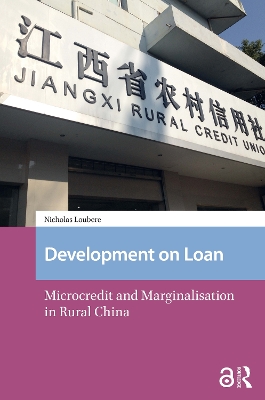
Key to China's plans to promote rural development is the de-marginalisation of the countryside through the incorporation of rural areas into the urban-based market-oriented financial system. For this reason, Chinese development planners have turned to microcredit -- i.e. the provision of small-scale loans to 'financially excluded' rural households -- as a means of increasing 'financial consciousness' and facilitating rural de-marginalisation. Drawing on in-depth fieldwork in rural China, this book examines the formulation, implementation and outcomes of government-run microcredit programmes in China-illuminating the diverse roles that microcredit plays in local processes of socioeconomic development and the livelihoods of local actors. It details how microcredit facilitates de-marginalisation for some, while simultaneously exacerbating the marginalisation of others; and exposes the ways in which microcredit and other top-down development strategies reflect and reinforce the contradictions and paradoxes implicit in rural China's contemporary development landscape.
Drawing on in-depth fieldwork in rural China, this book examines the formulation, implementation and outcomes of government-run microcredit programmes in China-illuminating the diverse roles that microcredit plays in local processes of socioeconomic development and the livelihoods of local actors.
Front Material
1. Introduction 1.1 Contested and Paradoxical Rural
Development in China 1.2 The Rise of the Global Microfinance Movement and the
Adoption of Microcredit in Rural China 1.3 Research Questions and Objectives
1.4 Research Methodology and Fieldwork Sites 1.5 Book Outline
2. Rural
Financial Services in China: Historical and Literature Review 2.1 The
Trajectories and Contours of the Rural Financial Landscape since 1949 2.2
Research on Rural Financial Services in China 2.3 Conclusion
3. Making
Microcredit: Policy Formulation and Implementation 3.1 The Formulation of
Microcredit Policy 3.2 A Tale of Three Townships: Microcredit Implementation
at the Local Level 3.3 Conclusion
4. Variation in Microcredit Implementation:
Understanding Heterogeneity from a Relational Perspective 4.1 Differentiated
Financial Landscapes and Segmented Financial Markets 4.2 Strategising and
Rationalising Pressures and Incentives 4.3 Interpersonal Relationships and
Negotiations at the Interface 4.4 Emergence and Complexity in Implementation
Outcomes 4.5 Conclusion
5. Microcredit as Modernisation and
De-marginalisation 5.1 The Linear Progression Development Paradigm 5.2 Local
Interpretations of Microcredit as a Means of De-marginalisation 5.3
Microcredit as De-marginalisation Through Capital, Knowledge, and Technology
Transfers 5.4 Microcredit as De-marginalisation Through the Formation of New
Socio-political and Socioeconomic Linkages 5.5 Microcredit as
De-marginalisation Through Employment, Local Cooperation, and Financial
Inclusion 5.6 Microcredit and Local Livelihood Improvement 5.7 Conclusion
6.
Microcredit, Precarious Livelihoods and Undercurrents of Marginalisation 6.1
The Unequal Foundations of Development and Relational Marginality 6.2 The
Rural-Urban Dichotomy and Relational Marginality in the Chinese Context 6.3
Microcredit as Resource Diversion and Extraction 6.4 Microcredit as Elite
Capture and Exclusion 6.5 Microcredit as Precarity, Risk, and Exploitation
6.6 Conclusion
7. Conclusion 7.1 In Summary 7.2 Key Findings 7.3 Directions
for Future Research End Material - Bibliography - Interview Lists - Index
Nicholas Loubere is an Associate Senior Lecturer in the Study of Modern China at the Centre for East and South-East Asian Studies, Lund University. His research examines socioeconomic development in rural China, with a particular focus on microcredit and migration.