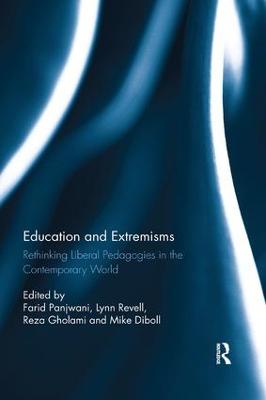
Education and Extremisms addresses one of the most pressing questions facing societies today: how is education to respond to the challenge of extremism? It argues that the implementation of new teaching techniques, curricular reforms or top-down changes to education policy alone cannot solve the problem of extremism in educational establishments across the world. Instead, the authors of this thought-provoking volume argue that there is a need for those concerned with radicalisation to reconsider the relationship between instrumentalist ideologies shaping education and the multiple forms of extremisms that exist.
Beginning with a detailed discussion of the complicated and contested nature of different forms of extremism, including extremism of both a religious and secular nature, the authors show that common assumptions in contemporary discourses on education and extremism are problematic. Chapters in the book provide a careful selection of pertinent and topical case studies, policy analysis and insightful critique of extremist discourses. Taken together, the chapters in the book make a powerful case for re-engaging with liberal education in order to foster values of individual and social enrichment, intellectual freedom, criticality, open-mindedness, flexibility and reflection as antidotes to extremist ideologies. Recognising recent criticisms of liberalism and liberal education, the authors argue for a new understanding of liberal education that is suitable for multicultural societies in a rapidly globalising world.
This book is essential reading for academics, researchers and postgraduate students with an interest in religion, citizenship education, liberalism, secularism, counter-terrorism, social policy, Muslim education, youth studies and extremism. It is also relevant to teacher educators, teachers and policymakers.
Foreword Acknowledgements List of Contributors Introduction Section
1.
State Policies and Educational Practices
1. Challenging Extremism and
Promoting Cohesion: National Policies and Local Implementation
2. Education,
Freedom of Belief and Countering Terrorism: The Minefield between UK Policy
and School Implementation
3. Education and Disengagement: Extremism and the
Perception of Muslim Students
4. Street Children, Integrated Education and
Violence in Northern Nigeria
5. Misplaced Utopia: Education and Extremism -
the Case of Pakistan Section
2. Perspectives on Extremism
6. Challenging the
Legitimacy of Extremism: Critique through Education in the Work of Khaled
Abou El Fadl
7. Teaching Early Muslim History: Facilitating Criticality
through a Source-based Approach
8. Mine Own Familiar Friend... Education
and Extremism, within Historic Culture
9. Gender Equality in Education,
Context and Criticality: Student Teacher Engagements in Three Northern
Nigerian States
10. The Balanced Nation: Addressing the Challenges of
Islamist and Far-Right Extremism in the Classroom
11. Multiple Ontologies of
Extremism: ISISes in Education, a Case Study Section
3. Reconceptualising
Liberal Education and Criticality
12. Negotiating Difference in Educatoin:
Extremism, Political Agency and an Ethics of Care
13. Resilience and Soft
Power: an Analysis of UK Government and International Guidelines and
Resources to Address Radicalisation and Extremism in Education.
14. Promoting
Tolerance to Schools in a Time of Extremism
15. Nurturing Critical Thinking
across Self-Other Dichotomies
16. Cosmopolitanism as Transformative
Experience: towards a New Social Ethic Epilogue
Farid Panjwani is a Senior Lecturer and founding Director at the Centre for Research and Evaluation in Muslim Education (CREME) at the UCL Institute of Education, University College London, UK.
Lynn Revell is Reader in Religion and Education at Canterbury Christ Church University, UK.
Reza Gholami is Lecturer in Sociology of Education in the School of Social Science and Public Policy at Keele University, UK.
Mike Diboll is Honorary Research Associate at UCL Institute of Education, University College London, UK.

 Rohkem infot Taylor & Francis e-raamatute kohta