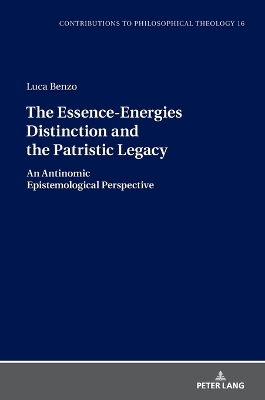
Since its clear formalization in the 14th century by the Orthodox theologian Gregory Palamas, the assertion of a real distinction in God between essence and uncreated energies has become the major point of conflict between Western and Eastern Christian theologies, to the point that nowadays even the notorious Filioque controversy tends to be seen as a theological consequence of this problem.
The innovative approach of this book on the Palamite controversy abandons the traditional ontological contraposition based on the (Eastern) defense or (Western) rejection of the aforementioned real distinction, and moves to epistemological terrain, taking the logical notion of antinomy, in its vital connection with theological apophaticism, as the formal touchstone to discern the effective continuity (or discontinuity) between Palamas thought and its patristic sources.
Acknowledgments - Introduction
Chapter 1 About the problem - 1.1 The
notion of antinomy - 1.2 Cataphatic way and apophatic way - 1.3 The Orthodox
and Latin reception of Palamism and the neo-Palamism - 1.4 Limits of
neo-Thomistic apologetics - 1.5 The Palamite controversy as a meta-problem: a
range of interpretive paradigms
Chapter 2 Greek patristics - 2.1 Vision of
God - 2.2 Fundamental Dualities in Patristic Thought - 2.3 The Thought of
Pseudo-Dionysius - 2.4 The Thought of Maximus the Confessor - 2.5
Apophaticism and Patristic Themes
Chapter 3 Gregory Palamas - 3.A On the
origin of the problem - 3.B Palamas Apodictic Treatises, the Filioque
problem and the essence-energies distinction - 3.1 Epistolary Exchanges
Between Palamas and Barlaam - 3.2 The Articulation Between Cataphatic and
Apophatic Theology in Palamas Thought - 3.3 The Essence-energies Distinction
in Palamas Doctrine - 3.4 The Palamite Identification Between Energeiai and
Logoi - 3.5 Personal Distinction and Energy Distinction - Conclusion -
Bibliography
Luca Benzo is currently a Research Associate at the Nanzan Institute for Religion and Culture, Nanzan University, Japan. He holds a PhD in Mathematics from the University of Rome Tor Vergata, as well as Master's Degrees in Theology and Philosophy from the Catholic Institute of Paris. Since 2022 he has been serving as a missionary priest in Japan.

 Lisainfo e-raamatute kohta