Muutke küpsiste eelistusi

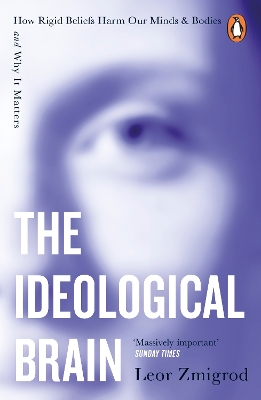
Ideological Brain: How Rigid Beliefs Harm Our Minds & Bodies And Why It Matters [Pehme köide]

  • Formaat: Paperback / softback, 336 pages, kõrgus x laius x paksus: 197x129x23 mm, kaal: 238 g
  • Ilmumisaeg: 05-Feb-2026
  • Kirjastus: Penguin Books Ltd
  • ISBN-10: 1405975148
  • ISBN-13: 9781405975148
Teised raamatud teemal:
  • Pehme köide
  • Hind: 16,43 €*
  • * hind on lõplik, st. muud allahindlused enam ei rakendu
  • Tavahind: 20,54 €
  • Säästad 20%
  • Kaupluses 3 eks Tule tutvuma - Raekoja plats 11, Tartu, E-R 10-18
  • Kogus:
  • Lisa ostukorvi
  • Tasuta tarne
  • Saadame välja 1 tööpäeva jooksul
  • Lisa soovinimekirja
  • Formaat: Paperback / softback, 336 pages, kõrgus x laius x paksus: 197x129x23 mm, kaal: 238 g
  • Ilmumisaeg: 05-Feb-2026
  • Kirjastus: Penguin Books Ltd
  • ISBN-10: 1405975148
  • ISBN-13: 9781405975148
Teised raamatud teemal:
Fascinating, insightful, lucidly and entertainingly written A. C. GRAYLING, author of The History of Philosophy


Extraordinary, eye-opening, startlingly original CASS R. SUNSTEIN, co-author of Nudge

Filled with insightful findings, this book shows that ideological extremism and polarization are not just problems to fret about but puzzles that can be studied and understood STEVEN PINKER, author of The Better Angels of Our Nature

How do our brains shape the ideologies we choose? And could our most cherished beliefs ultimately harm our brains and bodies?

In The Ideological Brain, Dr Leor Zmigrod argues that when we believe passionately and extremely in an ideology, it is not only our political opinions that are changed our entire brain can be transformed too. Drawing on cutting-edge research, Zmigrod reveals how rigid belief systems transform the way we think, act and interact with others, making us less sensitive, less adaptable and less free.

Guiding you through innovative experiments, Zmigrod uncovers the deep and surprising connections between your political beliefs and the biology of your brain, exposing why some of us are more likely to gravitate towards rigid ideologies than others. She reveals the complex interplay between the psychological, neurobiological and social factors affecting our ideological choices, and carves a hopeful way forward, explaining how we can keep our minds open and free in the face of extreme ideologies.

Eye-opening, provocative, and unforgettable, The Ideological Brain is a groundbreaking book that challenges you to resist black-and-white thinking and reassess your closest convictions. Lucid, eloquent, timely ADAM PHILLIPS, author of Missing Out

Deeply fascinating and beautifully written JULIA EBNER, author of Going Dark

One of the most brain-frying books I have read in an incredibly long time. JOHN BURN-MURDOCH, chief data reporter, Financial Times

Arvustused

Leor Zmigrods hotly awaited debutuses new research to show that polarised thinking isnt something that just floats through the mind: it changes our entire neural architecture THE TELEGRAPH, BEST BOOKS OF 2025 * The Telegraph * 'Zmigrod reveals the science behind dogma and shows us how to nurture cognitive flexibility instead THE GUARDIAN, BRILLIANT BOOKS IN READ IN 2025 * Guardian * 'Massively important...Zmigrod is a joyful and compelling writer' -- Tom Calver * The Sunday Times * If I had to pick one, Zmigrods would be my book to watch out for in 2025 -- Simon Ings * New Scientist * 'Filled with insightful findings, this book shows that ideological extremism and polarization are not just problems to fret about but puzzles that can be studied and understood' -- Steven Pinker, author of The Better Angels of Our Nature 'An extraordinary, eye-opening and startlingly original book, showing what ideology does to the human brain, and casting a bright new light on the sources and nature of dogmatism, ideology and open-mindedness. Packed with insights, this is a remarkable achievement' -- Cass R. Sunstein, co-author of Nudge 'Fascinating, insightful, lucidly and entertainingly written, Zmigrod's account illuminates the debate about the nature of ideology and the power it exerts, by bringing cognitive neuroscience in fact, an intriguing development of it: political neuroscience to bear on both. An educative, rewarding, troubling, but ultimately hopeful, book' -- A. C. Grayling, author of The History of Philosophy 'The Ideological Brain is a deeply fascinating and beautifully written investigation of the human minds susceptibility to radical ideologies. Leor Zmigrod elegantly weaves together her ground-breaking research with vivid storytelling. The book is a treasure trove of surprising insights: from the epigenetics of extremism to the impact of stress on rigid thinking, and the role of parenting styles in cultivating authoritarian attitudes.' * Julia Ebner, author of GOING DARK * 'A fascinating and important exploration of the causes of cognitive rigidity and of the factors that make some people more vulnerable to it than others. Leor Zmigrod draws on neuroscience, psychology and philosophy in her quest to understand why and how some people are drawn to authoritarian thinking and even to terrorism while others are able to question and resist dominant ideologies' -- Nigel Warburton, author of A Little History of Philosophy 'This remarkable book tells us something fascinating and heartening about the neuroscience of our inflexibilities and our dogmatisms. Lucid and eloquent, The Ideological Brain couldn't be more timely' -- Adam Phillips, author of Missing Out

Dr Leor Zmigrod is a prize-winning scientist and pioneer in the field of political neuroscience. She studied at Cambridge University as a Gates Scholar before winning a Junior Research Fellowship at Churchill College, Cambridge. Zmigrod has published over 30 peer-reviewed papers and has held visiting fellowships at Stanford, Harvard, and both the Berlin and Paris Institutes for Advanced Study. She was listed on Forbes 30 Under 30 in Science and has won numerous prizes, including the Women of the Future Science Award and the Glushko Prize. She has spoken at the Hay Festival and TEDx, and her research has been featured widely in the media, including in The New York Times, Guardian, Financial Times and New Scientist. Zmigrod advises policymakers at the United Nations, the UK and US governments, and other international organizations. This is her first book.