Muutke küpsiste eelistusi

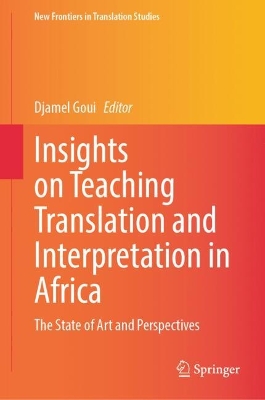
Insights on Teaching Translation and Interpretation in Africa: The State of Art and Perspectives [Kõva köide]

Edited by
  • Formaat: Hardback, 355 pages, kõrgus x laius: 235x155 mm, 21 Illustrations, color; 1 Illustrations, black and white
  • Sari: New Frontiers in Translation Studies
  • Ilmumisaeg: 05-Jun-2026
  • Kirjastus: Springer Verlag, Singapore
  • ISBN-10: 9819584604
  • ISBN-13: 9789819584604
  • Kõva köide
  • Hind: 133,04 €*
  • * hind on lõplik, st. muud allahindlused enam ei rakendu
  • Tavahind: 177,39 €
  • Säästad 25%
  • See raamat ei ole veel ilmunud. Raamatu kohalejõudmiseks kulub orienteeruvalt 3-4 nädalat peale raamatu väljaandmist.
  • Kogus:
  • Lisa ostukorvi
  • Tasuta tarne
  • Tellimisaeg 2-4 nädalat
  • Lisa soovinimekirja
  • Formaat: Hardback, 355 pages, kõrgus x laius: 235x155 mm, 21 Illustrations, color; 1 Illustrations, black and white
  • Sari: New Frontiers in Translation Studies
  • Ilmumisaeg: 05-Jun-2026
  • Kirjastus: Springer Verlag, Singapore
  • ISBN-10: 9819584604
  • ISBN-13: 9789819584604
This book investigates the methods and strategies of how translation and interpreting are taught in Africa, and it identifies the subject matters studied in several African universities, namely the five corners: north, south, west, east, and central Africa. The book goes through its different chapters to measure the efficiency of those translation and interpretation programs, departments, faculties, and schools via a comparison with the rate of employability of the graduates and their reputation in different local and continental organisms. This book reveals the teaching translation and interpretation in Africa which is still adopting the traditional classical methods or adopting new methodologies in this age of AI and recommends methods to face positively the increasing integration of AI at all life levels including in translation and interpretations to highlight the pros and cons of it and prospect or recommend adaptive measures, methods, strategies, or likely methodologies for better outcomes and performance. This book also presents the mapping of major schools, faculties, institutes, and departments of translation and interpreting in Africa. It can serve as a useful academic guide for academic scholars and professional readers on African instructions of translation and interpreting teaching.
Chapter
1. Evaluating job advertisements for legal interpreters and
translators in Zimbabwe (Eventhough Ndlovu).
Chapter
2. Analysing
translation and interpretation training curricula in Cameroon, Canada and
Belgium (Rachid Oumarou Mal Mazou).
Chapter
3. Teaching Translation and
Interpreting in South Africa: Programmes, Courses and Pedagogical Approaches
(Tawffeek A. S. Mohammed).
Chapter
4. Teaching Translation in Algeria
(Djamel Goui).
Chapter
5. The role of AI in student translation: challenges
and issues at the Department of Applied Foreign Languages of university
Gaston Berger (Senegal) (Omar DIOP).
Chapter
6. Charting the Future of
Translation and Interpretation in Africa: Reflections from Mozambique and
Beyond (Manuel Cabinda).
Chapter
7. Translator and Interpreter Training in
Nigeria (Mariam Birma).
Chapter
8. Training of translators and interpreters:
landscape and relevance of programmes in Sub-Saharan Africa (Stephanie
Engola).
Chapter
9. Court Interpreter Training in South Africa (Celimpilo
Piety Dladla).
Chapter
10. A Critical Evaluation of Translation Pedagogy and
Market Alignment in Libyan Higher Education (Mohamed Ebrahim Alafi Al
Alshniet).
Chapter
11. Historical Account on Teaching Translation or
Interpreting in Côte dIvoire (ATCHE Djedou).
Chapter
12. The Teaching of
Translation and Interpreting in Tanzania: Past, Present and Future (Titus
Mpemba).
Chapter
13. Homegrown Conference Interpreters: From Self-Training
to a Formalised Degree Programme (Pamela Amoah).
Chapter
14. The Relevance
of Training Translators and Interpreters in Mali and Niger (Drahamane
Salmana).
Chapter
15. Translation Education in Sudan: A Solid Structure
Poised for Innovation and Change (Saadia Elamin).
Chapter
16. Teaching
Translation and Interpreting in Burkina Faso (SANON-OUATTARA Féridjou Emilie
Georgette).
Chapter
17. Teaching Translation at the University of Ndjamena:
Challenges and Opportunities (Sioudina MANDIBAYE).
Chapter
18. Scaffolding
Simultaneous Interpreting Competence Through Translation Foundation:
Longitudinal Evidence from Cross-Modal Interpreter Training in Tunisia
(Hammouda Salhi).
Chapter
19. Decolonizing Translation and Interpreting
Pedagogy through Malagasy Cultural and Linguistic Competencies (Graziella
MASINDRAZANA).
Djamel Goui is a professor of translation and interpreting Arabic, French and English from the Department of Translation at the University of Kasdi Merbah Ouargla in Algeria and a very known figure in Africa and the Arab world. He is the founder of the research laboratory English language, literature and Translation and production of knowledge as well as the team head in the same laboratory ELLITRAK at the University of Ouargla. Prof. Goui served as a keynote speaker in many regional and world conferences in translation and intercultural communication such as in Algeria, South Africa, Cameroon, and Turkey. He earned significant experience in the field by taking part in more than 60 national, regional and international conferences. Prof. Goui has plenty of national publications in Algeria and many international publications including  chapters in Cambridge Scholars, articles and chapters in Springer among others. Prof. Goui contributed to training interpreters and translators around many countries under projects of the African Union and others under the European Union.