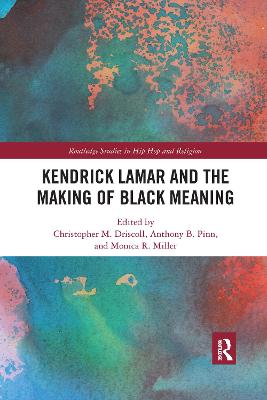
This book is the first to provide an interdisciplinary academic analysis of the impact of Kendrick Lamar’s corpus. Starting with Section 80 and ending on DAMN., it deals with each of Lamar’s four major projects.
Kendrick Lamar has established himself at the forefront of contemporary hip-hop culture. Artistically adventurous and socially conscious, he has been unapologetic in using his art form, rap music, to address issues affecting black lives while also exploring subjects fundamental to the human experience, such as religious belief. This book is the first to provide an interdisciplinary academic analysis of the impact of Lamar’s corpus. In doing so, it highlights how Lamar’s music reflects current tensions that are keenly felt when dealing with the subjects of race, religion and politics.
Starting with Section 80 and ending with DAMN., this book deals with each of Lamar’s four major projects in turn. A panel of academics, journalists and hip-hop practitioners show how religion, in particular black spiritualties, take a front-and-center role in his work. They also observe that his astute and biting thoughts on race and culture may come from an African American perspective, but many find something familiar in Lamar’s lyrical testimony across great chasms of social and geographical difference.
This sophisticated exploration of one of popular culture’s emerging icons reveals a complex and multi faceted engagement with religion, faith, race, art and culture. As such, it will be vital reading for anyone working in religious, African American and hip-hop studies, as well as scholars of music, media and popular culture.
Acknowledgements; Introduction: K.Dotting the American Cultural
Landscape with Black Meaning- Anthony B. Pinn and Christopher M. Driscoll;
Part I: Section.80 (2011); 1 Kendrick Lamars Section.80: Reagan Era Blues-
Ralph Bristout; 2 Can I be Both?: Blackness and the Negotiation of Binary
Categories in Kendrick Lamars Section.80- Margarita Simon Guillory; 3 Hol
Up: Post-Civil Rights Black Theology within Kendrick Lamars Section.80 Album
- Daniel White Hodge; 4 Sensibility in Section.80: Kendrick Lamars Poetics
of Problems- Michael L. Thomas; Part II: good kid, m.A.A.d. city (2012); 5
The Good, the m.A.A.d., and the Holy: Kendrick Lamars Meditations on Sin and
Moral Agency in the Post-Gangsta Era- Juan M. Floyd-Thomas; 6 Real is
Responsibility: Revelations in White through the Filter of Black Realness on
good kid, m.A.A.d. city- Rob Peach; 7 Black Meaning Out of Urban Mud: good
kid, m.A.A.d city as Compton Griot-Riff at the Crossroads of
Climate-Apocalypse- James W. Perkinson; 8 Rap as Ragnarök: Kendrick Lamar,
Eminem, and the Value of Competition- Christopher M. Driscoll: Part III: To
Pimp a Butterfly (2015) ; 9 Can Dead Homies Speak? The Spirit and Flesh of
Black Meaning- Monica R. Miller; 10 Loving [ You] is Complicated: Black
Self-Love and Affirmation in the Rap Music of Kendrick Lamar- Darrius D.
Hills; 11 From Blackness to Afrofuture to Impasse: The Figura of the Jimi
Hendrix/Richie Havens Identity Revolution as Faintly Evidenced by the work of
Kendrick Lamar and More than a Head Nod to Lupe Fiasco- Jon Gill; 12 Beyond
Flight and Containment: Kendrick Lamar, Black Study, and an Ethics of the
Wound- Joseph Winters; Part IV: DAMN. (2017); 13 Real Nigga Conditions:
Kendrick Lamar, Grotesque Realism, and the Open Body-Anthony B. Pinn; 14
DAMNed to the Earth: Kendrick Lamar, De/colonial Violence,and Earthbound
Salvation- Ben Lewellyn-Taylor and Melanie C. Jones; 15 Kendrick Lamars
DAMN. as an Aesthetic Genealogy- Dominik Hammer; 16 Im an Israelite:
Kendrick Lamars Spiritual Search, Hebrew Israelite Religion, and the
Politics of Celebrity Encounter- Sam Kestenbaum: 17 Damnation, Identity, and
Truth: Vocabularies of Suffering in Kendrick Lamars DAMN.- André E. Key; 18
Hebrew Israelite Covenantal Theology and Kendrick Lamars Constructive
Project in DAMN.- Spencer Dew; Conclusion: KENosis: The Meaning of Kendrick
Lamar- Monica R. Miller; References ; Contributors
Christopher M. Driscoll is Assistant Professor of Religion, Africana, and American Studies at Lehigh University. Driscoll is also cofounder and former chair of the Critical Approaches to Hip Hop and Religion group at the American Academy of Religion. Much of his work attends to hip hop culture, including editing a 2011 special issue of the Bulletin for the Study of Religion on the topic, he is coauthor of Breaking Bread, Breaking Beats: Churches and Hip Hop A Guide to Key Issues (Fortress, 2014), and more. Driscoll is also author of White Lies: Race & Uncertainty in the Twilight of American Religion (Routledge, 2015), and coauthor (with Monica R. Miller) of Method as Identity: Manufacturing Distance in the Academic Study of Religion (Lexington, 2018).
Monica R. Miller is Associate Professor of Religion, Africana Studies, and Director of Women, Gender, and Sexuality Studies at Lehigh University, USA. Miller is the author of Religion and Hip Hop (Routledge, 2012), The Hip Hop and Religion Reader, coedited with Anthony B. Pinn (Routledge, 2014), Religion in Hip Hop: Mapping the New Terrain in the US, coedited with Anthony B. Pinn and Bernard "Bun B" Freeman (Bloomsbury, 2015), Claiming Identity in the Study of Religion: Social and Rhetorical Techniques Examined ed. (Equinox, 2016), and Humanism in a Non-Humanist World ed. (Palgrave Macmillan) among other books, numerous essays, and book chapters on the topic. Miller is cofounder and current cochair of the Critical Approaches to hip hop and Religion group at the American Academy of Religion and has presented nationally on the topic over the past ten years.
Anthony B. Pinn is Agnes Cullen Arnold Professor of Humanities and Professor of Religious Studies at Rice University. He is also the founding Director of Rice's Certer for Engaged Research and Collaborative Learning. Pinn is also the Director of Research for the Institute for Humanist Studies (Washington, DC). In addition to courses on African American religious thought, liberation theologies, and religious aesthetics, Pinn co-teaches with Bernard "Bun B" Freeman a popular course on religion and hip hop culture. The course received media coverage from a variety of outlets including MTV. He is the author/editor of over 30 books, including Noise and Spirit: Rap Musics Religious and Spiritual Sensibilities (NYU Press, 2003); The Religion and Hip Hop Reader, coedited with Monica R. Miller (Routledge, 2014); and Religion in Hip Hop: Mapping the New Terrain in the US, coedited with Monica R. Miller and Bernard "Bun B" Freeman (Bloomsbury, 2015).