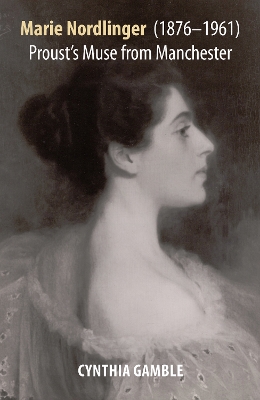
For French readers, the name Marie Nordlinger (1876-1961) is for ever linked with the writer Marcel Proust, as a friend and as assistant translator into French of two works by John Ruskin: The Bible of Amiens and Sesame and Lilies. However, this biographical study goes beyond this friendship to shed light on the wide scope of her artistic activities.
The story begins in Manchester, where she was born into a wealthy middle-class family. Her father, Selmar Nordlinger, originally an immigrant from Venice, was a cotton industrialist and philanthropist who espoused the Ruskinian values of work. Her mother, Helene, the daughter of a wealthy Jewish banker, was born in Hamburg. Marie, the third of seven children, thrived in a multilingual environment, at school and at home.
After initial studies at the Municipal School of Art in Manchester, she continued learning as an artist and sculptor in Paris in the studio of Gustave Courtois, chaperoned by her Aunt Caroline (Caro). She made the acquaintance of Marcel Proust at the home of her cousin Reynaldo Hahn in December 1896. Proust was immediately attracted to her beauty and likened her to a lady in a Titian painting in the Louvre.
This was the start of a remarkable adventure for this talented, polyglot artist and sculptor. Between 1899 and 1908, she and Proust were in regular correspondence, mainly about questions of translation but often about his delicate health. Proust's letters to Marie were published as Lettres a une amie (Manchester, Editions du Calame, 1942).
Marie, known as the 'Parisienne from Manchester', had a pioneering spirit: she crossed continents for work and study long before women in Britain had been emancipated. She spent time as an apprentice sculptor in Hamburg, and then, in Belle-Epoque Paris, she was employed in the gallery of Siegfried Bing, the art dealer and disseminator of Japonisme.
Marie was so exceptional and hard working that Bing sent her, unaccompanied, to America as his representative to negotiate contracts and also to help catalogue in Detroit the precious collection of East Asian, Middle Eastern and American art of the wealthy industrialist Charles Lang Freer.
In 1911, Marie married the German art historian Rudolf Meyer-Riefstahl, with whom she set up an antique business in central Paris. Three years later, at the time of the Great War, the couple's assets were seized by the French state. The family took refuge in England.
This marked the beginning of the first of many tragedies in Marie's life. When her husband, deemed an enemy alien, emigrated to America, where he could remain and establish his career, Marie and her two children were left behind. Her stoicism following her divorce is remarkable. In the Second World War, she coped with another tragedy, the death of her only son, a pilot.
Shining through this dramatic story of great courage and resilience is Marie's unrequited love for her cousin, the Venezuelan-born musician and composer Reynaldo Hahn.
A lifelong Francophile, she worked tirelessly to promote Franco-British relations and in 1957 was awarded the Legion d'honneur.
The book's publication marks the 150th anniversary of Marie Nordlinger's birth in Manchester.