Muutke küpsiste eelistusi

E-raamat: In the Matter of J. Robert Oppenheimer: The Security Clearance Hearing

  • Formaat: PDF+DRM
  • Ilmumisaeg: 06-Aug-2018
  • Kirjastus: Cornell University Press
  • Keel: eng
  • ISBN-13: 9781501729515
  • Formaat - PDF+DRM
  • Hind: 180,38 €*
  • * hind on lõplik, st. muud allahindlused enam ei rakendu
  • Lisa ostukorvi
  • Lisa soovinimekirja
  • See e-raamat on mõeldud ainult isiklikuks kasutamiseks. E-raamatuid ei saa tagastada.
  • Formaat: PDF+DRM
  • Ilmumisaeg: 06-Aug-2018
  • Kirjastus: Cornell University Press
  • Keel: eng
  • ISBN-13: 9781501729515

DRM piirangud

  • Kopeerimine (copy/paste):

    ei ole lubatud

  • Printimine:

    ei ole lubatud

  • Kasutamine:

    Digitaalõiguste kaitse (DRM)
    Kirjastus on väljastanud selle e-raamatu krüpteeritud kujul, mis tähendab, et selle lugemiseks peate installeerima spetsiaalse tarkvara. Samuti peate looma endale  Adobe ID Rohkem infot siin. E-raamatut saab lugeda 1 kasutaja ning alla laadida kuni 6'de seadmesse (kõik autoriseeritud sama Adobe ID-ga).

    Vajalik tarkvara
    Mobiilsetes seadmetes (telefon või tahvelarvuti) lugemiseks peate installeerima selle tasuta rakenduse: PocketBook Reader (iOS / Android)

    PC või Mac seadmes lugemiseks peate installima Adobe Digital Editionsi (Seeon tasuta rakendus spetsiaalselt e-raamatute lugemiseks. Seda ei tohi segamini ajada Adober Reader'iga, mis tõenäoliselt on juba teie arvutisse installeeritud )

    Seda e-raamatut ei saa lugeda Amazon Kindle's. 

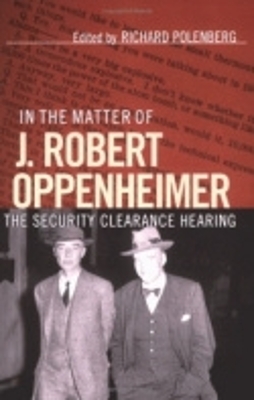
At the end of World War II, J. Robert Oppenheimer was one of America's preeminent physicists. For his work as director of the Manhattan Project, he was awarded the Medal for Merit, the highest honor the U.S. government can bestow on a civilian. Yet, in 1953, Oppenheimer was denied security clearance amidst allegations that he was "more probably than not" an "agent of the Soviet Union." Determined to clear his name, he insisted on a hearing before the Atomic Energy Commission's Personnel Security Board.In the Matter of J. Robert Oppenheimer contains an edited and annotated transcript of the 1954 hearing, as well as the various reports resulting from it. Drawing on recently declassified FBI files, Richard Polenberg's introductory and concluding essays situate the hearing in the Cold War period, and his thoughtful analysis helps explain why the hearing was held, why it turned out as it did, and what that result meant, both for Oppenheimer and for the United States.Among the forty witnesses who testified were many who had played vitally important roles in the making of U.S. nuclear policy: Enrico Fermi, Hans Bethe, Edward Teller, Vannevar Bush, George F. Kennan, and Oppenheimer himself. The hearing provides valuable insights into the development of the atomic bomb and the postwar debate among scientists over the hydrogen bomb, the conflict between the foreign policy and military establishments over national defense, and the controversy over the proper standards to apply in assessing an individual's loyalty. It reveals as well the fears and anxieties that plagued America during the Cold War era.

At the end of World War II, J. Robert Oppenheimer was one of America's preeminent physicists. For his work as director of the Manhattan Project, he was awarded the Medal for Merit, the highest honor the U.S. government can bestow on a civilian. Yet...

Arvustused

The Polenburg edition has a number of important virtues, beginning with the fact that it brings this classic back into print, three decades after the original 1954 edition was reprinted by MIT Press in 1971. Whereas the original volume extended over a thousand pages of tiny, densely packed type and was nearly unreadable for more than a few pages at a time, the new edition is handsomely produced with a decently sized typeface and is a pleasure to read.

- Steven Aftergood (Journal of Cold War Studies) This book is a wonderful resource for teaching. It is ideal for use as a core text in courses on twentieth-century American history and on the history of modern science. And it should appeal also to the general reader as an accessible version of an authentic and pivotal historical drama.

- Charles Thorpe (British Journal for the History of Science) In the spring of 1954... the Atomic Energy Commission (AEC) held hearings to determine if Dr. J. Robert Oppenheimer, scientific director of the WWII atomic bomb project, should be allowed to retain his security clearance. The proceedings were initiated by a letter from the Chief of Staff of the AEC... in which he suggested that Oppenheimer was an agent of the Soviet Union.... The 28-page introduction contains a useful discussion of the background and politics behind the hearings. The index is good, and the list of suggested reading material is useful.

(Choice) The criteria of significane and balance are very well met, making the book an excellent case study in the temper of those times.... This book deserves high marks indeed.

- Gordon L. Shull (Perspectives on Politics)

Richard Polenberg is Goldwin Smith Professor of American History at Cornell University. Among his previous books is Fighting Faiths: The Abrams Case, the Supreme Court, and Free Speech, also from Cornell.