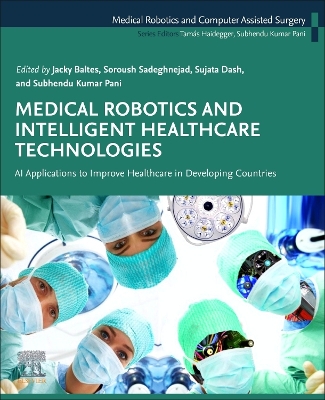
Medical Robotics and Intelligent Healthcare Technologies: AI Applications to Improve Healthcare in Developing Countries is an essential reference for professionals and researchers in fields such as biomedical engineering, health informatics, bioelectronics, medical electronics, physiology, and robotics. This book presents the latest advancements in AI and machine learning-based robotics applications, enabling readers to quickly grasp effective methods and compare various approaches. Addressing critical research areas that directly impact human life and health fills a significant market gap, providing valuable insights into AI, deep learning, machine learning, and big data analytics methods as they relate to emerging robotics research models in the biomedical and healthcare domains.
It offers a comprehensive understanding of the concepts, themes, and tools in medical robotics, IoT-based applications, edge computing, and artificial intelligence. With a specific focus on developing countries, this book catalyzes healthcare progress by showcasing the potential of medical robotics and intelligent healthcare technologies. It aims to empower researchers and practitioners to harness these state-of-the-art technologies to improve healthcare systems worldwide.
1. Robotics for medical applications
2. Neurorobotics approach in the human infant.
3. Control methods in biomedical system
4. Real-time classification of electromyography signals for robotics
5. Computational methods and mathematics for Medical Robotics
6. Computational method in modelling and control with bio signal processing
7. Image-guided Diagnosis and Therapy
8. Smart instrumented tools for surgery
9. Rehabilitation Robotics System Development
10. Safety aspects in rehabilitation and assistive robotics
11. Classification of robotic data using Machine learning techniques
12. Tactile and sensor technologies in medical usage
13. Haptic and Teleoperation in Biomedicine
14. Usage of explainable machine learning and interpretable artificial intelligence in medical robotics
Jacky Baltes is a Full Professor in the computer science department at the University of Manitoba in Winnipeg, Canada. Dr. Baltes was born and grew up in Munich, Germany. He is a three-time national champion in speed skating and participated at the 1984 and 1988 Olympic games. Dr. Baltes received his Ph.D. in 1996 from the University of Calgary, Canada in artificial intelligence and machine learning. For his Ph.D., Dr. Baltes developed a learning multi-strategy planning system called DoLittle. From 1996 to 2002, Dr. Baltes worked as a senior lecturer in the computer science department at the University of Auckland, New Zealand. In 2002, Dr. Baltes moved to the University of Manitoba in Winnipeg, Canada.
Soroush Sadeghnejad is an Assistant Professor of Biomedical Engineering Department at Amirkabir University of Technology from 2020. He received his Ph.D. in 2017, from the Sharif University of Technology in the area of medical robotics engineering. In his Ph.D., he worked on the development of virtual-based sinus endoscopic surgical training systems. Beforehand, he received his MSc and BSc in Mechanical Engineering Department of the Amirkabir University of Technology with the top ranks. He is also currently the student scientific association office manager of Amirkabir University of Technology (Tehran Polytechnic). From 2019, he appointed as the Federation of International Robosports Association Vice-President. In 2014, he has been appointed as the Executive Committee (EC) member of the International RoboCup Federation by the board of Trustees and now he is the Iran FIRA chapter head.
Sujata Dash is a Professor of Information Technology at Nagaland University, India, and an IEEE Senior Member, with over three decades of academic and research experience. She holds a PhD in Computational Modeling and has also completed postdoctoral research at the University of Manitoba, Canada, where she later served as a Visiting Professor. Her research spans machine learning, deep learning, artificial intelligence, bioinformatics, natural language processing, and IoT, with applications across healthcare, data science, and smart systems. Dr. Dash has an extensive publication record with leading publishers including Elsevier, Springer, Wiley, and CRC Press, and serves on the editorial boards of several international journals. She has delivered keynote lectures and chaired sessions at numerous international conferences and has received several awards, including the Global Distinguished Award (IEEE IAS, 2023), Outstanding Scientist Award, and Best Researcher Award. Subhendu Kumar Pani received his PhD from Utkal University, Odisha, India, in 2013. He currently serves as Principal of Krupajal Engineering College, Bhubaneswar, India, and has over 17 years of teaching and research experience. A prolific author, he serves as Series Editor for CRC Press Advances in Computational Collective Intelligence, Apple Academic Press AAP Advances in Artificial Intelligence & Robotics, and Wiley-Scriveners Intelligent Data Analytics for Terror Threat Prediction, and is actively involved as an associate editor, editorial board member, and reviewer for several international journals. He also contributes to national and international conference communities. His research interests include data mining, big data analytics, web data analytics, fuzzy decision-making, and computational intelligence. He is a Fellow of SSARS (Canada) and a Life Member of several professional bodies, including IE, ISTE, ISCA, OBA, OMS, SMIACSIT, SMUACEE, and CSI. He has received multiple research awards in recognition of his contributions.