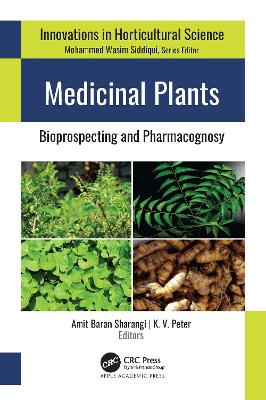
With chapters written by scientists from respected institutes and universities around the world, this book looks at the bioprospecting of medicinal plants for potential health uses and at the pharmacognosy of a selection of medicinal and aromatic plants.
The book touches on a diverse selection of topics related to medicinal plants. Chapters look at the use of medicinal plants in healthcare and disease management, such as to treat inflammation, antihyperglycemia, and obesity and as immunity boosters. The authors also address the conservation, maintenance, and sustainable utilization of medicinal plants along with postharvest management issues. A chapter discusses the use of synthetic seeds in relation to cryopreservation, and a chapter is devoted to the use of microcomputed tomography and image processing tools in medicinal and aromatic plants. Other topics include consumption, supply chain, marketing, trade, and future directions of research.
Looks at the bioprospecting of medicinal plants for potential health uses and at the pharmacognosy of a selection of medicinal and aromatic plants, such as to treat inflammation, anti-hyperglycemia, and obesity and as immunity boosters. It discusses the conservation, maintenance, and sustainable utilization of medicinal plants.
1. Medicinal Plants: Perspectives and Retrospectives
2. Traditional
Medicine in Health Care and Disease Management
3. Herbal Drug Discovery
Against Inflammation: Traditional Wisdom to Modern Therapeutics
4. Foeniculum
vulgare Mill: Flavoring, Pharmacological, Phytochemical, and Folklore Aspects
5. Ocimum basilicum: A Model Medicinal Industrial Crop Enriched with an Array
of Bioactive Chemicals
6. Syzygium aromaticum, Curcuma longa, and Lavandula:
Volatile Components and Antioxidant Activities
7. Anti-Hyperglycemic Property
of Medicinal Plants
8. Improved Production and Postharvest Technologies in
Ashwagandha (Indian Ginseng)
9. Endangered Medicinal Plants of Temperate
Regions: Conservation and Maintenance
10. Conservation and Sustainable
Utilization of Threatened Medicinal Plants of North East India
11. Essential
Oils: Clinical Perspectives and Uses
12. Asparagus sp.: Phytochemicals and
Marketed Herbal Formulations
13. Phytosomes: Preparations, Characterization,
and Future Uses
14. Synthetic Seeds vis-a-vis Cryopreservation: An Efficient
Technique for Long-Term Preservation of Endangered Medicinal Plants
15. Use
of Microcomputed Tomography and Image Processing Tools in Medicinal and
Aromatic Plants
16. Postharvest Care of Medicinal and Aromatic Plants: A
Reservoir of Many Health Benefiting Constituents
17. Prosopis cineraria
(Khejri): Ethanopharmacology and Phytochemistry
18. Mitigation of Obesity: A
Phytotherapeutic Approach
19. Ethnomedicinal Plants of North Eastern
Himalayan Region of India to Combat Hypertension
20. Medicinal Plants:
Consumption, Supply Chain, Marketing, and Trade in India
21. Potential of
Spices as Medicines and Immunity Boosters
22. Medicinal Plants: Future Thrust
Areas and Research Directions
Amit Baran Sharangi, PhD, is Professor of Horticultural Science and former Head of the Department of Plantation, Spices, Medicinal and Aromatic Crops in the Faculty of Horticulture at Bidhan Chandra Krishi Viswavidyalaya (Agricultural University), India. He has been teaching for 23 years and was instrumental in the process of coconut improvement, leading to the release of a variety Kalpa Mitra from the Central Plantation Crops Research Institute. He spent time at several laboratories around the world and has published many research papers, conference papers, book chapters, and books. One of his papers was ranked among the top 25 articles by ScienceDirect. Presently he is associated with 50 international and national journals as editor-in-chief, associate editor, regional editor, technical editor, editorial board member, and reviewer. The recipient of several international awards, Dr. Sharangi has delivered invited lectures around the world on herbs and spices.
K. V. Peter, PhD, is the former Vice-Chancellor at Kerala Agricultural University (KAU), India; Director of ICARIndian Institute of Spices Research, Calicut; Director of Research at KAU; and Professor of Horticulture. He is an acknowledged teacher and science manager and is associated with development of biotic stress resistant varieties in chili (Pant-CI, Pant-C2), tomato (Sakthi), and brinjal (Surya) grown throughout the Indian sub-continent. He is the author or editor of many books and is Editor (Horticulture) of Agricultural Research, published by NAAS New Delhi. Dr. Peter has received many awards for his work. He is a Fellow of the National Academy of Agricultural Sciences, National Academy of Sciences, National Academy of Biological Sciences, International Society of Noni Science, Indian Academy of Horticulture Science, and Confederation of Horticultural Associations of India.