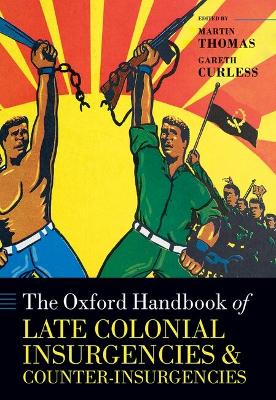
The lethality of conflicts between insurgent groups and counter-insurgent security forces has risen markedly since the Second World War just as those of conventional, or inter-state wars have declined. For several decades, conflicts within states rather than between them have been the prevalent form of organised political violence worldwide. Recent conflicts in Afghanistan, Iraq, and Syria have fired interest in colonial experiences of rebellion, while current western interventions in sub-Saharan Africa have prompted accusations of 'militarist humanitarianism'. Yet, despite mounting interest in counter-insurgency and empire, comparative investigation of colonial responses to insurrection and civil disorder is sparse. Some scholars have written of a 'golden age of counter-insurgency', which began with Britain's declaration of a Malayan Emergency in 1948 and ended with the withdrawal of US ground troops from Vietnam in 1973. It is with this period, if not with any presumed 'golden
age' that this volume is concerned. This Handbook connects ideas about contested decolonization and the insurgencies that inspired it with an analysis of patterns and singularities in the conflicts that precipitated the collapse of overseas empires. It attempts a systematic study of the global effects of organized anti-colonial violence in Asia and Africa. The objective is to reconceptualize late colonial violence in the European overseas empires by exploring its distinctive character and the globalizing processes underpinning it.
Arvustused
I would highly recommend this volume to scholars of empire, of decolonization, and of insurgencies/counter-insurgencies and modern warfare. Its essays are coherent, cutting-edge, well-researched, and can effectively orient a scholar toward emerging research in their respective fields. * Matthew J. Bowser, Bulletin *
Martin Thomas: Introduction: Revisiting the Violent Collapse of Empires
Approaches to Insurgent and Counter-Insurgent Violence 1: Jonathan Krause
and Miles Larmer: Beyond the State/Rebel Dichotomy in Twentieth Century
African Warfare 2: Alex Marshall: Counterinsurgency and the Russian 'Way of
War' 3: Gemma Clark: Fire as Revolution and Repression: Revolutionary Ireland
in Perspective 4: Peter Keppy, Abdul Wahid, and Bart Luttikhuis: Insurgencies
in early post-colonial Indonesia 5: Jeremy Kuzmarov: Humanitarian Illusions:
American Counterinsurgency, From the Indians Wars to the Global War on Terror
6: Rachel Kowalski: Sources, Methods, and the Violence of Insurgency in
Northern Ireland 'Rules of the game': Law, Doctrine, and Propaganda 7:
Martin Thomas: Decolonization's Wars and the Civilianization of Violence 8:
Matthew Hughes: The Architecture of Colonial Control: Britain's Pacification
of the Arab Revolt in Palestine, 1936-1939 9: Christiaan Harinck: Late
colonial counterinsurgency as an intellectual challenge: the development of
Dutch tactical doctrine during the Indonesian War, 1945-1949 10: Boyd van
Dijk: The Geneva Conventions, Insurgency, and Decolonization 11: Stacey Hynd:
'More an Inspiration than a Deterrent'? Capital Punishment and British
Colonial Counter-Insurgency, c. 1916-73 12: Brian Drohan: Sinning Quietly:
Law and Human Rights in British Colonial Counter-Insurgency 13: Tony Craig:
Internment, imprisonment, interrogation, and resistance in low intensity
conflict. Carceral warfare and republican paramilitaries in Northern Ireland
1968-c. 1988 Affiliations: Motivation and Mobilization 14: Gajendra Singh:
The Place of Revolutionary Violence in India, 1905-1947: From Aberrant
Nationalisms to the Nationalist Mainstream 15: Kent Fedorowich and Ian van
der Waag: The Afrikaner Rebellion 1914-15: Internal Conflict and the
Counterinsurgency Campaign 16: Daniel Branch: Unwanted Friends: Loyalty and
Citizenship in Britain's Imperial Wars, 1899-1960 17: Roel Frakking:
'Independence or Death'? Rank and File Recruitment, Ideology, and Desertion
during the Wars of Decolonization in Indonesia and Malaysia, ca. 1945-1960
18: Pierre Asselin: Hanoi's National Liberation Strategy, 1954-1975 19: Emily
Bridger: Gender, Mobilisation, and Insurgency in South Africa: Young Comrades
in the 1980s Township Uprisings 20: Neil Macmaster: Guns, Grain, and Gold:
the peasant base of Algerian guerrilla logistics, c.1954-1957 21: Saphia
Arezki: The insurgent strategies of the ALN in Algeria (1954-1962) 22: Edward
Burke and Huw Bennett: The Aden Protectorate Levies, Counter-insurgency, and
the Loyalist Bargain in South Arabia, 1951-1957 Development and Population
Control 23: Moritz Feichtinger: Strategic Resettlement: Population Removal
and Coercive Development in Late Colonial Counter-Insurgency 24: Andreas
Stucki: Gendering Development and Social Control in the Iberian Empires in
Africa, 1950s-1970s 25: Kate Bruce-Lockhart and Bethany Rebisz: Discourses of
Development and Practices of Punishment: Britain's Gendered
Counter-Insurgency Strategy in Colonial Kenya 26: Miguel Bandeira Jerónimo
and José Pedro Monteiro: The labours of (in)security in Portuguese late
colonialism 27: Claudia Castello: (Un)settling late colonial Niassa,
Mozambique (1966-1974): social knowledge, development, and counter-insurgency
28: Philip J. Havik: Mass Medicine, Disease Control, and Conflict: Collective
Health Security During Late Colonialism in Africa 29: Phi-Vān Nguyen:
Refugees in Violent Decolonizations 30: Christian Gerlach: Indonesian
strategic resettlement and development policies in East Timor Beyond
Borders: Transnational Dimensions 31: Aditya Kiran Kakati: Limits of
sovereignty: developing blank spaces across Asian borders after the Second
World War 32: Christopher Goscha: The Hunger General: Economic Warfare during
the Indochina War 33: Elie Tenenbaum: A community of mavericks: circulating
counterinsurgency knowledge in the West (1945-1975) 34: Mathilde von Bülow:
Exile, Safe Havens, and Rear Bases: External Sanctuaries and the
Transnational Dimension of Late Colonial Insurgencies and
Counter-insurgencies 35: Aaron Edwards: Dark Networks and Conflict
Transformation in Northern Ireland Ending Insurgencies and the Afterlives of
Violent Decolonisation 36: Maria Hadjiathanasiou: The Cyprus Revolt and the
'Prickly Subject' of Truces 37: Raphaėlle Branche: To forget and remember:
the paradoxical legacy of French military actions in Algeria 38: Gareth
Curless: Violence and (Dis)Order in the Caribbean PostColony: Guyana and
Jamaica
Martin Thomas is Professor of Imperial History at the University of Exeter, where he has taught since 2003. He is co-director of Exeter's Centre for Histories of Violence and Conflict, which brings together researchers with interests in historical approaches to studying collective violence, its meanings, and impacts. He is a past winner of a Philip Leverhulme research prize and a holder of Leverhulme Trust Major Research Fellowships. He is also a fellow of the Independent Social Research Foundation. He works on decolonization and political violence.
Gareth Curless is a Senior Lecturer in the Department of History at the University of Exeter, where he has taught since 2013. He is a historian of decolonization, with a particular interest in histories of work, class, and the 'labour question' at the end of empire.

 Lisainfo e-raamatute kohta