Muutke küpsiste eelistusi

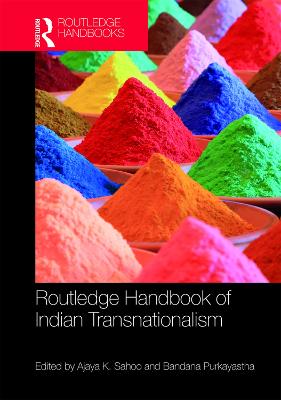
E-raamat: Routledge Handbook of Indian Transnationalism

Edited by (University of Hyderabad, India), Edited by (University of Connecticut, USA)
  • Formaat: EPUB+DRM
  • Ilmumisaeg: 11-Jul-2019
  • Kirjastus: Routledge
  • Keel: eng
  • ISBN-13: 9781351612906
  • Formaat - EPUB+DRM
  • Hind: 63,69 €*
  • * hind on lõplik, st. muud allahindlused enam ei rakendu
  • Lisa ostukorvi
  • Lisa soovinimekirja
  • See e-raamat on mõeldud ainult isiklikuks kasutamiseks. E-raamatuid ei saa tagastada.
  • Formaat: EPUB+DRM
  • Ilmumisaeg: 11-Jul-2019
  • Kirjastus: Routledge
  • Keel: eng
  • ISBN-13: 9781351612906

DRM piirangud

  • Kopeerimine (copy/paste):

    ei ole lubatud

  • Printimine:

    ei ole lubatud

  • Kasutamine:

    Digitaalõiguste kaitse (DRM)
    Kirjastus on väljastanud selle e-raamatu krüpteeritud kujul, mis tähendab, et selle lugemiseks peate installeerima spetsiaalse tarkvara. Samuti peate looma endale  Adobe ID Rohkem infot siin. E-raamatut saab lugeda 1 kasutaja ning alla laadida kuni 6'de seadmesse (kõik autoriseeritud sama Adobe ID-ga).

    Vajalik tarkvara
    Mobiilsetes seadmetes (telefon või tahvelarvuti) lugemiseks peate installeerima selle tasuta rakenduse: PocketBook Reader (iOS / Android)

    PC või Mac seadmes lugemiseks peate installima Adobe Digital Editionsi (Seeon tasuta rakendus spetsiaalselt e-raamatute lugemiseks. Seda ei tohi segamini ajada Adober Reader'iga, mis tõenäoliselt on juba teie arvutisse installeeritud )

    Seda e-raamatut ei saa lugeda Amazon Kindle's. 

This book introduces readers to the many dimensions of historical and contemporary Indian transnationalism and the experiences of migrants and workers to reveal the structures of transnationalism and the ways in which Indian origin groups are affected.

The concept of crossing borders emerges as an important theme, along with the interweaving of life in geographic and web spaces. The authors draw from a variety of archives and intellectual perspectives in order to map the narratives of Indian transnationalism and analyse the interplay of culture and structures within transnational contexts. The topics covered range from the history of transnational networks, activism, identity, gender, politics, labour, policy, performance, literature and more. This collection presents a wide array of issues and debates which will reinvigorate discussions about Indian transnationalism.

This handbook will be an invaluable resource for academics, researchers, and students interested in studying South Asia in general and the Indian diaspora in particular.

Arvustused

"Dissecting the economic, cultural, political, gendered and historical aspects of cross-border engagements with respect to India, this volume succeeds in starting a conversation with related approaches such as colonialism and intersectionality and provides a firm grounding for analysing the Indian case in a global perspective." Thomas Faist, Professor of Sociology, Bielefeld University, Germany

"This timely volume offers a path-breaking collection of essays on transnationalism with special reference to India and the Indian diaspora. Supported by detailed historical research, both traditional and web-based, each essay interrogates global disjunctures, unequal power structures, gender hierarchies and social and ethnic collisions that underlie the politics of migration, borders, homeland narratives, cosmopolitanism and the changing definitions of the nation state." Vijay Mishra, Professor of English and Comparative Literature, Murdoch University, Australia

"This is an excellent collection of essays that includes the entire gamut of themes relating to the Indian transnationalism from migrant workers (labourers and skilled professionals), implications for culture and identity, political and gender dynamics, and global networks which would appeal to scholars and students of sociology, anthropology, history, geography and diaspora studies." Brij Maharaj, Professor of Geography, University of KwaZulu-Natal, South Africa

List of figures
x
List of tables
xi
Notes on contributors xii
Acknowledgements xvii
List of abbreviations
xviii
Introduction: Indian transnationalism 1(18)
Bandana Purkayastha
Ajaya K. Sahoo
PART I Migrants'/workers' lives
19(48)
1 Globality in exceptional spaces: service workers in India's transnational economy
21(10)
Kiran Mirchandani
2 Skill gap and brain drain for United States: impact of Trump executive order on H1B and India
31(11)
Anjali Sahay
3 From students to spouses: gender and labor in Indian transnationalism
42(12)
Amy Bhatt
4 Transnationalism and return migration of scientists and engineers from the United States to India
54(13)
Meghna Sabharwal
Roli Varma
PART II On culture and identities
67(64)
5 Translocal puja: the relevance of gift exchange and locality in transnational Guyanese Hindu communities
69(9)
Sinah Theres Kloß
6 Indian music and transnationalism
78(14)
Peter Manuel
Andre Fludd
7 Transnational collaborations by selected contemporary Indian dancers
92(12)
Ketu H. Katrak
8 Revealing the messiness of transnational identities: second-generation South Asians in Canada
104(15)
Kara Somerville
9 Negotiating transnational identity among second-generation Indian residents in Oman
119(12)
Sandhya Rao Mehta
PART III Political engagement in transnational spaces
131(40)
10 Transnationalism and Indian/American foreign policy
133(10)
Pierre Gottschlich
11 Constructing Hindu identities in France and the United States: a comparative analysis
143(15)
Lise-Helene Smith
Anjana Narayan
12 Facing strong head winds: Dalit transnational activism today
158(13)
Peter J. Smith
PART IV Gender and Indian transnationalism
171(68)
13 Experiences of empowerment and constraint: narratives of transnational Indian women entrepreneurs
173(18)
Manashi Ray
14 Indian origin women: organising against apartheid
191(10)
Quraisha Dawood
Mariam Seedat-Khan
15 Workers, families, and households: towards a gendered, raced, and classed understanding of Indian transnationalism in Canada
201(11)
Amrita Hari
16 Is migration a ticket to freedom? exploring sense of freedom among Indian women in Toronto
212(15)
Sutama Ghosh
17 Middling Tamil migrants in Singapore and the translocal village
227(12)
Selvaraj Velayutham
PART V On historic and contemporary networks in transnational spaces
239(40)
18 The transnational mobility of Indians in the time of the British Empire
241(12)
Sumita Mukherjee
19 Layered cities, shared histories: gold, mobility and urbanity between Dubai and Malabar
253(13)
Nisha Mathew
20 Emergence of Singapore as a pivot for Indian diasporic and transnational networks
266(13)
Jayati Bhattacharya
Glossary 279(2)
Index 281
Ajaya K. Sahoo teaches at the Centre for Study of Indian Diaspora, University of Hyderabad, India. His research interests include the Indian diaspora and transnationalism. He has co-edited the Routledge Handbook of the Indian Diaspora (2018), Indian Transnationalism Online (2014), Transnational Migrations: The Indian Diaspora (2009) and Tracing an Indian Diaspora: Contexts, Memories, Representations (2008). He is also the editor of South Asian Diaspora, also published by Routledge.

Bandana Purkayastha is Professor of Sociology and Asian American Studies at the University of Connecticut, USA. Her research interests are the intersections of gender/racism/class/age, transnationalism, violence and peace, and human rights. Her recent books are The Human Rights Enterprise: Political Sociology, State Power, and Social Movements (2015), Voices of Internally Displaced Persons in Kenya: A Human Rights Perspective (2015) and Human Trafficking (2018).