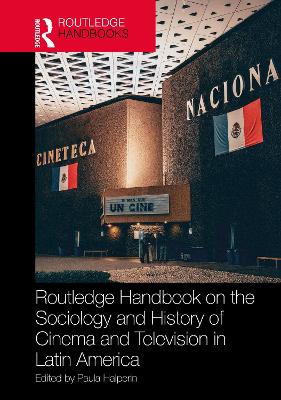
The Routledge Handbook on the Sociology and History of Cinema and Television in Latin America explores the historical and sociological dimensions of Latin American cinema and television from the 1960s and 1970s onward.
The Routledge Handbook on the Sociology and History of Cinema and Television in Latin America explores the historical and sociological dimensions of Latin American cinema and television from the 1960s and 1970s onward, decentering the New Latin American Cinema (NLAC) without diminishing its significance. The political and experimental energy that animated it has not vanished; instead, it reemerges across diverse objects, periods, and media forms, sometimes directly, sometimes obliquely. In this sense, the political is located not only in audiovisual texts but also in the interpretive frameworks scholars in the region bring to their analysis, revealing the enduring impact of that radical movement throughout the following decades.
By foregrounding scholarship produced in Latin America, the volume maps both convergences and divergences within the broad field of film and audiovisual studies. It brings together multiple scales of analysis (national, regional, transnational), alongside varied epistemological approaches (canonical inquiry, archival reconstruction, feminist praxis), as well as a wide range of archives spanning on film, television, digital, and private collections. In doing so, the volume situates Latin America audiovisual media within longer transnational traditions and intellectual histories.
Adopting a sociological and historical approach to media and film studies, this handbook offers a critical framework for understanding Latin America’s political, social, and cultural dynamics since the 1960s. It features key scholars based in the region in the social sciences, humanities, and the arts, presenting a field in motion that revisits its disciplinary foundations while engaging new archival practices and challenging enduring political and social exclusions.
Arvustused
This Handbook is extremely useful because often students and even researchers are not aware of the different scholarly approaches to the study of cinema and TV in the Humanities and Social Sciences, or how a Cultural and Film Studies approach differs from a Sociological one. Halperin bridges these approaches constructively. Undergraduate courses are increasingly interdisciplinary in nature, and this volumes study of history, cinema, and society will suit them well. This Handbook will undoubtedly become a valuable resource and contribution to the study of cinema and television.
Mercedes Vįzquez, Assistant Professor of Communication, University of Nottingham
This Handbook will be of high interest for researchers and students from different areas and interdisciplinary lines of work such as sociology, media, cinema, and cultural studies. It will also be of interest for researchers on feminist, indigenous, and Afro-American studies. The significance of this book is that it is grounded in a cross disciplinary approach and the vast scope of periods and countries covered. Until recently, approaches to Latin American cinema and media were categorized by periods, national cinemas, film directors or movie titles. Moreover, much of these books rely on film and media canons and are focused on a specific time period (e.g. the 1960s or the 1970s). In the case of this Handbook, the approach is not only interdisciplinary but simultaneously reaches a historical and contemporary scope. Also, the idea of cinema and television as a political practice gives this volume a subtle yet strong unity.
Marķa Fernanda Arias, Professor of Cultural Studies, Universidad de Antioquia
Editors Introduction; Part I. Constructing the Latin American
Audiovisual as an Object of Inquiry; Part I Introduction, Paula Halperin;
1.
Historical Research on Brazilian Cinema: A Case Study and Contemporary
Perspectives, Eduardo Victorio Morettin;
2. Georges Sadoul and the
Historiography of Argentine Cinema (1952-1974), Rafael Morato Zanatto;
3.
Television News Archives: Towards a Method for Historical Research, Fernando
Seliprandy;
4. �Ya fue! Overcoming Androcentric Approaches to Latin American
Cinema History, Isabel Seguķ and Lorena Best Urday; Part II. Transitions:
From the Long 1960s to Re-Democratization; Part II Introduction, Paula
Halperin;
5. Revolution and Unionism in Argentine Cinema. 1968-1976, Javier
Campo;
6. New History and New Cinema. Political Debate and Rewriting of the
Past in Mexican Cinema in the 1970s, Israel Rodriguez;
7. Thinking About the
Past, Planning the Future: Brazilian Cinema's Journey Toward a New Democracy,
Reinaldo Cardenuto;
8. Foreign Television and the Chilean Dictatorship:
Between Institutionality and Clandestinity, Carolina Amaral de Aguiar;
9.
Cuba in the 1980s: Through the Lens of Noticiero ICAIC Latinoamericano,
Mariana Villaēa;
10. The Experience of the Documentary Filmmaker Carlos
Echeverrķa in the Argentine Television Program Edición Plus, Paola Margulis;
11. Joaquim Pedro de Andrades Cinematic Writing of History, Luiz Ancona;
12.
Uruguayan Fiction Film on Local Television in the late 1980s. Prospects and
Challenges for National Audiovisual Production, Mariel Balįs; Part III.
Circulation; Part III Introduction, Paula Halperin;
13. The Cinematheque of
the Museum of Modern Art of Rio De Janeiro as a Cultural Insurgent. 1958
1988, Fabiįn Nśńez;
14. A Key Figure: Walter Achugar and the New Latin
American Cinema, Cecilia Lacruz and Mariano Mestman;
15. Prohibitions and
Omissions. The Elusive Presence of Latin American Cinema in the Chile of
Pinochet, Jorge Iturriaga;
16. Moments of Uncertainty: Cinemateca Uruguaya,
the Democratic Transition, and the Latin American Turn,
Mariana Amieva; Part IV. National/Regional/Transnational; Part IV
Introduction, Paula Halperin;
17. Landscapes of the Amazon and the Encounter
with the Foreigner in Cinematic Narratives from the 1960s to the 1990s,
Alexandre Busko Valim and Naiara Leonardo Araśjo;
18. Breaking the
Concentration in Buenos Aires: 21st-Century Audiovisual Practices in
Argentina's Provinces, Clara Kriger;
19. Notes on Contemporary Central
American Cinema (2000-2025), Maria Lourdes Cortés; Part V. Identities and
Differences: Absent Images; Part V Introduction, Paula Halperin;
20.
Recovering Filmmaker José Rodrigues Cajado Filhos Trajectory in Brazilian
Black Cinema, Noel dos Santos Carvalho;
21. Beyond the Map: Shadows of
Dictatorship in Paraguayan Cinema and the Healing Poetics of Guapo'y, Andréa
C. Scansani;
22. Jorge Sanjinés and the Ukamau Group Against Qara History,
Yanet Aguilera Viruéz Franklin de Matos;
23. Phantasmagoric Images of the
Colonial Past in the Film Aēścar by Renata Pinheiro and Sérgio Oliveira,
Alberto da Silva;
Part VI. Collective Memory and the Writing of Historical Narratives on TV and
Cinema; Part VI Introduction, Paula Halperin;
24. The Civil-Military
Question in Documentary Representations of the Memory of the Chilean
Dictatorship, Ignacio del Valle-Dįvila;
25. History And Cultural Memory Under
Debate: Television Representations of the Conquest of Mexico, Įlvaro Vįzquez
Mantecón;
26. National Identities in Historical Television Fiction: The Case
of Gritos de Muerte y Libertad (2010), Adrien Charlois Allende;
27. The
Audiovisual Expression of Brazils New Right: Tracing a Conservative Wave,
Marcos Napolitano;
28. Materialist Horror and Woman-Centered Narratives in
Latin American Cinema: Medusa (2023) and The Bone Woman (2022), Jack Draper;
29. Manufacturing Violence in Colombian Cinema: Critical Constructions of
Memory in Bad at Painting Figures, Juan Carlos Arias;
30. Narcos: Mexico.
Narrative and Cultural Memory,
Janny Amaya Trujillo and Adrien Charlois Allende;
31. Between Love and Exile:
Salvador Allende (Patricio Guzmįn, 2004), Marķa Aimaretti; Part VII. Cinema,
Expanded Television, and Digital Communities: Dialogues and Circulation; Part
VII Introduction, Paula Halperin;
32. Models and General Principles of
Alternative Television in Argentina and Chile, Natalia Vinelli;
33. Religion
Making Media Culture: The Confluence of television, the internet, and
religion in contemporary Brazil, Cacilda Rźgo;
34. The Practice of
Audiovisual Democracy in the Wambra Digital Community Media Outlet (Ecuador),
Miguel Alfonso Bouhaben;
35. The digitization of Television Images in the
Twenty-First Century: Principles of a Technological History of TV Globos
Telenovelas (Brazil), Marina Tedesco Cavalcanti;
36. Streaming the Nation:
Telenovelas and the Reimagining of Brazil on Digital Platforms, Rachel Fabian
and Paula Halperin
Paula Halperin is Associate Professor of Cinema and Television Studies and History, and Director of the School of Film and Media Studies at Purchase College, SUNY, as well as Visiting Professor at the Universidade Federal do Estado do Rio de Janeiro (UNIRIO). Her research examines the intersections of visual culture, nationalism, and the public sphere in Latin America, with a particular emphasis on Brazil and Argentina from the 1960s to the 1980s. She has published widely in peer-reviewed journals and edited volumes in Brazil, Argentina, the US, and France, contributing to scholarly debates on media history, television cultures, and the politics of representation. Interdisciplinary in scope, her work bridges film and media studies, cultural history, and Latin American studies.