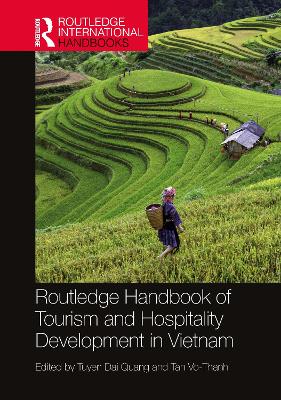
Written from a range of disciplinary perspectives including local Vietnamese scientists and practitioners, the book offers valuable insights into the challenges, opportunities, and local realities of the tourism and hospitality industries.
Through its six sections covering various topics such as destination development and marketing, sustainable practices, customer experience and satisfaction, community engagement and development, workforce development and education, and technology and innovation, the book provides a deep dive into the dynamics of Vietnam’s tourism and hospitality landscape. It explores emerging trends, transformative experiences, and policy recommendations for sustainable growth. This book bridges a significant gap in the literature on Vietnamese tourism and hospitality, offering insights relevant to anyone interested in the future of these industries in emerging destinations beyond this region.
This volume will be an invaluable resource for practitioners, policymakers, scholars, researchers and students of tourism and hospitality.
Written from a range of disciplinary perspectives including local Vietnamese scientists and practitioners, the book offers valuable insights into the challenges, opportunities, and local realities of these industries.
'Part I. Introduction to the Handbook.
1. Vietnam Tourism Post-COVID-19:
An Overview and Current Challenges. Part II. Destination Development and
Marketing.
2. Insight into Vietnamese Domestic Tourists: A Bibliometric
Study.
3. Vietnams Domestic Tourism Landscape: Navigating Challenges and
Leveraging Opportunities Post-COVID-19.
4. Residents' Perceptions of Cruise
Tourism Impacts on Quality of Life and Behavioral Intentions Toward Cruise
Tourism Support in Vietnam.
5. Touristification: An Absence of Concept in
Vietnamese Literature.
6. Direction for Developing Responsible Tourism
Program in Tha Thiźn Hu, Vietnam.
7. Harnessing Multidimensional Wellness
Tourism Potential: An In-depth Analysis of Tha Thiźn Hu Province.
8.
Exploring Bn Tre Culinary Heritage: Unveiling Food Values, Harnessing
Tourism Potential, and Enhancing Culinary Experiences.
9. Understanding
Tourism Culture Towards Tourism and Host-Guest Interaction in Ho Chi Minh
City, Vietnam.
10. Cruise Tourism Development in Thua Thien Hue Province,
Vietnam: Lessons from the Case Studies of The Franconia and Le Lapérouse.
11.
The Aesthetic Value of Kitsch through Tourist Practices in Vietnam. Part III.
Sustainable Tourism Practices.
12. Responsible Tourism Practices: A Study of
Small and Medium-Sized Tour Operators in Ho Chi Minh City.
13. The Influence
of Destination Social Responsibility on the Environmental Behaviors of
Tourists: A study in Dalat, Vietnam.
14. Sustainable Leadership Practices in
Community-Based Tourism in Vietnam.
15. Hospitality Food Waste Management:
Lessons from Luxury Hotels in Danang City, Vietnam.
16. Sustainable Tourism
Practices in the MICE Industry: Insights from Practitioners.
17. Enhancing
Community-Based Tourism through Asset-Based Community Development: Insights
from c Ph, Vietnam.
18. Impact of Residents Perceived Tourism
Responsibility on Quality of Life and Support for Responsible Tourism
Development in Hue City, Vietnam. Part IV. Customer Satisfaction and
Experience.
19. Satisfy the Vietnamese Gen Z with the Food and Beverage
E-Commerce Platforms.
20. Online Customer Review Helpfulness on Tourism
Super-apps in Vietnam: A Signaling Theory Perspective.
21. The Role of Online
Reviews on Consumers' Purchase Intentions: A Case Study of Vietnamese Airbnb
Users and Non-Users.
22. Understanding Gen Y's Intentions towards Wellness
Tourism in Vietnam: A Theory of Planned Behavior Approach.
23. Understanding
Heritage Religious Tourism in Vietnam.
24. The Role of Authenticity and
Memorable Tourism Experience: A Case Study of Cai Rang Floating Market in Can
Tho City, Vietnam.
25. Unveiling the Influence of Altruism on Price
Judgement.
26. How Does the Smart Tourism Service Ecosystem Foster Intention
to Revisit?
27. From Hanoi to Ho Chi Minh City: Tales of Backpacking
Adventures in Vietnam through TripAdvisor. Part V. Workforce Development and
Education.
28. Strategies for Developing a Professional Competency Workforce
in the Tourism Industry: Insights from State-Owned Property Sector.
29.
Boosting Hotel Employee Engagement: The Roles of Corporate Social
Responsibility, Workplace Ostracism, and Work Social Support.
30. Antecedents
and Consequences of Work-family and Family-work Conflicts in the Hospitality
Industry in Vietnam.
31. The Impacts of Tourism Activities on Career Choices
of Young Cotu People in Vietnam: An Intersectional Approach.
32. Using the
Extended TAM Model to Examine the Attitude and Behavioral Intention of
Tourism Students in the Context of e-Learning. Part VI. Conclusion and Future
Research.
33. Conclusion and Future Research.
Tuyen Dai Quang is a lecturer at the Faculty of Tourism, Nguyen Tat Thanh University, Vietnam. His primary research interests include heritage conservation and tourism development, sustainable tourism, and community-based tourism. He is a co-founder of the Vietnam Tourism Research Network, the largest and most dynamic network in the field of tourism in Vietnam.
Tan Vo-Thanh is Full Professor at Excelia Business School, France. His current research mainly focuses on digitalization process, smart technology adoption, sustainable tourism, customer experience, consumer behavior, customer engagement, employee engagement, and organizational behavior. Tan is an advisory board member of the Vietnam Tourism Research Network and serves on the editorial boards of and as a reviewer for several international journals.