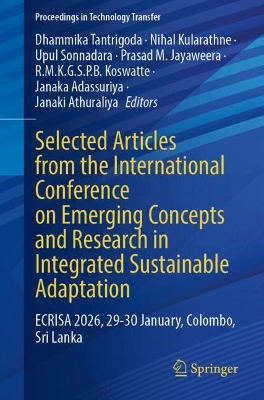
This book highlights selected peer-reviewed articles from the International Conference on Emerging Concepts and Research in Integrated Sustainable Adaptation, ERICSA 2026, held in Colombo, Sri Lanka, under the theme Technological Synergies for a sustainable Sri Lanka. This conference offers a vital platform to publish academic and innovative industrial solutions in wide array of subject domains, namely, electronics and communication engineering, information technology, space technology and its applications, robotics, and astronomy. Other than above multidisciplinary subject domains, the conference include a unique Industry Track, which consists of short articles showcasing innovative products and solutions. The primary beneficiaries include practicing engineers, scientists, graduate students, and other professionals engaged in research, development, and innovation.
Machine Learning Approaches for Exoplanet Detection and Classification A
Comparative Study of Traditional and Deep Learning Models with Explainable
AI.- An Investigation of 7 Non-Eclipsing SU UMa Systems Using TESS Data.-
Classical Cepheid Candidates in the Globular Cluster NGC 121 A Multi Mission
Study with HST and TESS.- Super Nyquist Analysis of Combined Quarters of
Kepler Light Curves KIC 8264492.- Non Linear Modeling of Chlorophyll a
Dynamics in the Indian Ocean Around Western Sri Lanka.
Emeritus Prof. Dhammika A. Tantrigoda has over 40 years of distinguished career as Academic and Researcher at the University of Sri Jayewardenepura, pioneering Solid Earth Geophysics in Sri Lanka. His research significantly contributed to the knowledge of the regions shallow subsurface structure. He served as Head of the Department, Dean of Graduate Studies, and University Council Member. A Fellow of the National Academy of Sciences since 1996, he also held FRAS status (19942004) and was President of Sri Lanka Association for the Advancement of Science in 2011. He served as Chairman of NASTEC and ACCIMT and is currently Chancellor of the Open University of Sri Lanka.
Prof. Upul Sonnadara completed his Ph.D. and postdoctoral research at the University of Pittsburgh, contributing to experiments in Relativistic Heavy Ion Physics at Brookhaven National Laboratory. Returning to Sri Lanka in 1995, he joined the University of Colombo, where he now holds Chair of Physics and serves as Dean of the Faculty of Science. His research spans computational and instrumentation physics. He has received multiple national and international awards, affiliated with CERNs CMS experiment, and is Active Member of several professional bodies.
Prof. Nihal Kularatna currently serves as Professor at the University of Waikato, New Zealand, where he also earned his Doctor of Science (D.Sc.) degree. With over 45 years in electronics research, he has published over 160 peer-reviewed papers and authored ten influential books in areas such as power electronics, surge protection, and energy storage.
Professor Prasad M. Jayaweera currently serves as Dean of the Faculty of Computing at the University of Sri Jayewardenepura. He earned his Ph.D. from Stockholm University and the Royal Institute of Technology, Sweden. He has held prestigious research fellowships at the University of Reading (UK), University of Namur (Belgium), and SYSLAB in Sweden. His research, widely published in national and international forums, focuses on process modeling, process patterns, and e-commerce systems.
Professor Kaveenga Rasika Koswattage earned his Ph.D. from Kobe University, Japan, and later served as Assistant Professor at Chiba University. He is currently a Professor and Dean of the Faculty of Technology at Sabaragamuwa University of Sri Lanka. His research focuses on surface and interface analysis of materials using synchrotron spectroscopies, as well as nanomaterials and nanodevices. He also serves as an Adjunct Professor at General Sir John Kotelawala Defence University.
Dr. Janaka Adassuriya earned his Ph.D. from the University of Colombo in 2021 and currently serves as Senior Lecturer at the same institution. Prior to this, he spent 18 years at the Arthur C. Clarke Institute for Modern Technologies, where he served as Research Scientist and later as Senior Research Scientist. His research focuses on asteroseismology, particularly the pulsation analysis of short-period variable stars. Dr. Adassuriya has published widely in both local and international forums and is Passionate Advocate for astronomy education among Sri Lankan students.
Ms. Janaki Athuraliya currently serves as Director (Electronics Engineering) at the Arthur C. Clarke Institute for Modern Technologies. She holds a B.Sc. Eng. (Hons) and an M.Sc. from the University of Moratuwa and is Chartered Engineer. She is Member of the Institution of Engineers, Sri Lanka. Eng. Athuraliya has played a key role in developing infrastructure for lightning protection system testing and is Highly Experienced Consultant in Lightning Protection System design. Her research interests include surge protection and embedded control systems.