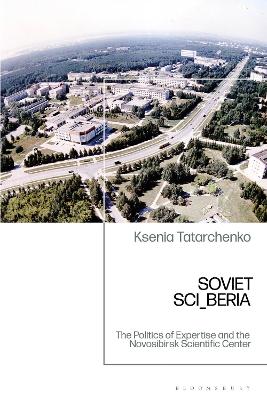
At first glance, the Novosibirsk Scientific Center, or Akademgorodok, appears as an outlier in academic excellence. This 'science city' is renowned for a preeminent university, dozens of research institutes, and a thriving technopark. At home, it is an emblem of Russian innovation; abroad, it is often portrayed as a potential threat, a breeding ground of cyber soldiers. Though Siberia has been the main source of post-1991 Russian carbon revenues, its soviet history and cold war legacy of internationalism demonstrates that territorial and scientific dimensions interlocked the moment the Siberian Branch of the Soviet Academy of Sciences was created in 1957. Drawing on a wide range of previously unexplored archives, Soviet SCI_BERIA focuses on how the post-Stalinist Siberia was redefined and represented through the ideal of rational development, the late socialist innovation practices, and the relationship between experts and the state. It offers a fresh insight into the transition from Soviet to post-Soviet Akademgorodok. In doing so, Tatarchenko not only fosters a conversation between history, area studies, and science studies but also sheds new light on Soviet modernity and the limits of its transformative projects.
Arvustused
Soviet SCI_BERIA is an essential contribution to our understanding of how knowledge and power were co-produced in the Cold War USSR This book will be invaluable to scholars and students of Soviet history, Siberian studies, and the history of science. * Russian Review * Tatarchenko has penned the story of Siberian science full of twists and turns previously unimagined. A stealth fighter of serious histories, this book recentered my vision for modern science on Siberia; I did not see it coming, and now I cannot imagine modernity without it. Essential reading * Benjamin Peters, Hazel Rogers Associate Professor of Media Studies, University of Tulsa, USA * This insightful book challenges the view of Siberian science as an island of intellectual autonomy and emphasizes its close ties with the Soviet projects of modernization, international cooperation, regional integration, and media showcasing * Slava Gerovitch, Lecturer in History of Mathematics, Massachusetts Institute of Technology, USA * Kseniya Tatarchenkos monograph represents a significant contribution to the study of the history of Soviet science and modernization the book offers a fresh perspective on the history of Akademgorodok and raises important questions about the role of science in shaping regional and national identity. It will be useful not only to specialists in the history of science but also to a broader audience interested in issues of modernization, regional development, and the interaction between science and politics. * Ab Imperio (ASEEES) *
Muu info
A comprehensive history of Akademgorodok, the Russian 'science city'.
Acknowledgments
Introduction
Chapter 1: Calculating a Showcase: Mikhail Lavrentiev, the Politics of
Expertise, and the Model Community in a Siberian Continuum
Chapter 2: The Siberian Carnivalesque: Tradition, Innovation, and Youth
Cultures at the Novosibirsk State University
Chapter 3: Passing the Torch: Virtues and Vices of Digital Entrepreneurship
Chapter 4: Beyond Scarcity: Gurii Marchuk, Numerical Methods, and Cold War
Scientific Diplomacy
Chapter 5: The Land of Tomorrow: Siberian Science and Its Publics
Chapter 6: How Genius Grows: Novosibirsk Specialized Physics and Mathematics
School (FMSh), Nonartificial Intelligence, and the Limits of Transformative
Projects
Epilogue: Inventing CY_BERIA, Living in CARB_BERIA
Notes
Note on the Select Bibliography, Translation, and Transliteration
Select Bibliography
Index
Ksenia Tatarchenko researches late Soviet history and the Cold War history of computing and AI. She has taught in the United States, Switzerland, and Singapore.

 Lisainfo e-raamatute kohta