Muutke küpsiste eelistusi

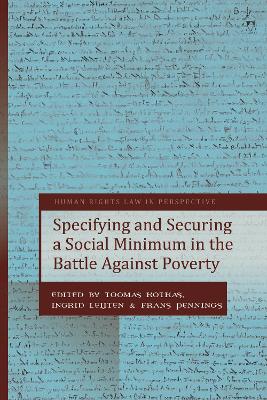
Specifying and Securing a Social Minimum in the Battle Against Poverty [Kõva köide]

Edited by , Edited by , Edited by
  • Formaat: Hardback, 352 pages, kõrgus x laius: 234x156 mm, kaal: 680 g
  • Sari: Human Rights Law in Perspective
  • Ilmumisaeg: 26-Dec-2019
  • Kirjastus: Hart Publishing
  • ISBN-10: 150992602X
  • ISBN-13: 9781509926022
Teised raamatud teemal:
  • Kõva köide
  • Hind: 103,50 €*
  • * hind on lõplik, st. muud allahindlused enam ei rakendu
  • Tavahind: 138,00 €
  • Säästad 25%
  • Raamatu kohalejõudmiseks kirjastusest kulub orienteeruvalt 3-4 nädalat
  • Kogus:
  • Lisa ostukorvi
  • Tasuta tarne
  • Tellimisaeg 2-4 nädalat
  • Lisa soovinimekirja
  • Formaat: Hardback, 352 pages, kõrgus x laius: 234x156 mm, kaal: 680 g
  • Sari: Human Rights Law in Perspective
  • Ilmumisaeg: 26-Dec-2019
  • Kirjastus: Hart Publishing
  • ISBN-10: 150992602X
  • ISBN-13: 9781509926022
Teised raamatud teemal:
This book addresses a topic that is currently high on the agenda in many fora: how to specify and secure a social minimum. The term social minimum has different meanings, depending on the context. These contexts are examined in this book from different perspectives, including law, sociology, philosophy, politics and economics.

In the first part, the social minimum is discussed from a conceptual and theoretical point of view.

The second part shows the various ways in which the social minimum can be specified and measured. There is a need for new indicators that take into account, for instance, aspects of adequate social participation. As this part shows, the choice of indicators is closely intertwined with political choices.

The third part approaches the social minimum from the perspective of legal obligations, addressing the nature of different obligations imposed on individuals and states.

The fourth part deals with the question of social minimum in the context of courts, adjudication and justiciability. The role of international treaties and national constitutions the interpretation of the rights they enshrine and the way these are dealt with by expert committees and courts is discussed with a view to understanding how the guarantee of a social minimum can be promoted within individual countries.

Besides being of interest for academics in fields ranging from legal theory and human rights to the social sciences, the book also serves as an important source for students as well as practitioners interested in the social minimum, and anyone who wants to gain an insight into the current debates on this extremely important issue.

Arvustused

The range of perspectives in the book is what readers will find appealing; persons who are interested in the social minimum will have an interesting read a number of intriguing ideas are proposed and discussed, which will hopefully spark inspiration for further research. -- Eddie Bambrough, University of Groningen * European Journal of Social Security *

Muu info

This book addresses a topic that is currently high on the agenda in many fora: how to specify and secure a social minimum?
List of Authors
vii
List of Abbreviations
xi
1 Introduction
1(14)
Ingrid Leijten
Toomas Kotkas
Frans Pennings
PART 1 CONCEPTUAL QUESTIONS
2 What is the Relationship between the Minimum Thresholds and Distributive justice*
15(16)
David Bilchitz
3 An Essential Dimension of the Social Minimum
31(16)
Malcolm Torry
4 A Social Minimum for Whom* Making a Case for a Normative Pattern of Pragmatic Decency
47(24)
Sara Stendahl
Otto Swedrup
PART 2 SPECIFYING A SOCIAL MINIMUM
5 The Social Minimum in the Context of Inequality
71(22)
Michael Adler
6 Is there Common Ground for Defining a Decent Social Minimum in Europe?
93(18)
Tim Goedeme
Tess Penne
Otto Swedrup
Karel Van den Bosch
Berenice Storms
7 Poverty Measurement and Poverty Alleviation between Norm-setting and Empirical Inquiries
111(28)
Eberhard Eichenhofer
PART 3 SECURING A SOCIAL MINIMUM: OBLIGATIONS FOR STATES AND INDIVIDUALS
8 Territorial and Extraterritorial Obligations to Ensure a Decent Social Minimum
139(10)
Elena Pribytkova
9 Eliding Poverty: Human Rights and Responsibilities
149(16)
David Piachaud
10 The Legal Status of Recipients of Public Assistance
165(18)
Frans Pennings
PART 4 SECURING A SOCIAL MINIMUM: THE ROLE OF COURTS AND SUPERVISORY BODIES
11 Giving Legal Substance to the Social Minimum
183(18)
Colm O'Cinneide
12 Legal Strategies and the Question of the Social Minimum: A Systems-Theoretical Approach
201(12)
Toomas Kotkas
13 Social Minima at the UN Treaty Bodies: Minimal Consistency?
213(16)
Ben T.C. Warwick
14 Potential and Pitfalls of Indivisible judicial Protection of a Social Minimum: From Inflation to Procedural Protection?
229(16)
Ingrid Leijten
15 Vulnerability as a Path to a `Social Minimum'? An Analysis of ECtHR jurisprudence
245(16)
Dimitrios Kagiaros
16 Constitutionalising a Social Minimum as a Minimum Core
261(20)
Katie Boyle
Bibiography 281(18)
Index 299
Toomas Kotkas is Professor of Jurisprudence and Social Law at the University of Eastern Finland. Ingrid Leijten is Assistant Professor at the Department of Constitutional and Administrative Law at Leiden University. Frans Pennings is Professor of Labour and Social Security Law at Utrecht University.