In the traditional Jewish liturgy, a man thanks God daily for not having been made a gentile, a woman, or a slave. Yoel Kahn traces the history of this prayer from its extra-Jewish origins to the present, demonstrating how different generations and communities understood the significance of these words.
Marginalized and persecuted groups used this prayer to mark the boundary between "us" and "them," affirming their own identity and sense of purpose. After the medieval Church seized and burned books it considered offensive, new, coded formulations of the three blessings emerged as forms of spiritual resistance. Book owners voluntarily expurgated the passage to save the books from being destroyed, creating new language and meaning while seeking to preserve the structure and message of the received tradition. During the Renaissance, Jewish women defied their rabbis and declared their gratitude at being "made a woman and not a man." And, as Jewish emancipation began in the nineteenth century, Jews again had to balance fealty to historical practice with their place in the world. Seeking to be recognized as modern and European, early modern Jews rewrote the liturgy to suit modern sensibilities and identified themselves with the Christian West against the historical pagan and the uncivilized infidel.
The Three Blessings is an insightful and wide-ranging study of one of the most controversial Jewish prayers, showing its constantly evolving language, usage, and interpretation over the past 2,000 years.
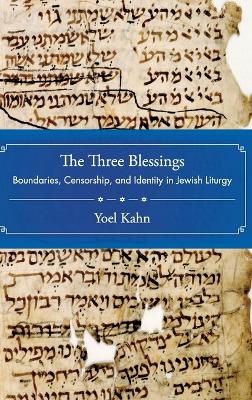
According to historical teaching, a Jewish man should give thanks each day for ''not having been made a gentile, a woman, nor a slave.'' Yoel Kahn's innovative study of a controversial Jewish liturgical passage traces the history of this prayer from its extra-Jewish origins across two thousand years of history, demonstrating how different generations and communities understood the significance of these words in light of their own circumstances. Marking the boundary between ''us'' and ''them,'' marginalized and persecuted groups affirmed their own identity and sense of purpose. After the medieval Church seized and burned books it considered offensive, new, coded formulations emerged as forms of spiritual resistance. Owners voluntarily carefully expurgated their books to save them from being destroyed, creating new language and meanings while seeking to preserve the structure and message of the received tradition. Renaissance Jewish women ignored rabbis' objections and assertively declared their gratitude at being ''made a woman and not a man.'' Illustrations from medieval and renaissance Hebrew manuscripts demonstrate creative literary responses to censorship and show that official texts and interpretations do not fully represent the historical record.
As Jewish emancipation began in the 19th century, modernizing Jews again had to balance fealty to historical practice with their own and others' understanding of their place in the world. Seeking to be recognized as modern and European, early modern Jews rewrote the liturgy to fit modern sensibilities and identified themselves with the Christian West against the historical pagan and the uncivilized infidel. In recent decades, a reassertion of ethnic and cultural identity has again raised questions of how the Jewish religious community should define itself.
Through the lens of a liturgical text in continuous use for over two thousand years, Kahn offers new insights into an evolving religious identity and recurring questions of how to honor both historical teaching and contemporary sensibility.

 Rohkem infot Oxford Scholarship Online e-raamatute kohta