Muutke küpsiste eelistusi

E-raamat: Music, Piety, and Propaganda: The Soundscape of Counter-reformation Bavaria [Oxford Scholarship Online e-raamatud]

(Associate Professor of Music, University of British Columbia, Vancouver, Canada)
  • Oxford Scholarship Online e-raamatud
  • Raamatu hind pole hetkel teada
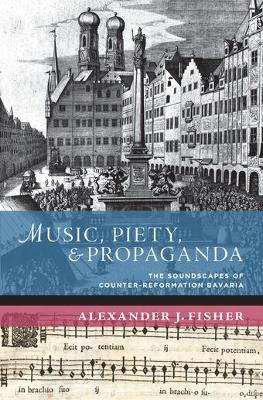
Music, Piety, and Propaganda: The Soundscapes of Counter-Reformation Bavaria explores the nature of sound as a powerful yet ambivalent force in the religious struggles that permeated Germany during the Counter-Reformation. Author Alexander J. Fisher goes beyond a musicological treatment of composers, styles, and genres to examine how music, and more broadly sound itself, shaped the aural landscape of Bavaria as the duchy emerged as a militant Catholic bulwark. Fisher focuses particularly on the ways in which sound--including bell-ringing, gunfire, and popular song, as well as cultivated polyphony--not only was deployed by Catholic secular and clerical elites to shape the religious identities of Bavarian subjects, but also carried the potential to challenge and undermine confessional boundaries.

Surviving literature, archival documents, and music illustrate the ways in which Bavarian authorities and their allies in the Catholic clergy and orders deployed sound to underline crucial theological differences with their Protestant antagonists, notably the cults of the Virgin Mary, the Eucharist, and the saints. Official and popular rituals like divine worship, processions, and pilgrimages all featured distinctive sounds and music that shaped and reflected an emerging Catholic identity. Although officials imposed a severe regime of religious surveillance, the Catholic state's dominance of the soundscape was hardly assured. Fisher traces archival sources that show the resilience of Protestant vernacular song in Bavaria, the dissemination and performance of forbidden, anti-Catholic songs, the presence of Lutheran chorales in nominally Catholic church services into the late 16th century, and the persistence of popular "noise" more generally. Music, Piety, and Propaganda thus reveals historical, theological, and cultural issues of the period through the piercing dimension of its sounds, bringing into focus the import of sound as a strategic cultural tool with significant impact on the flow of history.
Acknowledgments xi
Abbreviations for Source Locations xv
About the Companion Website xvii
Chapter One Sound, Space, and Confession in Counter-Reformation Bavaria
1(29)
Historical Soundscapes
4(5)
Sound, Space, and Place
9(4)
Identity, Discipline, and Confessionalization
13(4)
The Soundscapes of Counter-Reformation Bavaria
17(10)
The Structure and Scope of the Book
27(3)
Chapter Two Sound and the Spaces of Worship
30(75)
Public Churches and the Experience of Liturgical Space
32(9)
Congregational Song
32(9)
The Jesuits and Counter-Reformation Worship in Munich and Beyond
41(13)
Cathedral, Collegiate, and Parish Churches in the Age of Tridentine Reform
54(23)
The Cathedral of Freising
55(1)
Unsere Liebe Frau in Munich
56(8)
St. Peter in Munich
64(2)
Liturgy in the Religious Orders
66(11)
Courtly Spaces for Liturgy: The Bavarian Court Chapel
77(28)
The Court Chapel of St. George and Liturgical Music in the Sixteenth Century
77(8)
The New Court Chapel of Mary of the Immaculate Conception and Liturgical Music under Maximilian I
85(20)
Chapter Three Sound and the Spaces of Devotion
105(85)
Devotional Polyphony for Cultivated Spaces
106(24)
Monastic Devotion
130(10)
Confraternities and Congregations
140(28)
The Marian Congregations
141(6)
Marian, Eucharistic, and Other Confraternities
147(9)
Corporate Devotional Services and Gatherings
156(1)
Funerals and Burials
156(3)
Salve Services
159(2)
Seasonal Devotions for Christmas and Lent
161(7)
Supplications and Celebrations
168(2)
Song and the Soundscape
170(20)
Protestant Song, Censorship, and Suppression
172(6)
Catholic Song in Bavaria
178(12)
Chapter Four Sound and Confession in the Civic Sphere
190(55)
Bells and the Urban Soundscape
192(13)
Regulating the Sounds of Profane Life
205(8)
Song in the Public Sphere
213(10)
Sound in Public Religious Spectacles
223(22)
Chapter Five Music, Sound, and Processional Culture
245(31)
Corpus Christi Processions
249(17)
The Corpus Christi Procession in Munich
253(13)
Good Friday Processions
266(3)
Processions of Supplication and Triumph
269(7)
Chapter Six Sound, Pilgrimage, and the Spiritual Geography of Counter-Reformation Bavaria
276(55)
Pilgrimage in the Reformation and Counter-Reformation Bavaria
278(5)
Songs and Litanies in Pilgrimage
283(29)
Bavarian Pilgrimage Songs
284(20)
The Litany in Bavarian Pilgrimage
304(8)
Sound in the Practice of Pilgrimage
312(1)
Departure
312(1)
En Route and upon Arrival
313(13)
A Pilgrimage to St. Benno in Munich
326(5)
Bibliography 331(22)
Index 353
Alexander J. Fisher is Assistant Professor of Music at the University of British Columbia in Vancouver, Canada. A musicologist specializing in music, sound, and religious culture in early modern Europe, he teaches courses in early music and coordinates the university's Early Music Ensemble.