"This book explores issues surrounding measles and vaccination in Pakistan. Drawing on long-term ethnographic research, it focuses on two major outbreaks in Sindh Province and on Pakistan's vaccination campaigns. The chapters examine the responses to outbreaks and vaccination from various stakeholders including local people, the Pakistani government and the WHO. Inayat Ali reflects on the competing agendas, differing conceptualizations of measles and vaccination, and the factors that lie behind these contestations. Situating outbreaks within the institutionalized form of disparities, he analyzes the rituals used to deal with measles and local resistance to vaccines in Pakistan. The distinct imaginaries and practices related to measles and vaccination areconsidered in national and global context, and the book makes a valuable contribution to the development of an anthropology of vaccination and medical anthropology of Pakistan"--
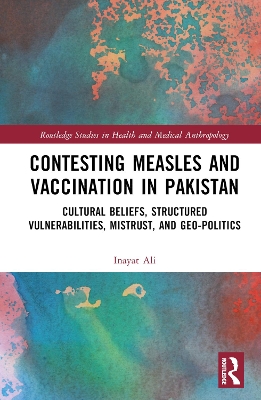
This book explores issues surrounding measles and vaccination in Pakistan. Drawing on long-term ethnographic research, it focuses on two major outbreaks in Sindh Province and on Pakistan’s vaccination campaigns. The chapters examine the responses to outbreaks and vaccination from various stakeholders including local people, the Pakistani government and the WHO. Inayat Ali reflects on the competing agendas, differing conceptualizations of measles and vaccination, and the factors that lie behind these contestations. Situating outbreaks within the institutionalized form of disparities, he analyzes the rituals used to deal with measles and local resistance to vaccines in Pakistan. The distinct imaginaries and practices related to measles and vaccination are considered in national and global context, and the book makes a valuable contribution to the development of an anthropology of vaccination and medical anthropology of Pakistan.
This book explores issues surrounding measles and vaccination in Pakistan. Drawing on long-term ethnographic research, it focuses on two major outbreaks in Sindh Province and on Pakistan’s vaccination campaigns.
Preface by Merrill Singer
Prologue
Introduction
1 Many Anthropologies: Reflections on Theoretical Threads and the Medical
Anthropology of Pakistan
2 Researchlogue: Design, Methodology, and Circumstances of Data collection
3 The Setting: From Sindh Province to the Sindhi Villages
4 Competing Healthcare Systems: Revisiting Medical Pluralism in Pakistan
5 Health and Illness: Socio-cultural Understanding
6 Local Rituals of Containment: Emic Perceptions and Practices around
Measles
7 Social Dramas: Two Measles Outbreaks and Multiple Narratives in Pakistan
8 The Critical Geopolitical Events: Making Sense of Anti-Vaccination
Sentiment
9 National and Global Rituals of Containment: Controversies, Contestations,
and Mistrust Surrounding Vaccination in Pakistan
10 Measles Vaccine: From General to Particular
11 Creating an Anthropology of Vaccination: The International "Anti-Vaxx"
Movement and Multiple Narratives
Conclusions: Interrelations between Measles Sacredness and Systematic
Disparities
Epilogue
Bibliography
Inayat Ali is in charge of the Department of Public Health and Allied Sciences and Assistant Professor in the Department of Anthropology at Fatima Jinnah Women University, Rawalpindi, Pakistan. He is also a Research Fellow in the Department of Social and Cultural Anthropology at the University of Vienna, Austria.

 Rohkem infot Taylor & Francis e-raamatute kohta