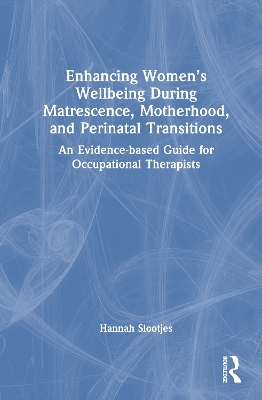
Guided by research and occupational therapy practices, this evidence-based text maps how occupational therapists and the allied health collective can holistically promote women’s health, wellbeing, and self-efficacy during matrescence – the bio-psycho-social-political-spiritual-developmental journey and rite of passage of mother-becoming.
Guided by research and occupational therapy practices, this evidence-based text maps how occupational therapists and the allied health collective can holistically promote women’s health, wellbeing, and self-efficacy during matrescence – the bio-psycho-social-political-spiritual-developmental journey and rite of passage of mother-becoming.
From person-centred, gender-sensitive, and feminist perspectives, this book introduces a compassionate and non-medicalised framework guiding how health and wellbeing professionals can engage responsively with women during motherhood journeys. Building on doctoral research exploring the role of occupational therapists in perinatal health, this guide includes occupation- and co-occupation-based theories, models, and frameworks for supporting women’s transitions and transformations as individuals, and mother-infant dyads. Bolstered by learning objectives, case studies, summaries and reflective questions, the chapters feature a collection of innovative occupational therapy approaches to support women struggling with overwhelm, burnout, and other common, normalised issues across the lifespan – from womanhood to grandmotherhood, and menstruation to menopause. Further, the book sheds light on the ‘dark side’ of motherhood occupations, outlining holistic strategies to promote functional capacities, empowering and enabling women work to through the impacts of role overloading, disrupted identity, shame, dysfunction, and perinatal trauma.
A much-needed addition to the perinatal care field, this essential guide is tailored for occupational therapy, mental health and other healthcare practitioners and postgraduate students working in perinatal health and matrescence.
SECTION 1: Theoretical foundations for understanding the occupational
nature of womens health and matrescence
1. Redefining women's health in the 21st century: Embracing holistic
perspectives and acknowledging gendered realities
2. Occupational therapy in womens health: Gender-responsive practice
approaches for girls and women throughout the lifespan
3. Exploring feminist perspectives in womens health, motherhood, and
occupational therapy
4. Allied health and holistic care approaches to womens health and
wellbeing: A collaborative team perspective
5. Enhancing womens health through occupational therapy leadership
6. Breaking the silence on womens invisible wellbeing challenges:
Contemporary practice and research priorities
SECTION 2: The occupational nature of matrescence
7. The occupational nature of matrescence
8. Matrescence as a spiritual occupation and transformative life event: Rites
of passage, rituals, and transitions
9. Exploring the intersection of feminism, matrescence, and occupational
therapy practice
10. The perinatal transitions of matrescence: An occupational therapy
perspective
11. The occupational nature of womens mental health and illness during
perinatal transitions and matrescence
12. Power, agency, and fundamental human needs: Health, wellbeing, and
quality of life during motherhood
SECTION 3: Occupational therapy skills and practice for perinatal health,
motherhood, and matrescence
13. Foundations to facilitate knowledge translation for evidence-based best
practice
14. Navigating normal motherhood struggles: Movement, compassion, and
occupational balance
15. Illuminating the dark side of matrescence: A practical guide for
responsive occupational therapy practice
16. Addressing the occupational nature of menstruation: A human occupation
approach
17. Strengthening womens psychosocial health, wellbeing, and quality of life
during perinatal transitions and motherhood
18. Co-occupation-based interventions during perinatal transitions and
motherhood
19. Occupation-based approaches to pelvic health and wellbeing
20. Empowering mothers during recovery: Occupational-based strategies for
women working through perinatal mental disorders
21. A neurodiversity-affirming approach to matrescence: Empowerment through
person-centred and strengths-based occupational therapy practices
22. Empowered girls and women with low vision and blindness across the
lifespan: Navigating gendered occupations during perinatal transitions of
matrescence
23. Empowering connections: Storytelling, lifespan approaches, and
therapeutic mothers groups for enhanced wellbeing
24. Navigating menopause transitions: Holistic occupational therapy
approaches for enhancing womens wellbeing
Dr Hannah Slootjes is an Australian occupational therapist and academic (pracademic), and Lecturer in Occupational Therapy at La Trobe University, with additional qualifications in literature, behavioural studies, and fine art. Dr Slootjes completed a PhD in 2022 exploring the occupational therapists role in perinatal health, and has a special interest in womens and girls' health, perinatal transitions, matricentric feminism, motherhood, and matrescence.

 Rohkem infot Taylor & Francis e-raamatute kohta