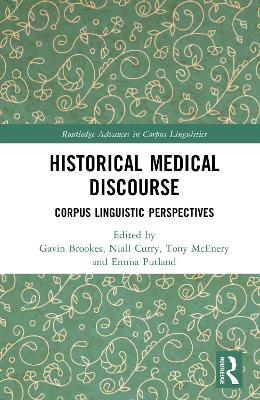
This collection showcases original research highlighting innovations in the application of corpus linguistic methods to the study of English historical medical discourse.
The volume builds on recent work expanding the contours of health communication research to extend to medical texts of the past, whose preservation allows for a clearer understanding of changes to medical knowledge and practices over time through their production, reception, and use. Chapters explore how corpus linguistic methods allow for a critical examination of how this past medical knowledge is mediated through language across a diverse range of health issues, time periods, textual genres, and sociocultural contexts. While focusing on the English language, the collection demonstrates a point of entry for future work applying corpus linguistic methodologies to historical medical texts more broadly across other languages, periods, and texts to continue growing this burgeoning area of research.
This book will be of interest to scholars in corpus linguistics, discourse analysis, medical humanities, and historical linguistics.
This collection showcases original research highlighting innovations in the application of corpus linguistic methods to the study of English historical medical discourse.This book will be of interest to scholars in corpus linguistics, discourse analysis, medical humanities, and historical linguistics.
1. Corpora and the Study of Historical Medical Discourse Gavin
Brookes, Niall Curry, Tony McEnery and Emma Putland;
2. From I Tried a
Purge to Experimental Intervention: A Corpus-Based Discourse Study of
Depersonalization as a Conceptual Strategy in Medical Writing from 1700 to
the Present Georg Marko;
3. Patterns of Change in Late Modern English
Microbiology Texts Katrin Menzel;
4. The Adaptation of Medical Knowledge in
Late-seventeenth- and Early-eighteenth-century Manuscript Household Books
Giulia Rovelli;
5. Gender-Based Evidence of Modalisation and Modulation
Strategies in Nineteenth-century Institution English Recipes Francisco J.
Alonso-Almeida;
6. The Role of Personal Pronouns to Express Interpersonality
in Womens Recipe Collections Isabel de la Cruz-Cabanillas;
7. When People
Overload The/Their Stomach(s): Non-verbal Plural Number Agreement and Generic
Reference in Early and Late Modern Medical Discourse Karolina Rudnicka and
Richard J. Whitt;
8. Sensory Language as a Gateway to Knowledge and Evidence
in Early Modern English Midwifery Writing (15401800): On Verbs of Tactile
Perception Richard J. Whitt;
9. Midwifery and Medical Writing in
18th-century British Reference Works: A Historical and Diachronic
Corpus-Based Study Elisabetta Lonati;
10. Advertising a Proprietary
Medicine: Daffys Elixir Salutis in Eighteenth-Century Newspaper
Advertisements Carla Suhr;
11. Anti-Vaccination Discourse in Victorian
England: Key Semantic Domains and Parallels with Present-Day Anti-Vaccination
Arguments Elena Semino, Derek Gatherer, Tara Coltman-Patel, William Dance,
Alice Deignan and Claire Hardaker.
Gavin Brookes is Reader in Linguistics and UKRI Future Leader Fellow in the Department of Linguistics and English Language at Lancaster University, UK.
Niall Curry is Senior Lecturer in the School of English at Manchester Metropolitan University, UK.
Tony McEnery is Distinguished Professor of Linguistics and English Language in the Department of English Language and Linguistics at Lancaster University, UK, and Changjiang Chair at Xi'an Jiaotong University, China.
Emma Putland is Senior Research Associate for the project Public Discourses of Dementia: Challenging stigma and promoting personhood, based in the Department of Linguistics and English Language at Lancaster University, UK.

 Rohkem infot Taylor & Francis e-raamatute kohta