Muutke küpsiste eelistusi

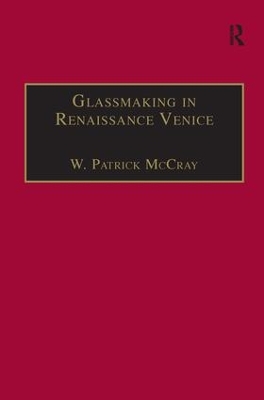
E-raamat: Glassmaking in Renaissance Venice: The Fragile Craft [Taylor & Francis e-raamat]

  • Formaat: 272 pages
  • Ilmumisaeg: 01-Nov-1999
  • Kirjastus: Routledge
  • ISBN-13: 9781315254296
  • Taylor & Francis e-raamat
  • Hind: 189,26 €*
  • * hind, mis tagab piiramatu üheaegsete kasutajate arvuga ligipääsu piiramatuks ajaks
  • Tavahind: 270,37 €
  • Säästad 30%
  • Formaat: 272 pages
  • Ilmumisaeg: 01-Nov-1999
  • Kirjastus: Routledge
  • ISBN-13: 9781315254296
The transformation of the Venetian glass industry during the Renaissance was not only a technical phenomenon, but also a social one. In this volume, Patrick McCray examines the demand, production and distribution of glass and glassmaking technology during this period and evaluates several key topics, including the nature of Renaissance demand for certain luxury goods, the interaction between industry and government in the Renaissance, and technological change as a social process. McCray places in its broader economic and cultural context a craft and industry that has been traditionally viewed primarily through the surviving artefacts held in museum collections. McCray explores the social and economic context of glassmaking in Venice, from the guild and state level down to the workings of the individual glass house. He tracks the dissemination of Venetian-style glassmaking throughout Europe during the sixteenth and seventeenth centuries and its effects on Venices glass industry. Integrating evidence from a wide variety of sources - written documents such as shop records and recipe books, pictorial representations of glass and glassmaking, and the careful physical and chemical analysis of glass pieces that have survived to the present - he examines the relation between consumer demand and technological change. In the process, he traces the organizational changes that signified a transition from an older and more traditional manner of artisan manufacture to a modern, factory-style manner of production.
Illustrations
vii
Tables
viii
Preface ix
Maps
x
Introduction
1(14)
Glass, Ceramics, and Society
1(2)
The Nature and Limitations of Available Sources of Information
3(5)
Technological Change and the Role of Consumer Demand
8(5)
The Plan of this Book
13(2)
``Masters of the Gold of Christendom'': Renaissance Venice, the World Economy, and Luxury Goods
15(18)
Introduction
15(1)
Venice in the Renaissance World Economy
16(6)
Artisans, Guilds, and the Venetian State
22(3)
The Economic Geography of Venice and Murano
25(1)
Capitalism, Consumerism, and Conspicuous Consumption
26(3)
Luxury Goods in the Renaissance Culture and Economy
29(3)
A Note on the Venetian Monetary System
32(1)
Master Aldrevandin's World: Glassmaking in Pre-Renaissance Venice
33(33)
Introduction
33(1)
Glassmaking in the Past
34(4)
Early Glassmaking Traditions in the Veneto
38(3)
Glassmaking in Medieval Venice
41(8)
The Glassmakers of Medieval Venice and their Products
49(4)
The Technology of Glass Production in Pre-Renaissance Venice
53(4)
Questions of Origins and Influence
57(4)
The Renaissance Venetian Glass Industry--a Self-Catalysed Phenomenon
61(5)
Demystifying the Demand for Renaissance Glass
66(30)
Introduction
66(1)
Why Glass?
67(7)
The Functions of Renaissance Glass
74(12)
Desire Defined: Two Favoured Qualities of Renaissance Venetian Glass
86(8)
Conclusion
94(2)
Desire Fulfilled: The Technology of Glassmaking in Renaissance Venice
96(45)
The Introduction and Innovation of New Luxury Glasses
97(3)
Luxury Glassmaking Technology in Renaissance Venice
100(14)
The Final Product
114(12)
The Social Organization of Venetian Glassmaking
126(6)
Venetian Glassmaking and the Renaissance Economy
132(4)
Venetian Glassmaking in Context: Some Concluding Remarks
136(5)
Consumers and Competitors: The Distribution of Glass and Glassmaking Knowledge
141(23)
Introduction
141(1)
The Distribution of Glass
142(7)
Technology Transfer and Renaissance Glassmaking
149(15)
Epilogue: The Innovations of Renaissance Venetian Glass 164(8)
Notes 172(37)
Bibliography 209(20)
Index 229


W. Patrick McCray, University of California - Santa Barbara, USA