Update cookies preferences

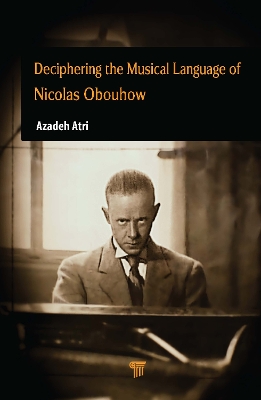
Deciphering the Musical Language of Nicolas Obouhow [Hardback]

  • Format: Hardback, 714 pages, height x width: 229x152 mm, 4 Tables, black and white; 147 Illustrations, color; 91 Illustrations, black and white
  • Pub. Date: 16-Jun-2026
  • Publisher: Jenny Stanford Publishing
  • ISBN-10: 9815352059
  • ISBN-13: 9789815352054
Other books in subject:
  • Hardback
  • Price: 80,20 €*
  • * the price is final i.e. no additional discount will apply
  • Regular price: 106,94 €
  • Save 25%
  • This book is not yet published. Book will arrive in about 3-4 weeks after it is published. Please allow another 2 weeks for shipping outside Estonia.
  • Quantity:
  • Add to basket
  • Delivery time 2-4 weeks
  • Add to Wishlist
  • Format: Hardback, 714 pages, height x width: 229x152 mm, 4 Tables, black and white; 147 Illustrations, color; 91 Illustrations, black and white
  • Pub. Date: 16-Jun-2026
  • Publisher: Jenny Stanford Publishing
  • ISBN-10: 9815352059
  • ISBN-13: 9789815352054
Other books in subject:
Nicolas Borisovich Obouhow (18921954) plays a significant role as an avant-garde composer who experimented, very early, with a 12-tone system and electronic sounds. This monograph reveals that Obouhow composed under the guise of a highly organised system which was formed and influenced by a mystical search that places him in a broader international cultural context associated with the occult and a belief in the transcendental power of sound. Through detailed and intelligible analysis of his compositions, the author also deciphers how Obouhows 12-tone harmonies and synthetic scale systems operate.

The story of Obouhow and his life-long quest, through his craft, for peace and unity, in a world destabilised by the upheavals of the 20th century, amidst war, revolution and expatriation, is not just the curious tale of a maverick ้migr้ of bygone, tumultuous days. He embarked on his search more than a century ago, and his journey is still relevant today in a world that continues to experience upheavals and wars. This research examines the way Obouhows views were expressed in musical terms and how Obouhow contributed to the early decades of modernism with his highly creative methods and original musical language.

Reviews

From the time of his arrival in France (in 1919), Obouhows unprecedented, exceptional uniqueness attracted attention. Nicolas Obouhow aimed to create a comprehensive spectacle with costumes and projected colours in a space which he himself conceived and built. Having created, at the beginning of the 20th century, a unique system of writing, he turns towards ultra-chromatic densities, both harmonic and melodic, and allows himself truly original gestures and textures. This very short introduction is certainly disproportionate to the many questions which may arise from Obouhows work... Azadeh Atris research contributes most positively to our knowledge of this Illumin้.

Jean-Michel Bardez

French musicologist, composer, pianist, visual artist, and director of collections

Material on Obouhow is rather scarceand even more so in English. Most of what is out there is biographical and anecdotal. This book is thus doubly valuable. It contains, for the first time, detailed analyses of compositional procedures. The analytical procedures are accompanied by many music examples, all illuminating the text. This work demonstrates the early days of writing for electronic instruments as well as an early approach to the construction and notation for such instruments. The translation of The Book of Life into English is another big bonus in this research. It is high time that a figure such as Obouhow is put under the microscope, as he is a fascinating and enigmatic composer.

Prof. Emer. Larry Sitsky (AO)

The Australian National University

Prologue Introduction
1. The Russian and the Paris Periods
2. Structural
Characteristics
3. In Search of a New Harmonic Language
4. Scales and
Intervallic Series that Defy Tonal Gravity
5. Glissandi and Ostinati: Two
Extensively Used Techniques
6. Variants as Evolutionary Steps towards
Orchestration Epilogue Appendices
Azadeh Atri is a pianist, composer, scholar, and essayist. She gained first-class honours for writing piano compositions of pedagogical intent, becoming the first composer to incorporate aspects of traditional Persian sources into pedagogical pieces. These works are available on the website of the National Library of Australia. She completed her doctoral degree at the Australian National University and her primary research area is the compositional methods of early 20th-century composers, particularly those of Nicolas Obouhow. Dr Atris research interests also include arts education and the professional development of arts teachers about which she has contributed an article. She is the author of philosophical essays and short stories, titled Deliriums.