Muutke küpsiste eelistusi

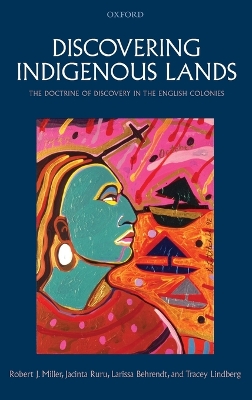
E-raamat: Discovering Indigenous Lands: The Doctrine of Discovery in the English Colonies [Oxford Scholarship Online e-raamatud]

(Senior Lecturer, University of Otago), (Professor of Law and Director of Research, Jumbunna Indigenous House of Learning, University of Technology, Sydney), (Associate Pr), (Professor of Law, Lewis & Clark Law School, Portland, Oregon)
  • Formaat: 320 pages
  • Ilmumisaeg: 05-Jan-2011
  • Kirjastus: Oxford University Press
  • ISBN-13: 9780199579815
  • Oxford Scholarship Online e-raamatud
  • Raamatu hind pole hetkel teada
  • Formaat: 320 pages
  • Ilmumisaeg: 05-Jan-2011
  • Kirjastus: Oxford University Press
  • ISBN-13: 9780199579815
This book presents new material and shines fresh light on the under-explored historical and legal evidence about the use of the doctrine of discovery in Australia, Canada, New Zealand, and the United States.

North America, New Zealand, and Australia were colonised by England under an international legal principle that is known today as the doctrine of discovery. When Europeans set out to explore and exploit new lands in the fifteenth through to the twentieth centuries, they justified their sovereign and property claims over these territories and the Indigenous peoples with the discovery doctrine. This legal principle was justified by religious and ethnocentric ideas of European and Christian superiority over the other cultures, religions, and races of the world. The doctrine provided that newly-arrived Europeans automatically acquired property rights in the lands of Indigenous peoples and gained political and commerical rights over the inhabitants. The English colonial governments and colonists in North America, New Zealand, and Australia all utilised this doctrine, and still use it today to assert legal rights to Indigenous lands and to assert control over Indigenous peoples.

Written by legal academics-an American Indian from the Eastern Shawnee Tribe, a New Zealand Maori (Ngati Rawkawa and Ngati Ranginui), an Aboriginal Australian (EualayaiGammilaroi), and a Cree (Neheyiwak) in the country now known as Canada-Discovering Indigenous Lands provides a unique insight into the insidious historical and contemporary application of the doctrine of discovery.

This book presents new material and shines fresh light on the under-explored historical and legal evidence about the use of the doctrine of discovery in Australia, Canada, New Zealand and the United States.

North America, New Zealand and Australia were colonised by England under an international legal principle that is known today as the doctrine of discovery. When Europeans set out to explore and exploit new lands in the fifteenth through to the twentieth centuries, they justified their sovereign and property claims over these territories and the indigenous peoples with the discovery doctrine. This legal principle was justified by religious and ethnocentric ideas of European and Christian superiority over the other cultures, religions, and races of the world. The doctrine provided that newly-arrived Europeans automatically acquired property rights in the lands of indigenous peoples and gained political and commercial rights over the inhabitants. The English colonial governments and colonists in North America, New Zealand and Australia all utilised this doctrine, and still use it today to assert legal rights to indigenous lands and to assert control over indigenous peoples.

Written by indigenous legal academics - an American Indian from the Eastern Shawnee Tribe, a New Zealand Maori (Ngati Rawkawa and Ngai Te Rangi), an Indigenous Australian, and a Cree (Neheyiwak) in the country now known as Canada, Discovering Indigenous Lands provides a unique insight into the insidious historical and contemporary application of the doctrine of discovery.
List of Contributors xiii
Table of Cases xv
Table of Legislation and Analogous Documents xix
1 The Doctrine of Discovery 1(25)
Robert J. Miller
A The Doctrine of Discovery
3(6)
B The Development of the International Law of Discovery
9(6)
C England and the Doctrine of Discovery
15(11)
2 The Legal Adoption of Discovery in the United States 26(40)
Robert J. Miller
A American Colonial Law of Discovery
27(9)
1 Colonial statutory laws
27(4)
2 Colonial courts
31(2)
3 Royal attempts to enforce Discovery
33(3)
B American State Law of Discovery
36(5)
1 State laws
36(3)
2 State court cases
39(2)
C American Federal Law of Discovery
41(20)
1 Articles of Confederation Congress 1781-1789
42(5)
2 United States constitutional era
47(14)
D Fundamental Principles of Federal Indian Law
61(5)
1 Plenary power
61(1)
2 Trust doctrine
62(2)
3 Diminished tribal sovereignty
64(2)
3 The Doctrine of Discovery in United States History 66(23)
Robert J. Miller
A 1789-1830
66(15)
1 Secretary of State Jefferson
67(2)
2 President Jefferson
69(1)
3 Lewis and Clark expedition
69(5)
4 Louisiana Purchase
74(2)
5 Jefferson and Madison administrations
76(1)
6 US Congress
77(1)
7 Monroe administration
78(3)
B 1830-1850
81(5)
1 Manifest Destiny
82(1)
2 President James K Polk
83(2)
3 Mexican-American War 1846-1848
85(1)
4 American settlers
85(1)
C 1850-1887
86(1)
D 1887-4934
86(2)
E Conclusion
88(1)
4 The Doctrine of Discovery in Canada 89(37)
Tracey Lindberg
A The Earth is Our Mother: Meta-Indigenous Conceptualizations of Our Relationship with Our Land
89(1)
B Indigenous Ideologies and Understandings
90(2)
C Indigenous Identification of Problems with Colonial Research, History, and Narrative
92(1)
D The Doctrine of Discovery
93(5)
1 Defined
93(1)
2 Sources
94(3)
3 Theory
97(1)
4 Practice
97(1)
E The Doctrine of Discovery in Canada: Early Era
98(6)
1 Colonizer philosophies and law
100(1)
2 Colonizing belief and peoples
101(3)
F Early Documentation
104(20)
1 Constitutional documents
104(3)
2 Treaties
107(6)
3 Legislation
113(6)
4 Early case law
119(5)
G Conclusion
124(2)
5 Contemporary Canadian Resonance of an Imperial Doctrine 126(45)
Tracey Lindberg
A Contemporary Documentation
128(33)
1 Constitutional documentation
128(3)
2 Terra nullius
131(1)
3 Treaty cases and Canadian treaty interpretation
132(6)
4 Legislation
138(10)
5 Canadian case law
148(13)
B Changing Policy and Modern Day Agreements
161(6)
C Conclusion
167(4)
6 The Doctrine of Discovery in Australia 171(16)
Larissa Behrendt
A First Contacts
171(1)
B Aboriginal Society and Practices
172(2)
C Claiming Australia
174(2)
D Invasion
176(1)
E Asserting the Doctrine of Discovery
177(2)
F Terra Nullius as the Exercise of the Doctrine of Discovery
179(4)
G Contesting Terra Nullius
183(2)
H Why no Treaty?
185(2)
7 Asserting the Doctrine of Discovery in Australia 187(20)
Larissa Behrendt
A Drafting the Australian Constitution
187(1)
B The Legacy of the Framers
188(3)
C Challenging the Status Quo
191(1)
D The Mabo Case: Overturning the Doctrine of Terra Nullius
192(3)
E Legislative Recognition of Rights
195(2)
F Land Rights Legislation
197(1)
G Contemporary Aspirations for the Recognition of Sovereignty and the Protection of Indigenous Rights
198(3)
H 'The Northern Territory Intervention': Continuing Legislative Power over Aboriginal People and their Rights
201(7)
1 Welfare quarantining
202(2)
2 Housing policy
204(3)
8 Asserting the Doctrine of Discovery in Aotearoa New Zealand: 1840-1960's 207(20)
Jacinta Ruru
A Background
208(1)
B Claiming Sovereignty: Treaty of Waitangi 1840
209(5)
C Symonds 1847
214(3)
D Native Acts 1860's
217(2)
E Wi Parata 1877
219(2)
F Privy Council Decisions Early 1900's
221(2)
G Cases and Policy in the 1960's
223(3)
H Conclusion
226(1)
9 The Still Permeating Influence of the Doctrine of Discovery in Aotearoa/New Zealand: 1970's-2000's 227(20)
Jacinta Ruru
A Case Law Era
228(7)
1 Te Week 1986
229(1)
2 Lands case 1987
229(2)
3 Muriwhenua Te Ika Whenua and McRitchie 1990's
231(1)
4 Ngati Apa 2003
232(3)
B Settlement Statute Era
235(4)
1 National parks
236(1)
2 Foreshore and seabed
237(2)
C Future Constitutional Era
239(5)
1 A constitutional document?
240(2)
2 Reciprocity principle
242(2)
D Wider Judicial Support
244(2)
E Conclusion
246(1)
10 Concluding Comparatively: Discovery in the English Colonies 247(21)
Jacinta Ruru
A Comparative Law
247(2)
B Comparative Analysis
249(17)
1 First discovery
249(2)
2 Actual occupancy and current possession
251(2)
3 Preemption/European title
253(2)
4 Indian/Native title
255(2)
5 Indigenous nations limited sovereign and commercial rights
257(1)
6 Contiguity
258(2)
7 Terra nullius
260(2)
8 Christianity
262(1)
9 Civilization
263(1)
10 Conquest
264(1)
11 Summary
265(1)
C Conclusion
266(2)
Bibliography 268(17)
Index 285
Robert J. Miller is a professor at Lewis & Clark Law School in Portland, Oregon, where he teaches Indian law courses and other classes. He is the chief justice of the Court of Appeals for the Grand Ronde Tribe and sits as a judge for other tribes, and is a citizen of the Eastern Shawnee Tribe of Oklahoma. He won the Woodcraft Circle of Native Writers Award for Writer of the Year, Non Fiction, 2006-07.


Jacinta Ruru (Ngai Raukawa, Ngai Te Rangi and Pakeha) is a senior law lecturer at the University of Otago where she teaches and researches Indigenous peoples' rights to land and natural resources. She has been the recipient of several awards including: the University of Otago Early Career Award for Distinction in Research (2006); the New Zealand Federation of Graduate Women Harriette Jenkins Award (2003); the Inaugural National Maori Academic Excellence Award for Law in recognition of her LLM thesis (2002); and a New Zealand Fulbright Travel Award (2002).


Larissa Behrendt is the Professor of Law and Director of Research at the Jumbunna Indigenous House of Learning at the University of Technology, Sydney and a practicing barrister. Larissa is a Land Commissioner at the Land and Environment Court and the Alternate Chair of the Serious Offenders Review Board. She is also NAIDOC Aboriginal Person of the Year in 2009 and has been awarded the Commonwealth Writer's Prize for South East Asia and the Pacific Best First Novel (2005), the David Uniapon Award for unpublished manuscript (2002), the Neville Bonner Teacher of the Year Award (2002) and a Federation Medal (2001).


Tracey Lindberg is Professor of Law at the University of Ottawa and Athabasca University in Canada and is a member of the Indigenous Bar Association and the Saskatchewan Bar. Dr. Lindberg teaches Advanced Aboriginal law, Indigenous legal theory, Aboriginal women's legal advocacy and the Historic Roots of Contemporary Legal Issues in Indigenous Nations. She has won the Social Sciences and Humanities Research Council Doctoral Award, The University of Ottawa's Governor General's Gold Medal in the Social Sciences for the highest academic standing in the Faculty of Graduate Studies at the University of Ottawa, and the Canadian Association of Graduate Studies / University Microfilms International Award for Distinguished Dissertation in Canada for her dissertation, Critical Indigenous Legal Theory.