Kirchner, a social studies consultant with experience as a high school social studies teacher, professor, and school district instructional supervisor, and McMichael, a professor of history, offer inquiry-based lessons in world history for students in grades seven through 10. Part of a two-volume set, this second volume covers 750 CE to the present and the world in transition, the era of revolutions, imperialism and global war, and the modern world. Chapters begin with short sections on the historical context, followed by standards and inquiry lessons, with handouts that include excerpts from documents or web links to sources. Lessons describe the strategies used, the organizing question, the materials needed, and the lesson plan. The book reinforces links between topics in art, religion, technology, culture, government, economics, and geography and is aligned with the world history content standards from the National Center for History in the Schools and the Common Core State Standards, as well as the College, Career, and Civic Life Framework of the National Council for the Social Studies. Annotation ©2019 Ringgold, Inc., Portland, OR (protoview.com)
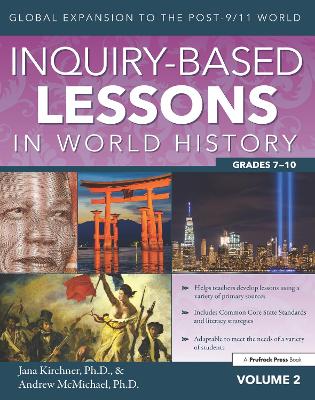
Spanning the time period from 750 CE to the present day, Inquiry-Based Lessons in World History (Vol. 2) focuses on creating global connections between people and places using primary sources in standards-based lessons. With sections on the world in transition, the era of revolutions, imperialism and global war, and the modern world, this book provides teachers with inquiry-based, ready-to-use lessons that can be adapted to any classroom and that encourage students to take part in the learning process by reading and thinking like historians. Each section contains four chapters that correspond to the scope and sequence of most world history textbooks. Each inquiry lesson begins with an essential question and connections to content and literacy standards, followed by primary source excerpts or links to those sources. Lessons include step-by-step directions, incorporate a variety of literacy strategies, and require students to make a hypothesis using evidence from the texts they have read.
Spanning the time period from 750 CE to the present day,
Inquiry-Based Lessons in World History (Vol. 2) focuses on creating global connections between people and places using primary sources in standards-based lessons. With sections on the world in transition, the era of revolutions, imperialism and global war, and the modern world, this bo
Spanning the time period from 750 CE to the present day,
Inquiry-Based Lessons in World History (Vol. 2) focuses on creating global connections between people and places using primary sources in standards-based lessons. With sections on the world in transition, the era of revolutions, imperialism and global war, and the modern world, this book provides teachers with inquiry-based, ready-to-use lessons that can be adapted to any classroom and that encourage students to take part in the learning process by reading and thinking like historians. Each section contains chapters that correspond to the scope and sequence of most world history textbooks. Each inquiry lesson begins with an essential question and connections to content and literacy standards, followed by primary source excerpts or links to those sources. Lessons include step-by-step directions, incorporate a variety of literacy strategies, and require students to make a hypothesis using evidence from the texts they have read.
Grades 7-10

 Rohkem infot Taylor & Francis e-raamatute kohta