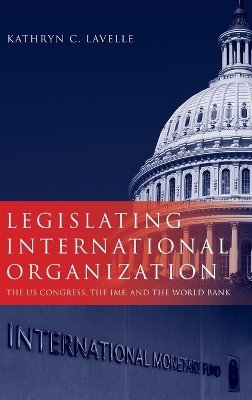
In Legislating International Organization, Kathryn Lavelle argues against the commonly-held idea that key international organizations are entities unto themselves, immune from the influence and pressures of individual states' domestic policies. Covering the history of the IMF and World Bank from their origins, she shows that domestic political constituencies in advanced industrial states have always been important drivers of international financial institution policy. Lavelle focuses in particular on the US Congress, tracing its long history of involvement with these institutions and showing how it wields significant influence. Drawing from archival research and interviews with members and staff, Lavelle shows that Congress is not particularly hostile to the multilateralism inherent in the IMF and World Bank, and has championed them at several key historical junctures. Congress is not uniformly supportive of these institutions, however. As Lavelle illustrates, it is more defensive of its constitutionally designated powers and more open to competing interest group concerns than legislatures in other advanced industrial states. Legislating International Organization will reshape how we think about how the U.S. Congress interacts with international institutions and more broadly about the relationship of domestic politics to global governance throughout the world. This is especially relevant given the impact of 2008 financial crisis, which has made the issue of multilateralism in American politics more important than ever.

 Rohkem infot Oxford Scholarship Online e-raamatute kohta