Update cookies preferences

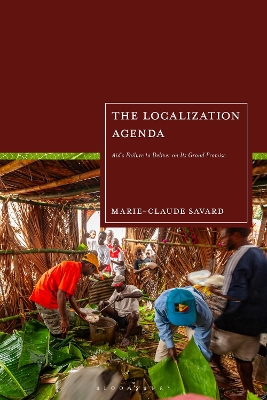
Localization Agenda: Aid's Failure to Deliver on Its Grand Promise [Hardback]

(University of Quebec at Montreal, Canada)
  • Format: Hardback, 240 pages, height x width: 234x156 mm, 10 bw illus
  • Pub. Date: 25-Jun-2026
  • Publisher: Bloomsbury Academic
  • ISBN-10: 1350579041
  • ISBN-13: 9781350579040
  • Hardback
  • Price: 88,31 €*
  • * the price is final i.e. no additional discount will apply
  • Regular price: 117,75 €
  • Save 25%
  • This book is not yet published. Book will arrive in about 3-4 weeks after it is published. Please allow another 2 weeks for shipping outside Estonia.
  • Quantity:
  • Add to basket
  • Delivery time 2-4 weeks
  • Add to Wishlist
  • Format: Hardback, 240 pages, height x width: 234x156 mm, 10 bw illus
  • Pub. Date: 25-Jun-2026
  • Publisher: Bloomsbury Academic
  • ISBN-10: 1350579041
  • ISBN-13: 9781350579040
This book tells the story of the humanitarian industrys latest failed attempt at reform, identifies the key contradiction at the heart of it, and suggests ways to do things better.

In 2016, the United Nations, international organizations and heads of state launched the Grand Bargain - A Shared Commitment to Better Serve People in Need - thereby announcing a systemwide reform. Key among the commitments was localization: placing local organizations at the centre of emergency responses. However, today, very little has changed, with most attributing the lack of progress to technical issues, such as donor requirements, contracting mechanisms, and local responders capacities.

However, this book argues that a paradox within the localization agenda is to blame. Drawing from in-depth research with diverse aid organizations, however, Marie-Claude Savard argues that the real problem is that the humanitarian industry is a territory upon which knowledge the currency of technocratic regimes is produced and guarded by power-wielding gatekeepers, who determine what constitutes a legitimate emergency responder. Those gatekeepers mandate international NGOs and standard-setting organizations to shepherd nonconforming local organizations towards their standards. This process only reaffirms enduring North-South hierarchies. Ultimately, the reformative potential of the localization agenda is thwarted by its own, internal contradictionsbut there are ways of doing things differently by aiming for a true polycentrism that could lead to more sustainable, enduring change.

Reviews

This is not another report on how to localize aid. The Localization Agenda is a sharp, thoughtful indictment of an industry unableor unwillingto relinquish control. Marie-Claude Savard exposes how power, knowledge, and managerialism hollow out attempts to reform the humanitarian sector, and invites readers to imagine a genuinely plural and emancipatory humanitarianism. * Fran็ois Audet, University of Quebec in Montreal * Savard's book offers a timely, critical unpacking of the localization agenda by foregrounding power, knowledge, and epistemic injustice. Through the concepts of gatekeepers, shepherds, and knowledges otherwise, it clarifies the conditions under which genuine power transfer and self-determination can occur in international aid. A must read for researchers and practitioners alike! * Clara Egger, Erasmus School of Social and Behavioural Sciences * This is a rare instance in which the title undersells the ambition, reach, and importance of the argument. This is not only an account of localization and the causes of its failure. It draws back the curtain to expose how technocratic knowledge production reproduces relations of superiority between internationals and locals. This is a study not of localization but a humanitarian machine that swallows up any and all reform movements. * Michael Barnett, co-author of the forthcoming The End of Humanity * Marie-Claudes stimulating book provides a reality check for an agenda often romanticized yet poorly implemented. It is a necessary invitation to honor the wisdom and plurality of knowledges within humanitarian assemblages, wisdom that has always existed but remains sidelined by those who hold the power. * Nelson Duenas, University of Ottawa, Canada *

More info

Examines the humanitarian industrys latest failed attempt at reform, identifies the key contradiction at the heart of it, and suggests ways to do things better.
Foreword by Dennis Dijkzeul, Executive Director of the Institute for
International Law of Peace and Armed Conflict

1. Localization: Failure to Launch?
2. Emergency Assistance and the Rise of Technocratic Thinking
3. The Localization Agenda: What We Know, What We Dont Know
4. The Gatekeepers
5. The Shepherds
6. The Case of Amani
7. Running to Stand Still The Humanitarian Systems Self-preservation
Mechanisms
8. Towards a Polycentric Ideal of Aid

References
Marie-Claude Savard is Professor of Critical Management Studies and International Assistance at the University of Quebec at Montreal, Canada. She is the scientific director of lObservatoire canadien sur les crises et laction humanitaires (the Canadian Research Centre on Humanitarian Crises and Aid).