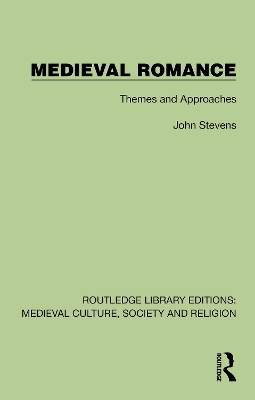
The subjects of medieval romance are the great and permanent concerns of the human mind. A literature is best approached by newcomers, through its major achievements, the author of this book, originally published in 1973, maintains. The books discussion centres on the romances of Chaucer and Chrétien de Troyes, and on such texts as Sir Gawain and the Green Knight, the Roman de la Rose, and Malorys Morte dArthur. The books introductory chapters stress the continuity between medieval and later literature.
1.Introduction: The Permanence of Romance
2. Man and Woman: Idealisms of
Love
3. Man and Society: The Romance of the Gentil Man
4. Man and Superman:
The Romance of the Self
5. Man and Supernature: The Marvellous in Romance
6.
Man and God: Religion and Romance
8. Realism and Romance: Characters and
Types
9. Realism and Romance: Discourse of Love
10. The Storyteller and the
Poet
11. Epilogue: The Pervasiveness of Romance. Historical Note on English
and French Romances.
John Stevens (1921-2002), CBE, was a fellow of Magdalene College, Cambridge, and Professor of Medieval and Renaissance English at Cambridge University. John Stevens was both a specialist for medieval and Renaissance literature and a musicologist. He is best known for his definitive editions of medieval and early Renaissance music in the Musica Britannica series (Mediaeval Carols; Music at the Court of Henry VIII; Early Tudor Songs and Carols) and for his comprehensive studies of the relationship between word and music, both in the Middle Ages and the early Renaissance (Music and Poetry in the Early Tudor Court, 1961; Words and Music in the Middle Ages, 1986). At Cambridge John Stevens taught a wide spectrum of medieval and post-medieval literature, ranging from medieval romance and lyrics to the poetry of George Herbert.

 Rohkem infot Taylor & Francis e-raamatute kohta