Muutke küpsiste eelistusi

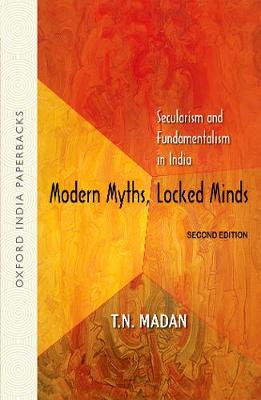
E-raamat: Modern Myths, Locked Minds: Secularism and Fundamentalism in India 2nd Revised edition [Oxford Scholarship Online e-raamatud]

(Professor, Institute of Ecnomic Growth, Delhi)
  • Formaat: 400 pages
  • Ilmumisaeg: 21-Jan-2010
  • Kirjastus: OUP India
  • ISBN-13: 9780198065104
  • Oxford Scholarship Online e-raamatud
  • Raamatu hind pole hetkel teada
  • Formaat: 400 pages
  • Ilmumisaeg: 21-Jan-2010
  • Kirjastus: OUP India
  • ISBN-13: 9780198065104
Secularism is one of the important and contentious public debates in India today. It is seen to be in greater crisis now than ever before, making a case for the continuing presence of this book. The debate also furnishes the making of Indian polity and society, given the inter-related development of culture, society and politics in India. It is thus a debate about religious nationalism and fundamentalism as well. Modern Myths, Locked Minds examines the ideologies of secularism and fundamentalism in the setting of the religious traditions of India--Hinduism, Sikhism, and Islam. Further insightful comparison of the traditions is offered, each seen over a long period of time, revealing markedly distinctive historical experiences.

This book reflects contemporary concerns about the inadequacies of secularism in the context of religious assertiveness in recent decades. It examines the ideologies of secularism and fundamentalism in the setting of the Hindu, Muslim, and Sikh religious traditions. In a new preface and two appendices, the author recapitulates earlier formulations on the subject and revisits the current debates. The book has been described as `an invitation to an enticing intellectual journey that reveals new landscapes' (Louis Dumont), acclaimed as a `tour de force' (Rajni Kothari), `a landmark intervention from the social sciences in public affairs' (Satish Saberwal), and a `major contribution to scholarship and the delineation of the interrelationship of religion and politics' (Harold Gould).

It will interest students and scholars of sociology, political science, history, religious studies and philosophy, and informed general readers.

Secularism is one of the important and contentious public debates in India today. It is seen to be in greater crisis now than ever before, making a case for the continuing presence of this book. The debate also furnishes the making of Indian polity and society, given the inter-related development of culture, society and politics in India. It is thus a debate about religious nationalism and fundamentalism as well. Modern Myths, Locked Minds examines the ideologies of secularism and fundamentalism in the setting of the religious traditions of India--Hinduism, Sikhism, and Islam. Further insightful comparison of the traditions is offered, each seen over a long period of time, revealing markedly distinctive historical experiences.

This second, paperback edition comes with a new preface where the author revisits this debate and contemporarizes it for the reader. Also included are two new appendices on secularism.
Preface to the Second Edition xi
Preface to the First Edition xxi
Acknowledgements xxiii
Chapter One Introduction: Scope, Concepts, Method
1(38)
Ideology: Religious Tradition
2(3)
Secularization, Secularism, the Christian Tradition and the Enlightenment
5(11)
Secularization and Secularism: Social Science Perspectives
16(9)
Fundamentalism and Pluralism
25(8)
Structure and Method
33(6)
Chapter Two The Sikh Religious Tradition: Meanings of Secularism
39(24)
Sikhism as This-Worldly Ethic
40(11)
The Doctrine of Two Swords
51(7)
The Secular State of Ranjit Singh
58(5)
Chapter Three The Sikh Religious Tradition: Fundamentalisms, Old and New
63(43)
Fundamentalists or Defenders of Faith?
63(12)
Exclusive Sikh Identity
75(7)
Gurudwara Agitation
82(4)
Sikh Separatism
86(5)
After Operation Blue Star, 1984-94
91(7)
Characteristics of Sikh Fundamentalism
98(8)
Chapter Four Islam in South Asia: From Orthodoxy to Fundamentalism
106(44)
Introduction
106(3)
Arrival of Islam in India: opportunities and Dilemmas
109(4)
Religious Authority versus Secular Power in Medieval India
113(5)
Religious Syncretism and Revivalism
118(10)
Loss of Power: Dar ul-Islam to Dar ul-Harb
128(5)
The Revivalist Hope: Redemption by Education: Tradition versus Modernity
133(5)
Islamic Fundamentalism in South Asia in the Twentieth Century
138(6)
Concluding Remarks: Lessons of Comparison
144(6)
Chapter Five Islam in South Asia: Quest for Pluralism
150(26)
Introduction
150(7)
Azad: Pluralism as the Politics of National Liberation
157(6)
Azad: Pluralism as a Religious Philosophy
163(5)
Azad: Pluralism as Cultural History
168(4)
Concluding Remarks
172(4)
Chapter Six The Hindu Religious Tradition: Secularism as Pluralism
176(27)
Introduction
176(4)
The Unity of the Sacred and the Secular
180(8)
Religious Pluralism
188(13)
Appendix
201(2)
Chapter Seven The Hindu Religious Tradition: Revivalism and Fundamentalism
203(30)
Reform and Revivalism in the Nineteenth Century
203(8)
The Arya Samaj
211(7)
Hindutva and the RSS
218(9)
Gandhi's Hinduism
227(6)
Chapter Eight The Crisis of Indian Secularism
233(33)
Introduction
233(2)
A Gandhian Perspective
235(3)
Nehru on Religion, Politics and Secularism
238(10)
Secularism and the Constitution
248(2)
The Majority-Minority Conundrum
250(10)
Concluding Remarks
260(6)
Epilogue 266(14)
Appendix I Secularism in its Place 280(19)
Appendix II Secularism Revisited: Doctrine of Destiny or Political Ideology? 299(32)
Glossary 331(5)
References 336(22)
Index 358
T.N. Madan is Honorary Professor (Sociology) at the Institute of Economic Growth, Delhi and Distinguished Senior Fellow at the Centre for the Study of Developing Societies, Delhi.