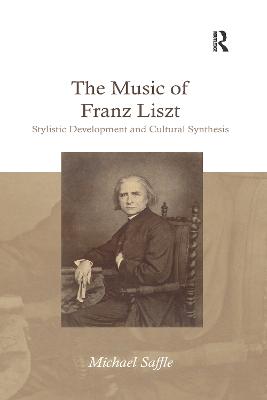
Much of Franz Liszt's musical legacy has often been dismissed as 'trivial’ or 'merely showy,' more or less peripheral contributions to nineteenth-century European culture. But Liszt was a mainstream composer in ways most of his critics have failed to acknowledge; he was also an incessant and often extremely successful innovator. Liszt's mastery of fantasy and sonata traditions, his painstaking settings of texts ranging from erotic verse to portions of the Catholic liturgy, and the remarkable self-awareness he demonstrated even in many of his most 'entertaining' pieces: all these things stamp him not only as a master of Romanticism and an early Impressionist, but as a precursor of Postmodern 'pop.' Liszt's Music places Liszt in historical and cultural focus. At the same time, it examines his principal contributions to musical literature -- from his earliest operatic paraphrases to his final explorations of harmonic and formal possibilities. Liszt's compositional methods, including his penchant for revision, problems associated with early editions of some of his works, and certain aspects of class and gender issues are also discussed. The first book-length assessment of Liszt as composer since Humphrey Searle’s 1956 volume, Liszt's Music is illustrated with well over 100 musical examples.
|
|
|
ix | |
| Acknowledgments |
|
xiv | |
| Abbreviations and sigla used throughout the present volume including the bibliography |
|
xv | |
| Introduction |
|
1 | (5) |
|
1 Liszt's apprenticeship: the performer as emerging composer |
|
|
6 | (30) |
|
The prodigy as piano improviser and interpreter |
|
|
6 | (3) |
|
|
|
9 | (3) |
|
Liszt as emerging composer |
|
|
12 | (16) |
|
Liszt and his youthful contemporaries |
|
|
28 | (8) |
|
2 Liszt comes of age: the composer as fantasist |
|
|
36 | (86) |
|
Liszt and the fantasy: an introduction |
|
|
36 | (3) |
|
Fantasy conventions and Lisztian innovations |
|
|
39 | (27) |
|
Nineteenth-century fantasy types and forms of expression |
|
|
66 | (3) |
|
Liszt and the dramatic fantasy |
|
|
69 | (20) |
|
Liszt's caprices, character pieces, and descriptive pieces |
|
|
89 | (7) |
|
Liszt's fantasies on national themes |
|
|
96 | (12) |
|
Liszt's fantasies and his reputation as a composer |
|
|
108 | (14) |
|
3 Liszt adapts and transforms: the fantasist/composer as re-composer |
|
|
122 | (51) |
|
Liszt's adaptations: a survey |
|
|
122 | (6) |
|
Critical approaches to Liszt's adaptations and transformations |
|
|
128 | (7) |
|
Individual Liszt transcriptions and adaptations |
|
|
135 | (27) |
|
Clusters and constellations of Liszt's (re-) compositions |
|
|
162 | (2) |
|
Terminology, reception, and profit: Liszt's prolific (self-) adaptations |
|
|
164 | (9) |
|
4 Liszt orchestrates and explains: the fantasist/(re-)composer as tone poet |
|
|
173 | (62) |
|
Liszt and the orchestra, 1825--1848 |
|
|
173 | (28) |
|
Liszt's "Weimar" works for instrumental ensembles |
|
|
201 | (16) |
|
Liszt's later orchestral works |
|
|
217 | (2) |
|
Liszt as master orchestrator |
|
|
219 | (4) |
|
|
|
223 | (12) |
|
|
|
235 | (40) |
|
|
|
236 | (13) |
|
Liszt's sacred and secular concerted vocal music |
|
|
249 | (17) |
|
Liszt, Catholicism, and prayer: a speculative conclusion |
|
|
266 | (9) |
| Bibliography |
|
275 | (14) |
| Index |
|
289 | |
Michael Saffle is Professor of Music and Humanities at Virginia Tech. His publications include Franz Liszt: A Guide to Research (2009) as well as articles and reviews in Acta Musicologica, Notes, and the Journal of Musicological Research. In addition to Humboldt and Rockefeller fellowships, Saffle held the 2000-2001 Bicentennial Fulbright Professorship of American Studies at the University of Helsinki.

 Rohkem infot Taylor & Francis e-raamatute kohta