Muutke küpsiste eelistusi

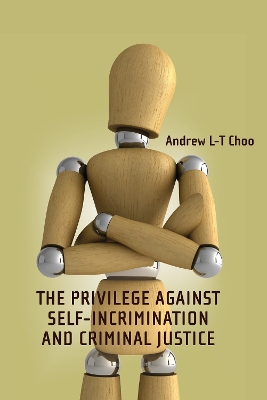
E-raamat: The Privilege Against Self-Incrimination and Criminal Justice [Hart e-raamatud]

  • Formaat: 180 pages
  • Sari: Criminal Law Library
  • Ilmumisaeg: 28-Nov-2013
  • Kirjastus: Hart Publishing
  • ISBN-13: 9781782253211
Teised raamatud teemal:
  • Hart e-raamatud
  • Hind: 67,48 €*
  • * hind, mis tagab piiramatu üheaegsete kasutajate arvuga ligipääsu piiramatuks ajaks
  • Formaat: 180 pages
  • Sari: Criminal Law Library
  • Ilmumisaeg: 28-Nov-2013
  • Kirjastus: Hart Publishing
  • ISBN-13: 9781782253211
Teised raamatud teemal:
The privilege against self-incrimination is often represented in the case law of England and Wales as a principle of fundamental importance in the law of criminal procedure and evidence. Logically, recognition of a privilege against self-incrimination should mean that a person cannot be compelled to provide information that could reasonably lead to, or increase the likelihood of, her or his prosecution for a criminal offense. Yet, there are many statutory provisions in England and Wales allowing demands for information that, if provided, could be used in a criminal prosecution, and, if not provided, could result in a criminal prosecution for the failure to provide it. This book examines the operation of the privilege in England and Wales, paying particular attention to the influence of the European Convention on Human Rights and the Human Rights Act 1998 on the development of the principle. Among the questions addressed are whether the relevant case law clarifies sufficiently what the potential scope of the privilege is (does it apply, for example, to pre-existing material?), and how the privilege might be justified. Consideration is given where appropriate to the approaches taken in jurisdictions, such as the US, Canada, and New Zealand. (Series: Criminal Law Library - Vol. 10)
Preface vii
Table of Cases
xi
Table of Legislation
xvii
Table of Conventions
xxvii
Table of International Treaties
xxviii
1 Introduction: Origins, Rationales and the Relevant Legal Framework
1(21)
1 Origins and Rationales
2(9)
1.1 Epistemic Considerations
3(3)
1.2 Non-Epistemic Considerations
6(5)
2 The Relevant Legal Framework
11(10)
2.1 The Context: A `Social' or `Moral' Duty of Co-operation
12(1)
2.2 Some General Principles
13(8)
3 Organisation of the Book
21(1)
2 The Jurisprudence of the European Court of Human Rights and the Response of the Law of England and Wales
22(20)
1 Funke v France
23(1)
2 Saunders v UK
24(3)
3 Prosecutions for Failure to Provide (Accurate) Information
27(7)
3.1 The Jurisprudence of the European Court of Human Rights Post-Funke v France
27(3)
3.2 The Case Law in England and Wales
30(4)
4 Use of `Compelled Information'
34(6)
4.1 `Use Immunity'
34(1)
4.2 Is There a Principle of `Derivative-Use Immunity'?
35(4)
4.3 Is the Information `Compelled Information'?
39(1)
5 Concluding Comments
40(2)
3 What Is `Information'?
42(20)
1 The Jurisprudence of the European Court of Human Rights
43(3)
2 The Case Law in England and Wales
46(4)
3 US Constitutional Law
50(6)
3.1 Voice
54(1)
3.2 Handwriting
55(1)
3.3 Sobriety Testing
55(1)
4 Australia
56(1)
5 New Zealand
57(1)
6 Canada
58(1)
7 India
59(1)
8 International Criminal Law: The ICTY
60(1)
9 Concluding Comments
61(1)
4 Identifying the `Essence' of the Privilege
62(18)
1 An `Absolute' Right?
62(1)
2 The Jurisprudence of the European Court of Human Rights
63(7)
3 The Case Law in England and Wales
70(4)
4 Canada
74(4)
5 Concluding Comments
78(2)
5 `Indirect' Compulsion: Confessions and Inferences From Silence
80(33)
1 Questioning Suspects
80(20)
1.1 Mandatory Exclusion and Mandatory Directions
81(3)
1.2 Legal Advice
84(5)
1.3 Cautioning Suspects
89(1)
1.4 Alternatives to Judicial Discretion
90(5)
1.5 Police Informants
95(4)
1.6 `Safety Interviews'
99(1)
2 Adverse Inferences From Silence
100(12)
2.1 Pre-Trial Silence
101(7)
2.2 Silence at Trial
108(4)
3 Concluding Comments
112(1)
6 Concluding Thoughts
113(8)
Appendix 1 121(3)
Appendix 2 124(7)
Appendix 3 131(4)
Bibliography 135(14)
Index 149
Andrew Choo is a Professor of Law at City University London and a barrister at Matrix Chambers.