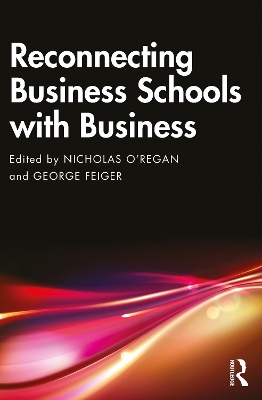
Reconnecting Business Schools with Business is a provocative call to action for business schools worldwide. This groundbreaking book argues that traditional business schools have strayed from their core mission: to be professional schools that directly serve and advance the practice of business.
Professional schools emphasise practical training, close links with their profession, and accreditation and codes of ethics by committees of practitioners. In the case of business schools, overwhelmingly there has been a shift towards an academic focus on research and theory. This book seeks to address this problem through providing clear steps to overcome the perpetuation of a point-scoring reward system, and a return to their roots as professional schools that are fully engaged with business.
Reconnecting Business Schools with Business Schools offers a comprehensive framework for reform that balances the need for effective engagement with the business community with a commitment to research excellence and cutting-edge scholarship. It is presented in two parts: the first outlines the current business school and its various shortfalls. Examples are presented from the other types of professional schools to show how we might achieve the New Professional Business School. The second part considers new interdisciplinary structures for the future. The second part of the book presents a number of steps that will enable business schools to move to the desired outcome.
Written by two leading business scholars and leaders, the book gives universities, business school leaders and policy makers the insight needed to prompt a holistic rethink of the role of the business school.
Foreword, Part 1: The Business School Landscape,
Chapter 1 Why Are We
Doing This?
Chapter 2 New Demands on Business Create New Opportunities for,
and New Demands of Business Schools,
Chapter 3 External Influences on the
Role of Business School,
Chapter 4 Exploring Liberal Undergraduate Management
Education in the UK, Part 2: The Case for Change,
Chapter 5 Business Schools:
Time for Change,
Chapter 6 The Future of Business Schools,
Chapter 7 The Case
for Radical Innovations in Business Schools: The Innovation Inertia Dilemma,
Part 3: The Next Business Education,
Chapter 8 The Next Management Education:
Charting a New Path Forward,
Chapter 9 Close to Industry and Academia:
Reflections on the History of MIT Sloan,
Chapter 10 Your Location Matters!
The Role of the Business School in Supporting Economic Growth,
Chapter 11
Management Education Is The New Liberal Arts,
Chapter 12 Standalone business
schools and their role in bridging the academia-business gap, Part 4:
Business as a Force for Good,
Chapter 13 Business as a Force for Good,
Chapter 14 Business Education and the Public Benefit of Research,
Chapter 15
Business Schools for the Public Good: Advancing the UN SDGs,
Chapter 16
Addressing Societal Challenges The Business School and the Business
Leaders,
Chapter 17 The Role of Business in Bridging the Gap Between Academia
and Business,
Chapter 18 How Purpose Driven Companies Are Re-Defining the
Future of Business,
Chapter 19 Solve Problems That Matter,
Chapter 20 The
Innovative Business School,
Chapter 21 Sustaining Excellence in Business
Education: Embracing Integration to Strengthen Research Foundations,
Chapter
22 The Victoria Forum a Collective Commitment to Addressing Key Societal
Issues, Part 5: Innovation and the Future of Business,
Chapter 23 Is
Engineering Education broken?
Chapter 24 The Making of a Product Manager: An
Interdisciplinary Education that Belongs in Business Schools,
Chapter 25
Transforming Business Education: The Impact of the LIFE Module at Dublin City
University,
Chapter 26 Creating Europes Largest Ecosystem on Artificial
Intelligence: The Role of TUM School of Management,
Chapter 27 An
Entrepreneurial School with Entrepreneurial People Connecting with the Best
Business Schools in Europe,
Chapter 28 Beyond Borders: Making Higher
Education More International, Diversified and Interdisciplinary, Part 6:
Shaping the Future of Business Education,
Chapter 29 Business Education in
the Age of Changei,
Chapter 30 The Evolving MBA,
Chapter 31 The Future of
Business Schools - an ACCA Perspective,
Chapter 32 Redefining Business
Education,
Chapter 33 Why Investing in Quality Leadership and Management Will
Deliver Better Leaders, Better Businesses, Better Productivity and a Better
Economy,
Chapter 34 Does an M.B.A. Still Matter? Part 7: A Blueprint for the
Engaged Business School,
Chapter 35 A Step-by-Step Guide for Effective
Engagement
Nicholas ORegan is Professor in Strategy at Aston Business School. After completing his PhD in Strategy and Leadership, he held Professorial appointments at Middlesex University, and Bristol Business School. Prior to a career in academia, he was the youngest local authority Town Clerk and Chief Executive in Ireland before moving to a number of senior and chief officer positions in UK Local Government.
George Feiger was Executive Dean of the College of Business and Social Sciences and Pro Vice Chancellor of Aston University between 2013 and 2023, after having founded and run a wealth management business in the United States. Prior to this, he held a variety of senior roles including Director of McKinsey & Company, Global Head of Investment Banking for SBC Warburg, and Global Head of Onshore Private Banking for UBS.

 Rohkem infot Taylor & Francis e-raamatute kohta