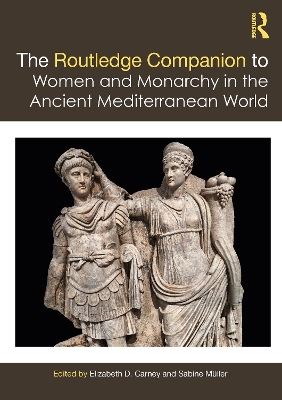
This volume offers the first comprehensive look at the role of women in the monarchies of the ancient Mediterranean. It consistently addresses certain issues across all dynasties: title; role in succession; the situation of mothers, wives, and daughters of kings; regnant and co-regnant women; role in cult and in dynastic image; and examines a sampling of the careers of individual women while placing them within broader contexts. Written by an international group of experts, this collection is based on the assumption that women played a fundamental role in ancient monarchy, that they were part of, not apart from it, and that it is necessary to understand their role to understand ancient monarchies. This is a crucial resource for anyone interested in the role of women in antiquity.
This volume offers the first comprehensive look at the role of women in the monarchies of the ancient Mediterranean.
Part I: Women and Monarchy in the Ancient Mediterranean
1. Introduction
to thinking about women and monarchy in the ancient world Part II: Egypt and
the Nile Valley
2. The Kings Mother in Old and Middle Kingdoms
3. Regnant
Women in Egypt
4. The Image of Nefertiti
5. The Gods Wife of Amun: Origins
and Rise to Power
6. The Role and Status of Royal Women in Kush
7. Ptolemaic
Royal Women
8. Berenike II
9. Royal Women and Ptolemaic Cults
10. Ptolemaic
Womens Patronage of the Arts
11. The Kleopatra Problem: Roman sources and a
female Ptolemaic ruler Part III: The Ancient Near East
12. Invisible
Mesopotamian Royal Women?
13. Achaimenid Women
14. Karian Royal Women and the
Creation of a Royal Identity
15. Seleukid Women
16. Apama and Stratonike: the
first Seleukid basilissai
17. Seleukid Marriage Alliances
18. Royal Mothers
and Dynastic Power in Attalid Pergamon
19. Hasmonean Women
20. Women at the
Arsakid Court
21. Women of the Sasanid Dynasty (224-651 CE)
22. Zenobia of
Palmyra Part IV: Greece and Macedonia
23. "Royal" Women in the Homeric Epics
24. Royal Women in Greek Tragedy
25. Argead Women
26. Women in Antigonid
Monarchy Part V: Commonalities
27. Transitional Royal Women: Kleopatra,
sister of Alexander the Great, Adea Eurydike, and Phila
28. Women and Dynasty
and the Hellenistic Imperial Courts
29. Royal Brother-Sister marriage,
Ptolemaic and otherwise
30. Jugate Images in Ptolemaic and Julio-Claudian
Monarchy Part VI: Rome: Late Republic through Empire
31. Octavia Minor and
Patronage
32. Livia and the Principate of Augustus and Tiberius
33.
Julio-Claudian Imperial women
34. The Imperial Women from the Flavians to the
Severi
35. Portraiture of Flavian imperial women
36. The Faustinas
37. Women
in the Severan Dynasty
38. Women in the Family of Constantine Part VII:
Reception from Antiquity to Present Times
39. Semiramis: Perception and
Presentation of Female Power in an Oriental Garb
40. Tanaquil and Tullia in
Livy as Roman Caricatures of Greek Mythic and Historic Hellenistic Queens
41.
Roman Empresses on Screen: an Epic Failure?
Elizabeth D. Carney is Professor of History and Carol K. Brown Scholar in the Humanities, Emerita, at Clemson University, USA. Her focus has been on Macedonian and Hellenistic monarchy and the role of royal women in monarchy, most recently in Molossia. She has written Women and Monarchy in Ancient Macedonia (2000), Olympias, Mother of Alexander the Great (2006), Arsinoė of Egypt and Macedon: A Royal Life (2013), and Eurydice and the Birth of Macedonian Power (2019). Some of her articles dealing with monarchy, with new afterwords, are collected in King and Court in Ancient Macedonia: Rivalry, Treason and Conspiracy (2015).
Sabine Müller is Professor of Ancient History at Marburg University, Germany. Her research focuses on the Persian empire, Argead Macedonia, the Hellenistic empires, Macedonian royal women, Lukian, and reception studies. Her publications include the monographs Das hellenistische Königspaar in der medialen Repräsentation. Ptolemaios II. und Arsinoė II. (2009), Perdikkas II. Retter Makedoniens (2017), and Alexander der Große. Eroberung Politik Rezeption (2019).

 Rohkem infot Taylor & Francis e-raamatute kohta