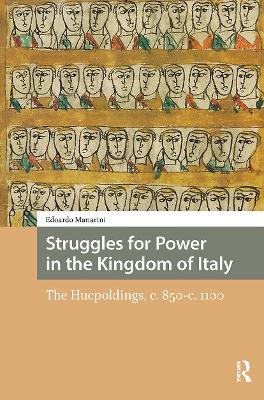
This book presents a detailed study of the Hucpoldings, an elite group in Carolingian and post-Carolingian Italy. Though the Hucpoldings have not received extensive treatment in previous anglophone scholarship, they had a key influence in much of what was happening in this period. Manarini’s groundbreaking study highlights the dramatic geopolitical changes surrounding this kinship group in the kingdom of Italy across three crucial centuries. The research reconstructs political events associated with every identifiable member of the kinship, as well as inquiring into their patrimony and their networks of relationships and patronage. Finally, it examines the distinctive characteristics of the group to gain a clearer picture of the nature of their power, their memory strategies and the shared perceptions and self-awareness of group members.
This book presents a detailed study of the Hucpoldings, an elite group in Carolingian and post-Carolingian Italy.
Preface by Simon MacLean, Introduction, Part I Kinship and Political
Relations,
1. The Hucpoldings' Involvement in the Political Struggles of the
Kingdom of Italy (847-945), Hucpold, Count Palatine of Louis II, Faction and
Endeavour: Hubald I, The Aristocratic Career of Boniface dux et marchio
between Rudolf II and Hugh of Arles, Bibliography,
2. Family Patterns and
Political Affirmation (945-1012), The Duchy of Spoleto and Tuscany, Eastern
Emilia and the Exarchate of Ravenna, The March of Tuscany, Bibliography,
3.
The Local Basis of Power in a Wide Political Network (1012-1116), Hugh II and
His Lineage in Bologna and Ferrara, The Ties that Bind: Boniface of Canossa
and Kinship Networks across the Apennines, The Counts of Romena-Panico,
Bibliography, Part II Properties and Patronage,
4. The Exarchate, Land
Possession and Relations in the Ninth Century, The Troubled Years,
c.960-c.1000, Persistence in the comitatus Faentinus and the 1034 Pact,
Bibliography,
5. The March of Tuscany, The Family Group Estates in the Ninth
Century, Marchisal Fisc and Monastic Foundations, Centres of Power, Patronage
Networks, Bibliography,
6. Ruling on the Border : Landed Possessions from the
Po Valley to the Apennines in Bononia's Diocese, Acquisitions, Exchanges,
Organization of Lands in the Tenth Century, Landed Wealth and Hegemony,
Lands, People and Castles (900-1100), Estate Management: Between Territorial
Consolidation and Dispersal, Bibliography, Part III Power, Relationships,
Memory,
7. Kinship, Self-awareness and Memory, Onomastic Choices, The lex
Ribuaria profession, The Role of Monastic Foundations: Family Memory,
Politics and Identity, Kinship Representations between Perceptions and
Self-awareness, Evolution and Hierarchy of Kinship Cohesion, Bibliography,
8.
Features and Practices of Power: From Officials to Lords, Firsts Steps at
Court: Offices and Responsibilities in the Kingdom of Italy, The Marchisal
Achievement and the Gaining of Ecclesiastical Offices, Dinastizzazione of the
Title of comes and the Development of Seigneurial Rule in a Border Region,
Bibliography,
9. Discontinuity between Public Powers and Private Seigneurial
Rule, Bibliography, Genealogical Tables, Bibliography, Index.
Edoardo Manarini is currently a postdoctoral fellow at the University of Turin. His research revolves around Western European medieval political institutions, focusing on Italys elite kindreds and their interconnection with regnal power, the links between kings and abbeys in Lombard and Carolingian Italy, the dynamics of memory and monastic production of written strategies.

 Rohkem infot Taylor & Francis e-raamatute kohta