Muutke küpsiste eelistusi

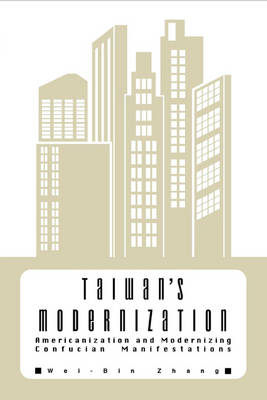
E-raamat: Taiwan's Modernization: Americanization and Modernizing Confucian Manifestations [World Scientific e-raamat]

(Ritsumeikan Asia Pacific University, Japan)
  • Formaat: 236 pages
  • Ilmumisaeg: 21-Jul-2003
  • Kirjastus: World Scientific Publishing Co Pte Ltd
  • ISBN-13: 9789812795243
Teised raamatud teemal:
  • World Scientific e-raamat
  • Hind: 113,65 €*
  • * hind, mis tagab piiramatu üheaegsete kasutajate arvuga ligipääsu piiramatuks ajaks
  • Formaat: 236 pages
  • Ilmumisaeg: 21-Jul-2003
  • Kirjastus: World Scientific Publishing Co Pte Ltd
  • ISBN-13: 9789812795243
Teised raamatud teemal:
This book is part of a broad examination of Confucianism and its implications for modernization of the Confucian regions (covering mainland China, Taiwan, Hong Kong, Macau, Vietnam, Japan, South Korea, North Korea, and Singapore). It is mainly concerned with the industrialization and modernization of Taiwan. To help readers understand the process of modernization, the book provides an introduction to the history of Taiwan and to Confucianism and its modern implications. As far as social and economic principles are concerned, Taiwan's modernization is, according to the author, characterized by Americanization and modernizing Confucian manifestations. The book demonstrates that Taiwan has actually provided an important case study not only for the capitalist spirit of overseas Chinese, but also for possible implications of Confucianism for modernization. The unique character of this book is that in explaining Taiwan's modernization, it deals not only with economic and social issues, but also examines the philosophical foundations, an endeavor which no other author has systematically made before.
Preface v
Acknowledgments vii
Introduction
1(19)
Taiwan's Economic Miracle and Rapid Democratization
2(3)
Common Patterns of Industrialization in the Confucian Regions
5(4)
The Principles of Confucianism
9(4)
Modernizing Manifestations of Confucianism
13(7)
History Before 1945
20(19)
Taiwan Under the Dutch
21(2)
The Ch'ing Dynasty
23(4)
Taiwan Under the Manchus
27(5)
Taiwan Under Japanese Colonial Rule
32(5)
Taiwan was Returned to the Chinese on October 25, 1945
37(2)
Government and Democratization
39(41)
The Confucian Ideal Government: The Government for the People
40(2)
Sun Yat-sen's Three Principles of the People
42(4)
The KMT on Taiwan Before 1950
46(5)
Consolidation of Power in the 1950s and 1960s
51(6)
Limited Liberalization in the 1970s
57(5)
Democratization in the 1980s
62(6)
Consolidation of Democracy Since 1990
68(4)
Taiwan's Relations with the PRC
72(8)
Education, Science, and Technology
80(37)
Education in the Colonial Time
82(5)
Education in Taiwan
87(7)
Mandarin Versus Taiwanese Language
94(3)
Science and Technology (S&T) and the Government Policy
97(8)
Taiwanese Computer Industry Competes in the Global Market
105(4)
Taiwan's Economic Growth and Human Capital Growth
109(8)
The Economic Miracle
117(53)
The Economic Miracle
119(3)
Economic Growth with Government Intervention
122(14)
Import substitution, 1950--1960
126(4)
Export substitution, 1960--1973
130(1)
Secondary import substitution, 1973--1981
131(2)
High technology and innovation since 1980
133(3)
Small- and Medium-Sized Enterprises (SMEs)
136(6)
Economic Structural Transformation
142(5)
Trade Dynamics
147(8)
Economic Linkages Between Taiwan and Mainland China
155(4)
Income Distribution and Social Welfare
159(3)
Poverty in Taiwan
162(2)
Economic Consequences of Social Welfare
164(6)
Uncertain Future
170(23)
Sustainable Economic Development or a Paper Tiger?
173(2)
Political Flexibility and Respect for Law
175(4)
Taiwan and the Mainland
179(7)
Being Oneself, Being Taiwanese, Being Chinese
186(7)
Bibliography 193(12)
Index 205