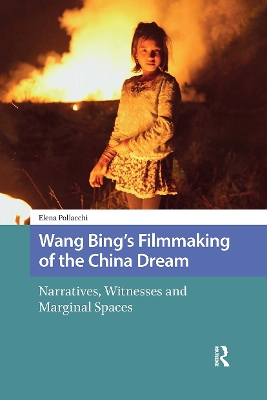
This volume offers an organic discussion of Wang Bing's filmmaking across China’s marginal spaces and against the backdrop of the state-sanctioned 'China Dream'. Wang Bing's cinema gives voice to the subaltern. Focusing on contemporary China, his work testifies to a set of issues dealing with inequality, labour, and migration.
This volume offers an organic discussion of Wang Bing's filmmaking across China’s marginal spaces and against the backdrop of the state-sanctioned 'China Dream'. Wang Bing's cinema gives voice to the subaltern. Focusing on contemporary China, his work testifies to a set of issues dealing with inequality, labour, and migration. His internationally awarded documentaries are considered masterpieces with unique aesthetics that bear reference to global film masters. Therefore, this investigation goes beyond the divides between Western and non-Western film traditions and between fiction and documentary cinema. Each chapter takes a different articulation of space (spaces of labour, history, and memory) as its entry point, bringing together film and documentary studies, Chinese studies, and globalization studies. This volume benefits from the author's extensive conversations with Wang Bing and insider observations of film production and the film festival circuit.
Acknowledgements, Foreword by Alberto Barbera, INTRODUCTION,
1. The
relevance of Wang Bing's filmmaking,
2. Themes, form and narrative structure:
A linked approach to Wang Bing's filmmaking,
3. Wang Bing ą la Wong Kar-wai,
4. Genesis and book's structure,
1. WANG BING'S CINEMATIC JOURNEY: A
COUNTER-NARRATIVE OF THE CHINA DREAM,
1. The centrality of space in Wang
Bing's narrativized reality,
2. Chinese marginal spaces and uneven
development,
3. Wang's counter-journey of the China Dream,
4. Spaces in Wang
Bing's oeuvre: an overview of the films and issues at stake,
2. HISTORY IN
THE MAKING: THE DEBUT EPIC TIEXI QU: WEST OF THE TRACKS,
1. The debut epic
Tiexi qu: West of the Tracks and its context,
2. West of the Tracks as a
contemporary cinematic reportage,
3. Filming 'history in the making' and the
legacy of the Lumičre films,
4. Towards an epic of labour: from Terrence
Malick's Days of Heaven to West of the Tracks,
3. SPACES OF LABOUR: THREE
SISTERS, 'TIL MADNESS DO US PART, BITTER MONEY,
1. Filming spaces of labour
and cinema as labour,
2. The transition from the industrial space of Tiexi to
rural and marginal spaces,
3. Three Sisters: an epic of survival reminiscent
of John Ford's The Grapes of Wrath,
4. Duration in Wang Bing's cinema: the
case of Three Sisters and Alone,
5. No Way Out: from Three Sisters to 'Til
Madness Do Us Part,
6. 'Til Madness Do Us Part: the camera work between
'madness' and 'love',
7. Reaching the new centres of labour: Bitter Money,
8.
Bitter Money: earning money in hardship,
4. SPACES OF HISTORY AND MEMORY: THE
WORKS ON THE ANTI-RIGHTIST CAMPAIGN, PART I - A space too much: The Ditch,
1.
The genesis of The Ditch (2004-09),
2. The Ditch: carving out a space for
documenting the past,
3. Historical spectacles: Wang Bing's The Ditch and
Pier Paolo Pasolini's Salņ (1975),
4. Ghosts of the past: Wang Bing's The
Ditch and Brutality Factory and Pedro Costa's Colossal Youth, PART II -
Spaces of Memories: Dead Souls,
1. From Fengming: A Chinese Memoir to Dead
Souls,
2. The genesis of Dead Souls,
3. Spaces for survival: archiving
audiovisual witnesses,
4. The act of filming and spaces of death,
5. Wang
Bing's Dead Souls and Claude Lanzmann's Shoah (1985),
5. COLLECTIVE SPACES -
INDIVIDUAL NARRATIVES: MAN WITH NO NAME, FANG XIUYING, GAO ERTAI - BEAUTY
LIVES IN FREEDOM,
1. Man With No Name: individual spaces of self-isolation,
2. Fathers and Sons: individual spaces and deteriorating family structures,
3. Mrs Fang: individual spaces of death,
4. Mi Niang and Ta'ang: spaces of
escape and refuge,
5. Gao Ertai - Beauty Lives in Freedom: individual spaces
of exile,
6. CONCLUDING REMARKS: EXHIBITION SPACES AND SPACES OF HUMAN
PRACTICE, Filmography, Bibliograhy, Index.
Elena Pollacchi is Senior Lecturer in Chinese Studies and has taught courses on Chinese-language film and documentary cinema, Asian cinema, and contemporary Chinese culture at Ca Foscari University of Venice (Italy), Stockholm University, and Gothenburg University (Sweden). She holds a PhD from Cambridge University in Chinese film studies and has published extensively on Chinese-language film and documentary cinema, film festivals, and film production and exhibition circuits. She is a member of the selection committee and programmer for Chinese-language film and South Korean cinema at the Venice International Film Festival.

 Rohkem infot Taylor & Francis e-raamatute kohta