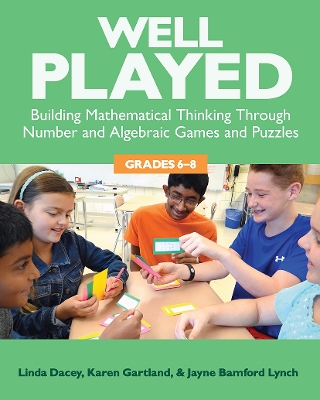
Students love math games and puzzles, but how much are they really learning from the experience? Too often, math games are thought of as just a fun activity or enrichment opportunity.
Well Played shows you how to make games and puzzles an integral learning component that provides teachers with unique access to student thinking.
This third book in the series helps you engage students in grades 6–8 in discussions of mathematical ideas and deepen their conceptual understanding. It also helps you develop students’ fluency with number systems; ratio and proportional relationships; expressions and equations, statistics and probability; and patterns, graphs, and functions.
The twenty-five games and puzzles in
Well Played, which have all been field-tested in diverse classrooms, contain:
- explanations of the mathematical importance of each game or puzzle and how it supports student learning;
- variations for each game or puzzle to address a range of learning levels and styles;
- clear step-by-step directions; and
- classroom vignettes that model how best to introduce the featured game or puzzle.
The book also includes a separate chapter with suggestions for how to effectively manage games and puzzles in diverse classrooms; reproducibles that provide directions, game boards, game cards, and puzzles; assessment ideas; and suggestions for online games, puzzles, and apps.
Well Played will help you tap the power of games and puzzles to engage students in sustained and productive mathematical thinking.
| Acknowledgments |
|
vi | |
|
|
|
1 | (4) |
|
|
|
2 | (1) |
|
Is It a Game or a Puzzle or an Activity? |
|
|
3 | (1) |
|
How Is This Book Organized? |
|
|
3 | (2) |
|
Chapter 2 Supporting Learning Through Games and Puzzles |
|
|
5 | (20) |
|
Using Games and Puzzles in the Classroom |
|
|
6 | (1) |
|
Building Student Responsibility for Learning |
|
|
7 | (6) |
|
Assessing Learning and Setting Goals |
|
|
13 | (5) |
|
Fostering Productive Discussions |
|
|
18 | (1) |
|
Meeting Individual Differences |
|
|
19 | (1) |
|
|
|
19 | (3) |
|
|
|
22 | (2) |
|
|
|
24 | (1) |
|
Chapter 3 The Number System |
|
|
25 | (20) |
|
|
|
25 | (1) |
|
|
|
26 | (3) |
|
|
|
29 | (4) |
|
|
|
33 | (4) |
|
|
|
37 | (3) |
|
|
|
40 | (3) |
|
|
|
43 | (2) |
|
Chapter 4 Ratios and Proportional Relationships |
|
|
45 | (22) |
|
|
|
45 | (2) |
|
|
|
47 | (3) |
|
|
|
50 | (4) |
|
|
|
54 | (3) |
|
The Question Is/The Answer Is |
|
|
57 | (4) |
|
|
|
61 | (4) |
|
|
|
65 | (2) |
|
Chapter 5 Expressions and Equations |
|
|
67 | (22) |
|
|
|
67 | (1) |
|
|
|
68 | (4) |
|
|
|
72 | (3) |
|
|
|
75 | (3) |
|
|
|
78 | (4) |
|
|
|
82 | (5) |
|
|
|
87 | (2) |
|
Chapter 6 Statistics and Probability |
|
|
89 | (20) |
|
|
|
89 | (1) |
|
|
|
90 | (4) |
|
|
|
94 | (4) |
|
|
|
98 | (3) |
|
|
|
101 | (3) |
|
|
|
104 | (3) |
|
|
|
107 | (2) |
|
Chapter 7 Patterns, Graphs, and Functions |
|
|
109 | |
|
|
|
109 | (1) |
|
|
|
110 | (5) |
|
|
|
115 | (3) |
|
|
|
118 | (3) |
|
|
|
121 | (4) |
|
|
|
125 | (3) |
|
|
|
128 | |
| Appendix |
|
1 | (92) |
| Answer Key |
|
93 | (8) |
| References |
|
101 | |
Linda Dacey, consultant and professor emeritus at Lesley University, has always believed that learning mathematics should be conceptually based and enjoyable. Her major interests are problem solving, number sense, and strategies for differentiation. Linda is the coauthor with Anne Collins of the Zeroing in on Number and Operations series, as well as other titles focused on teaching mathematics at the K-2 level. Karen Gartland is a mathematics coordinator and classroom teacher at Groton-Dunstable Middle School. She enjoys working with students of all ages, with a focus on conceptual understanding of mathematics through critical thinking and application as well as best practices for integrating technology. Karen is also an adjunct faculty member at Lesley University. Jayne Bamford Lynch is a district math instructional coach in Cambridge, Massachusetts, where she spends most of her days in elementary classrooms supporting coaches, teachers, and students. Jayne presents workshops for teachers, administrators, and parents on a multitude of topics and is also a National Faculty member of the School of Education at Lesley University.

 Rohkem infot Taylor & Francis e-raamatute kohta