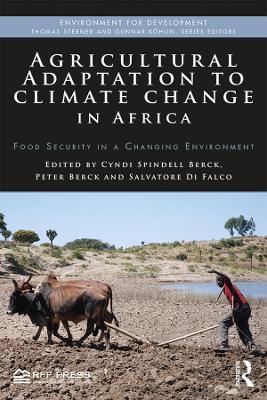
A changing climate is likely to have a drastic impact on crop yields in Africa. The purpose of this book is to document the effects of climate change on agriculture in Africa and to discuss strategies for adaptation to hotter weather and less predictable rainfall. These strategies include promoting opportunities for farmers to adopt technologies that produce optimal results in terms of crop yield and income under local agro-ecological and socioeconomic conditions.
The focus is on sub-Saharan Africa, an area that is already affected by changing patterns of heat and rainfall. Because of the high prevalence of subsistence farming, food insecurity, and extreme poverty in this region, there is a great need for practical adaptation strategies. The book includes empirical research in Ethiopia, Kenya, South Africa, Tanzania, and other Sub-Saharan countries, and the conclusion summarizes policy-relevant findings from the chapters.
It is aimed at advanced students, researchers, extension and development practitioners, and officials of government agencies, NGOs, and funding agencies. It also will provide supplementary reading for courses in environment and development and in agricultural economics.
1. Introduction Part I: Climate Science, Agronomic and Agro-Ecological
Factors
2. Understanding Adaptation to Climate Change
3. Mapping
Vulnerability to Climate Change of the Farming Sector in the Nile Basin of
Ethiopia: A Micro-level Perspective
4. Climate Change and Food Security in
Kenya Part II: On-farm Practices Related to Food Crop Productivity
5.
Adaptation to Climate Change in Sub-Saharan Agriculture: Assessing the
Evidence and Rethinking the Drivers
6. Maize Intensification among
Smallholder Farmers in Kenya: Understanding the Impacts of Climate
7.
Adaptation to Climate Change by Smallholder Farmers in Tanzania
8. Risk
Preferences and the Poverty Trap: A Look at Farm Technology Uptake amongst
Smallholder Farmers in the Matzikama Municipality
9. Good Things Come in
Packages: Sustainable Intensification Systems for Smallholder Farmers Part
III: On-farm Practices Other Than Those Related to Food Crop Productivity
10.
Climate Change Adaptation and Livestock Activity Choice in the Nile Basin of
Ethiopia: An Economic Analysis
11. The Distributive Effect and Food Security
Implications of Biofuels Investment in Ethiopia: A CGE Analysis
12. Climate
Change and Post-Harvest Agriculture Part IV: Gender Issues
13. Contribution
of Small-Holder Agriculture to Daily Calories, Macro-Nutrients, Minerals and
Vitamins in Male- and Female-Headed Farm Households in Sub-Saharan Africa
14.
Gender-differentiated Impacts of Climate Variability in Ethiopia: A
Micro-Simulation Approach Part V: The Broader Development Context
15. The
Land Certification Program in Ethiopia: A Review of Achievements, Constraints
and Opportunities
16. Migration as an Adaptation Strategy to Weather
Variability: An Instrumental Variables Probit Analysis
17. A Changing Climate
in a Changing Land Part VI: Conclusion and Policy Implications
18. Conclusion
Cyndi Spindell Berck, M.P.P., J.D., is the principal of International Academic Editorial Services, based in Orinda, California, USA, and Managing Editor of the EfD Discussion Paper series and Research Brief series.
Peter Berck is Professor of Agricultural and Resource Economics and Policy and S.J. Hall Professor of Forestry, University of California, Berkeley, USA. He is Editor-in-Chief of the EfD Discussion Paper Series.
Salvatore Di Falco is Professor of Environmental Economics and Director of the Institute of Economics and Econometrics, Geneva School of Economics and Management, University of Geneva, Switzerland.

 Rohkem infot Taylor & Francis e-raamatute kohta