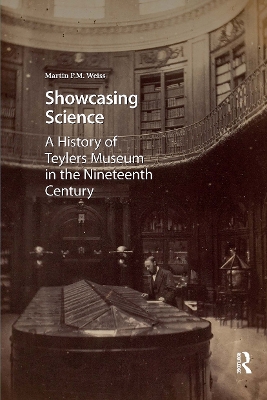
This book charts the history of Teylers Museum from its inception until Lorentz' tenure. From the vantage point of the Museum's scientific instrument collection, it gives an analysis of the changing public role of Teylers Museum over the course of the 19th century.
Teylers Museum was founded in 1784 and soon thereafter became one of the most important centres of Dutch science. The Museum's first director, Martinus van Marum, famously had the world's largest electrostatic generator built and set up in Haarlem. This subsequently became the most prominent item in the Museum's world-class, publicly accessible, and constantly growing collections. These comprised scientific instruments, mineralogical and palaeontological specimens, prints, drawings, paintings, and coins. Van Marum's successors continued to uphold the institution's prestige and use the collections for research purposes, while it was increasingly perceived as an art museum by the public. In the early twentieth century, the Nobel Prize laureate Hendrik Antoon Lorentz was appointed head of the scientific instrument collection and conducted experiments on the Museum's premises. Showcasing Science: A History of Teylers Museum in the Nineteenth Century charts the history of Teylers Museum from its inception until Lorentz' tenure. From the vantage point of the Museum's scientific instrument collection, this book gives an analysis of the changing public role of Teylers Museum over the course of the nineteenth century.
Chapter I: Introduction I. Teylers at the Paris Electrical Exhibition
II. Teylers Museum III. Museums and Popular Science IV. Structure and
Intended Readership of the Book
Chapter II: The Birth of a Musaeum I The
Museum's Pre-History
1. Martinus van Marum and the Beginning of the Age of
Museums
2. Martinus van Marum's Formative Years and The Holland Society of
Sciences
3. Pieter Teyler van der Hulst
4. The Contents of Pieter Teyler's
Last Will and Testament
5. Contextualising the Will: Mennonite Governors in
Haarlem
6. Teyler's Choice of Arts and Sciences II The Establishment of
Teylers Museum
1. A Financial Setback
2. The Teyler Foundation's First
Trustees
3. The Appointment of a Kastelein
4. The Foundation's Buildings
5.
The Haarlem Drawing Academy
6. Teylers Learned Societies
7. Prize Essay
Competitions
8. Pieter Teyler's Prints and Drawings
9. Birth of a Musaeum
10.
The Design of the Oval Room
11. Ideas for the Oval Room
12. Van Marum Is
Appointed Director of Teylers Museum
13. Teylers Museum and the Public
14.
Musaeum or Museum
Chapter III: Van Marum - Empiricism and Empire I Van
Marum's Work at Teylers Museum
1. Van der Vinne Resigns
2. Experiments with
the Cuthbertson Electrostatic Generator
3. Van Marum Generates Attention
4.
From Physics to Chemistry
5. A Financial Windfall
6. The Addition of a
Laboratory
7. Van Marum's Acquisition Plans
8. Amateurs and Professionals
9.
London and the Aftermath
10. Van Marum's Practical Appliances
11. Van Marum
and the Earth Sciences
12. French Occupation
13. Cuvier and the Mosasaur
14.
Homo Diluvii Testis, Lying Stones and Ohio
15. A Matter of Faith
16.
Aesthetic Value
17. Van Marum's Dispute with the Trustees II Van Marum's
Philosophy of Science
1. Van Marum's Take on Kant
2. A Matter of Belief
3.
Relying on Experiments
4. The Practical Turn
5. Van Marum's Lectures During
the French Occupation
6. A Summary of Van Marum's Ideals III Open All Hours:
Public Accessibility of Teylers Museum 1780-1840
1. Tourism Emerges
2.
Selection of Visitors?
3. Early Travel Reports of Teylers Museum
4. Teylers
Museum as Testimony to the Histoy of Physics IV The Forgotten Art
1. No Great
Connoisseur of Pictures
2. Christina of Sweden's Collection of Drawings
3.
Changing Definitions of Art
4. Paintings by Contemporary Artists
Chapter IV:
Van der Willigen - Precision and the Discipline of Physics I. An Unexpected
Guessing Game (Intro) II. Volkert Simon Maarten van der Willigen (I): Early
Years
2. A New Methodology
3. The Athenaeum in Deventer
4. Amateurs,
Specialists and True Physics III. The Art of Presenting
1. The Rise of Public
Art Exhibitions
2. The First Art Gallery, a Permanent Exhibition?
3. The More
Visitors, the More Exclusive? IV. Changing Defintion of Museums
1. From
Scholarly Musaeum to Educational Museum
2. The Great Exhibition, Albertopolis
and the South Kensington Museum
3. The Public Museum in Support of Public
Mores
4. Prince Albert and the History of Art
5. London to Haarlem V. Jacob
Gijsbertus Samuėl van Breda at Teylers Museum
1. Mid-Century Dutch Liberalism
2. Some Critics of Official Dutch Museum Policy
3. Jacob Gijsbertus Samuėl
van Breda
4. Van Breda, Logeman, Winkler
5. Different Approaches to
Collecting
6. The Rhenish Mineral-Office Krantz
7. Monuments of Science VI.
Volkert Simon Maarten van der Willigen (II): Curator in Haarlem
1. On the Job
2. Van der Willigen's Work in Haarlem
3. Public Lectures and the Centennial
in Philadelphia
4. The Special Loan Collection at South Kensington
5. Febris
Rheumatica Articularis
Chapter V: Lorentz - Function Follows Form and Theory
Leads to Experiment I. Themes of the
Chapter II. A New Type of Museum
1. New
Government Policy in the 1870s
2. The New Annex to Teylers Museum
3. Guards
at Teylers Museum
4. Teylers New Annex and the Rijksmuseum III. T.C. Winkler
and E. van der Ven
1. Tiberius Cornelis Winkler
2. Elisa van der Ven IV.
Function Follows Form
1. Moving House
2. Function Follows Form
3. The Birth
of a Museum of the History of Science
4. Science Museums and Museums of the
History of Science V Lorentz: A Theoretician as Curator 1.A Revered
Theoretical Physicist
2. Much to Offer
3. Refurbishment of the Laboratory and
Subsequent Research 4.The Isolation of Haarlem 5.The Museum Next Door 6
Conclusion I Summary 333II Museum or Museum? 335III The Changing Status of
the Scientific Instrument Collection, Appendix, Acknowledgements, Archives,
Bibliography, Index.
Martin P.M. Weiss is a historian of science at the German Maritime Museum. He studied in Aachen and Utrecht and received his PhD from Leiden University.

 Rohkem infot Taylor & Francis e-raamatute kohta