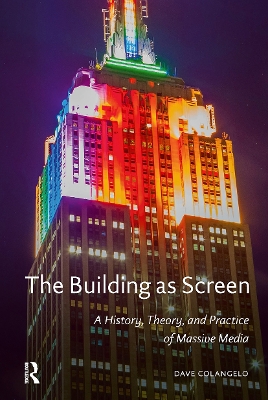
The Building as Screen: A History, Theory, and Practice of Massive Media describes, historicizes, theorizes, and creatively deploys massive media -- a set of techno-social assemblages and practices that include large outdoor projections, programmable architectural faēades, and urban screens -- in order to better understand their critical and creative potential. Massive media is named as such not only because of the size and subsequent visibility of this phenomenon but also for its characteristic networks and interactive screen and cinema-like qualities. Examples include the programmable lighting of the Empire State Building and the interactive projections of Montreal's Quartier des spectacles, as well as a number of works created by the author himself. This book argues that massive media enables and necessitates the development of new practices of expanded cinema, public data visualization, and installation art and curation that blend the logics of urban space, monumentality, and the public sphere with the aesthetics and affordances of digital information and the moving image.
Acknowledgements, List of Illustrations,
Chapter 1: Introducing Massive
Media, - From the Top, - Why Massive Media? - A Brief History of the Public
Sphere, Monumentality, and Media, The Most Advanced Site of Struggle: The
Public Sphere, Looking Up Together: Monumentality, A Modern Monument for the
Modern Masses, Space and Media, Accelerated Rituals, Reverie Amidst the Real,
Entering Supermodernism, - How This Book Works,
Chapter 2: Experiments in
Large-scale Projection and the (New) New Monumentality, - Moving Images, - A
Short history of the Moving Image in Public Space, - Architecture, Expanded
Cinema, and the New Monumentality, - The Image Mill, Superimposition and
Massive Media: Super Imposing, Spatial Montage: Extra Diegetic, Dispositif
and Apparatus: Staging the City, - McLarena: Recentring the Audience,
Participation: Don't Just Sit There and Watch, Place Branding and
Theatricality, - A New (New) Monumentality? - Experiments in Public
Projection, 30 moons many hands, The Line, - A Perceptual Laboratory for
Popular Needs and Aspirations,
Chapter 3: The Empire State Building and the
Roles of Low-Resolution Media Faēades in a Data Society, - This Building is
on Fire, - A Short History of the Empire State Building, Colours and
Meanings, - Understanding Contemporary Dimensions of Public Data
Visualizations, - The Empire State Building as Monumental Public Data
Visualization, - Experiments in Public Data Visualization, E-TOWER, In The
Air, Tonight, - Temporary Intensities and Collective Conversations in
Supermodern, Relational Space,
Chapter 4: Curating Massive Media, - Changing
Spaces, - A Short History of Public Screen Practice, - Massive Media and
Public Art, - What People Have in (The) Common, - Connecting Cities, -
Streaming Museum, - Curating the Ryerson Image Arts Building, - Connecting
Sites and Streams,
Chapter 5: When Buildings Become Screens, - Dancing with
Buildings, - Tactics and Strategies, - More Massive, More Media,
Bibliography, Index.
Dave Colangelo is Professor of Digital Experience Design in the School of Design at George Brown College, Director, North America, of the Media Architecture Institute, and Co-Founder of Public Visualization Studio.

 Rohkem infot Taylor & Francis e-raamatute kohta