Muutke küpsiste eelistusi

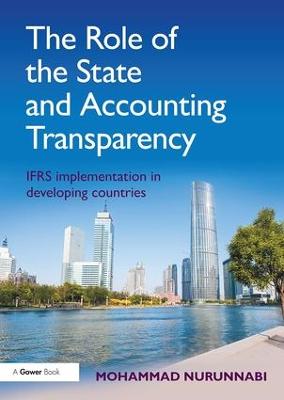
E-raamat: Role of the State and Accounting Transparency: IFRS Implementation in Developing Countries [Taylor & Francis e-raamat]

  • Formaat: 224 pages, 17 Tables, black and white
  • Ilmumisaeg: 20-Jun-2018
  • Kirjastus: Routledge
  • ISBN-13: 9781315553276
Teised raamatud teemal:
  • Taylor & Francis e-raamat
  • Hind: 207,73 €*
  • * hind, mis tagab piiramatu üheaegsete kasutajate arvuga ligipääsu piiramatuks ajaks
  • Tavahind: 296,75 €
  • Säästad 30%
  • Formaat: 224 pages, 17 Tables, black and white
  • Ilmumisaeg: 20-Jun-2018
  • Kirjastus: Routledge
  • ISBN-13: 9781315553276
Teised raamatud teemal:
Dr Mohammad Nurunnabi examines the factors that affect the implementation of International Financial Reporting Standards (IFRS) in developing countries and answers these specific research questions: - What is the relative impact of accounting regulatory frameworks and politico-institutional factors on the implementation of IFRS in developing countries? - How do cultural factors affect said implementation? - How does a study of implementing IFRS help to build an understanding of a theory of the role of the state in accounting change in developing countries? This follows a mixed methodology approach, in which interviews are conducted, IFRS-related enforcement documents and annual reports are evaluated. More than 138 countries have adopted IFRS, yet the International Accounting Standards Board (IASB) does not provide an implementation index. Financial reporting varies by country, even within the area of the world that has apparently adopted IFRS and Nurunnabi offers an important viewpoint that considers the issues of IFRS implementation from various perspectives. This is an invaluable resource for Undergraduate, Masters and PhD students, policy makers (at local, regional and international level) namely the IASB, World Bank, IMF, practitioners and users, giving them the necessary insight into the financial reporting environment and the state’s attitude towards accounting transparency. Most importantly, this book contributes to military and democratic political regimes and the Max Weberian view of the theory of the role of the state’s attitude towards accounting transparency.
List of figures
viii
List of tables
ix
List of abbreviations
xi
About the author xiv
Preface xvi
Acknowledgements xviii
1 Introduction
1(13)
2 Review of literature
14(31)
3 Theory
45(11)
4 The financial reporting environment in Bangladesh
56(22)
5 Research methodology
78(13)
6 The relative impact of accounting regulatory frameworks and politico-institutional factors
91(32)
7 The impact of training opportunities in the accounting profession, corruption and country-specific factors
123(27)
8 Theory of the role of the state in the implementation of IFRS
150(12)
9 Conclusions
162(9)
References 171(21)
Appendices 192(26)
Index 218
Mohammad Nurunnabi FHEA FRSA FAIA(Acad) is an Associate Professor in Accounting and Chair of the Department of Accounting at Prince Sultan University, Riyadh, Saudi Arabia. He holds a PhD in Accounting (International Financial Reporting Standards IFRS) with outright pass (no corrections) from the University of Edinburgh, UK. Previously he was a Senior Lecturer in Accounting and Research Leader in the Accounting Group at the University of East London, UK. He also taught in University of Bedfordshire, UK and Edge Hill University, UK. He teaches Advanced Accounting, Accounting Theory, Auditing and Management Accounting. He is an Editorial Member of eight journals and reviewer of 41 journals.