Muutke küpsiste eelistusi

E-raamat: Grey Behaviors after Logical Fallacies in Public and Professional Communication [Taylor & Francis e-raamat]

(Colorado State University, USA), (Mobarakeh Steel Company, Iran)
  • Formaat: 142 pages, 113 Tables, black and white; 5 Line drawings, black and white; 5 Illustrations, black and white
  • Ilmumisaeg: 25-May-2021
  • Kirjastus: Routledge
  • ISBN-13: 9781003179610
  • Taylor & Francis e-raamat
  • Hind: 66,46 €*
  • * hind, mis tagab piiramatu üheaegsete kasutajate arvuga ligipääsu piiramatuks ajaks
  • Tavahind: 94,95 €
  • Säästad 30%
  • Formaat: 142 pages, 113 Tables, black and white; 5 Line drawings, black and white; 5 Illustrations, black and white
  • Ilmumisaeg: 25-May-2021
  • Kirjastus: Routledge
  • ISBN-13: 9781003179610
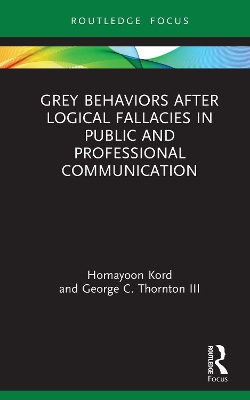
This practical guide enables readers to recognize, assess, and defend against gray behaviorsattempts to persuade listeners using fallacious arguments. It provides valuable tools for communicating successfully in a wide variety of public and professional contexts.

The book examines 20 wide-ranging logical fallacies, cognitive errors, and rhetorical devices that may take place in persuasive communication, and discusses how to assess and respond the behavior of a speaker who may be disingenuously attempting to manipulate the listeneror who may simply be mistaken. Drawing upon research and insights from communication, psychology, business management, and human resources, it considers fallacies in reasoning not just as abstract formulas, but as a feature of communication encounters such as negotiations, interviews, public debates, and personal conversations. Each form of fallacious reasoning is exemplified by dialogues in both professional settings (such as interviewing and personnel assessment), as well as everyday interactions in public discourse. The book then provides self-assessment tests to ensure the reader can evaluate the grey behavior in these encounters.

This book provides research-based skills and insights that will benefit students and professionals in fields ranging from communication, politics, management, human resources, organizational psychology, journalism, and anyone else looking to develop critical interaction skills.
List of Illustrations
xi
Preface xiii
1 Introduction
1(17)
2 Grey Behaviors After Relevance Fallacies 1-9
18(33)
Fallacy 1 Ad Hominem (Personal Attack)
19(4)
Fallacy 2 Straw Man
23(3)
Fallacy 3 False Dilemma
26(3)
Fallacy 4 Misplacing the Burden of Proof
29(5)
Self-Assessment 1
32(2)
Fallacy 5 Begging the Question
34(3)
Fallacy 6 Appeal to Emotion
37(3)
Fallacy 7 Two Wrongs Make a Right
40(3)
Fallacy 8 Red Herring
43(3)
Fallacy 9 Irrelevant Conclusion
46(5)
Self-Assessment 2
49(2)
3 Grey Behaviors After Induction Fallacies 10-17
51(36)
Fallacy 10 Hasty Generalization
52(4)
Fallacy 11 Accident or Hasty Application
56(4)
Fallacy 12 Weak Analogy
60(4)
Fallacy 13 Mistaken Appeal to Authority
64(6)
Self-Assessment 3
68(2)
Fallacy 14 Mistaken Appeal to Popularity
70(4)
Fallacy 15 Fallacies Related to Cause and Effect
74(4)
Fallacy 16 Slippery Slope
78(4)
Fallacy 17 Untestable Explanation
82(5)
Self-Assessment 4
85(2)
4 Grey Behaviors After Formal Fallacies And Fallacies Of Language 18-20
87(15)
Fallacy 18 Formal Fallacies
88(5)
Fallacy 19 Ambiguity
93(3)
Fallacy 20 Composition and Division
96(6)
Self-Assessment 5
100(2)
5 Other Examples Of Potentially Misleading Tactics That May Be Followed By Grey Behavior
102(6)
Rhetorical Devices
102(2)
Social Influence Tactics
104(1)
Attribution and Cognitive Errors
104(3)
The Appeal of Different Misleading Tactics
107(1)
6 Conclusions And Applications
108(7)
Conclusions
108(1)
Practical Applications
109(1)
Research Applications
110(1)
Example of a Research Study
111(4)
References 115(2)
Appendix I Answers to Quizzes in Self-Assessments 117(10)
Index 127
Homayoon Kord is the Chief of Competency Assessment and Development in Mobarakeh Steel Company (MSC), Iran. He has established several assessment centers to assess and develop leadership skills, and to attract and screen talented people for expert positions. He has also developed an assessment center to identify and develop auditor talents in quality management systems (ISO and EFQM).

George C. Thornton III is Professor Emeritus at Colorado State University, USA. He received the Distinguished Alumni Award from Purdue University, the Legacy Lifetime Award from the South African Assessment Center Study Group, and the Lifetime Achievement Award from the United Kingdom Assessment Centre User Group. His most recent books include Assessment Center Perspective for Talent Management Strategies (2015, with Deborah E. Rupp, & Brian J. Hoffman) and Developing Organizational Simulations: A Guide for Practitioners, Students, and Researchers (2nd ed, 2017, with Rose A. Mueller-Hanson & Deborah E. Rupp).